

Legal Articles
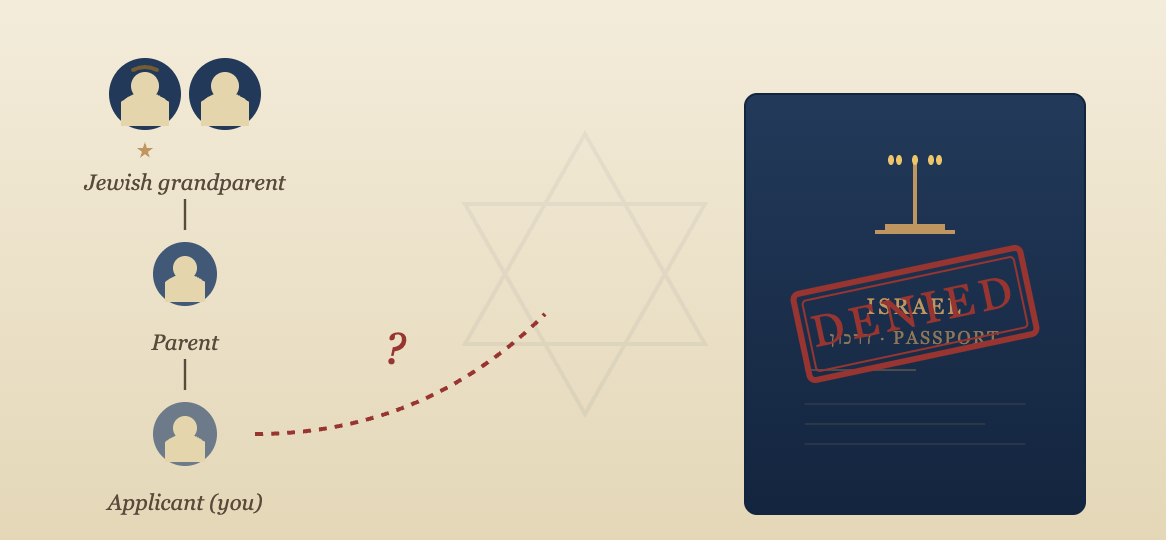
On paper, the rule sounds simple: if you have one Jewish grandparent, you qualify for aliyah. Many families arrive at our office with exactly that line in their head, picked up from a cousin who made aliyah in 1995 or from a half-remembered article online. They produce a grandmother's ketubah, a great-uncle's grave inscription, a yellowing birth certificate from Łódź, and assume the matter is settled.

The short answer is no. And the longer answer is one of the strangest tensions in Israeli public life: a person can be unambiguously Jewish under halacha, the Orthodox rabbinate can accept them as Jewish without reservation, and the State of Israel can still refuse them citizenship under the Law of Return.
The State of Israel's Law of Return stands as one of the most significant pieces of legislation in modern Jewish history. Enacted in 1950, just two years after Israel's establishment, this law grants Jews worldwide the fundamental right to immigrate to Israel and obtain citizenship. Understanding Aliyah eligibility under this law is crucial for anyone considering making Israel their home.
Aliyah—Hebrew for “ascent”—is the immigration of Jews to Israel. This fundamental right is protected under Israel’s Law of Return, one of the nation’s foundational laws enacted in 1950 and amended in 1970. Understanding who qualifies is the essential first step in your journey home.
The Law of Return stands as one of Israel's most significant and defining pieces of legislation. Enacted in 1950, just two years after the nation's establishment, this law fundamentally shapes the character of the State of Israel and its relationship with Jews around the world.

Making Aliyah as a divorced or single parent when the other parent is alive and possibly involved presents unique challenges—legal, emotional, financial, and practical. Whether you're considering moving with your children or without them, this decision requires careful navigation of international law, custody arrangements, and your children's best interests.

Making Aliyah is a significant life transition that brings both excitement and challenges. While most olim (new immigrants to Israel) are familiar with the standard bureaucratic procedures, many are unaware of the extensive legal support services available to help navigate the complexities of establishing a new life in Israel.