
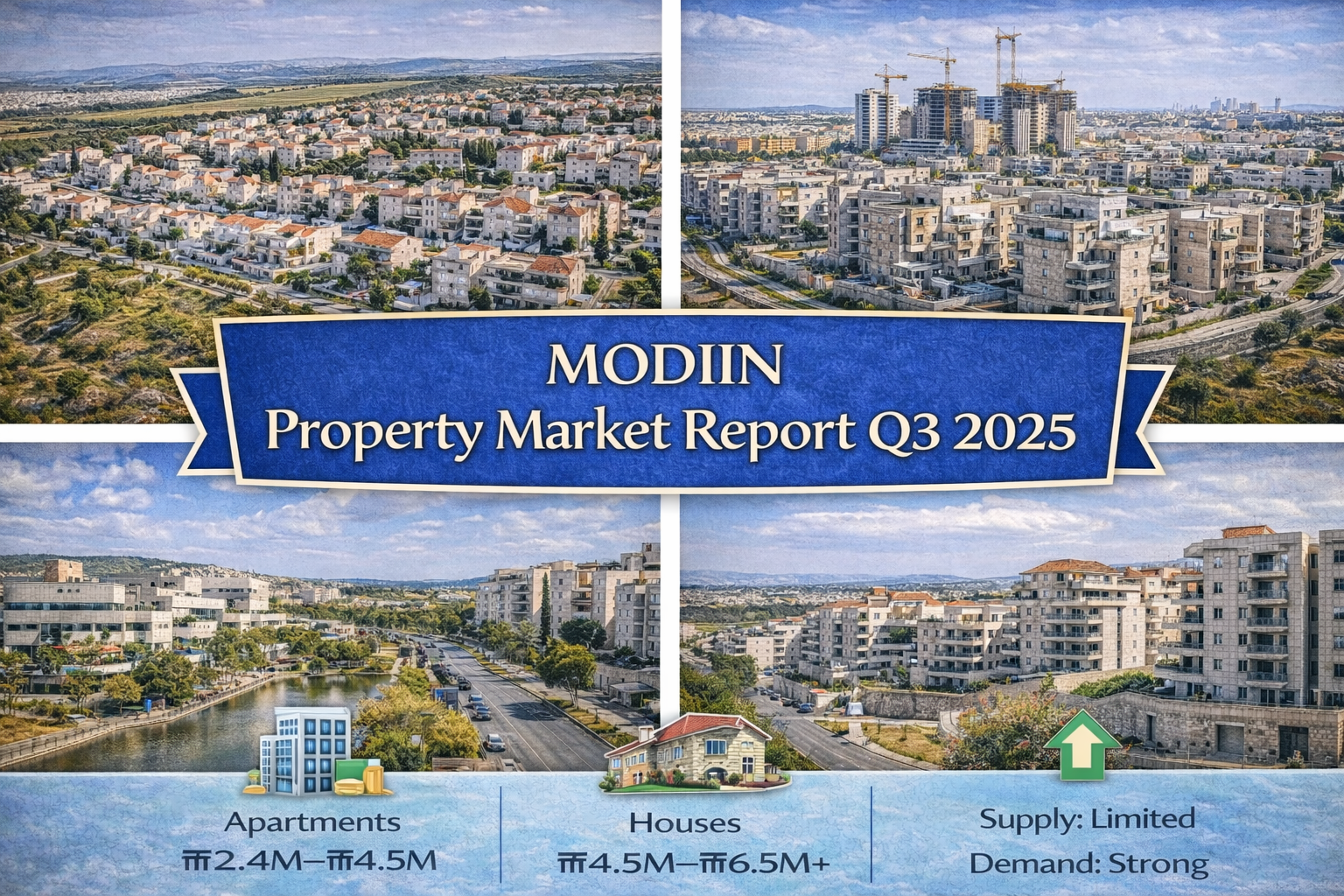
Modiin-Maccabim-Reut stands as one of Israel's most successful planned cities, a municipality founded in 1994 that has grown to approximately ninety-seven thousand residents by 2021 with ambitious master planning projecting expansion to two hundred fifty thousand by 2040. The city occupies a strategic geographic position roughly halfway between Tel Aviv and Jerusalem, creating unique appeal as a residential destination serving families seeking modern suburban living with direct rail connections to both of Israel's primary urban centers. This positioning has established Modiin as a premier destination for English-speaking immigrants, particularly from North America, who appreciate the city's futuristic planning, spacious housing stock, and established Anglo community providing soft landing infrastructure for families making aliyah and navigating Israeli integration.
The property market in Modiin during Q3 2025 demonstrated the dynamics affecting Central District planned cities, with average prices for four-room apartments estimated between 2.4 and 2.5 million shekels and five-room units ranging from 2.5 to 2.8 million shekels, positioning the city approximately four percent below the Central District average of 2.61 million shekels according to Central Bureau of Statistics data. This mid-range pricing creates value proposition for families seeking quality suburban living at costs significantly below Tel Aviv's 3.68 million shekel average—approximately forty-seven percent cheaper—while maintaining modern housing standards and comprehensive amenities impossible at comparable price points in older, more expensive municipalities. Historical transaction data from August 2023 showing a three-room apartment of seventy-six square meters selling for 1.8 million shekels provides baseline context, though prices have appreciated since that period reflecting both market dynamics and the specific property characteristics of individual transactions.
Geographic positioning creates Modiin's fundamental competitive advantage, with the city's location providing genuine dual-access to both Tel Aviv and Jerusalem employment centers through direct rail service that makes commuting viable to either city depending on workplace location. The train journey to Tel Aviv takes approximately forty-five minutes, while Jerusalem can be reached in similar timeframe, creating flexibility for dual-career families where spouses work in different cities or for individuals whose employment may shift between locations over career trajectories. Highway access via Route 443 provides alternative transportation to Jerusalem, while connections to Highway 1 and Route 3 enable Tel Aviv commuting and north-south travel throughout central Israel. This transportation infrastructure represents crucial value driver supporting Modiin's appeal to professional families requiring reliable access to major employment centers while desiring suburban quality of life impossible within the cities themselves at comparable costs.
The Anglo community infrastructure in Modiin represents perhaps the city's single most distinctive asset beyond pure geographic positioning, creating social and cultural ecosystem that attracts continuing waves of English-speaking immigration and provides integration support reducing the friction typically associated with international relocation. With thousands of North American, British, and South African families established in the city, Modiin offers English-language synagogues across religious denominations, community organizations providing absorption assistance, educational guidance helping new immigrants navigate Israeli school systems, and social networks where children easily integrate into peer groups without requiring immediate Hebrew fluency though most residents eventually achieve Hebrew proficiency through daily life exposure. This Anglo concentration creates self-reinforcing dynamics where new immigrants research Israeli relocation options and consistently identify Modiin as premier soft landing destination, sustaining demand from international buyers establishing permanent Israeli residence or purchasing investment properties in markets offering better value propositions than more expensive Anglo alternatives like Ra'anana.
Property type composition in Modiin reflects the city's planned development character, with predominance of four and five-room apartments suitable for growing families with children, though the city also features private homes, cottages, and varied housing formats providing greater diversity than typical high-rise dominated Israeli urban markets. Standard three-room apartments of seventy to eighty square meters typically range from 1.8 to 2.0 million shekels, representing entry-level options for young couples or smaller families establishing Modiin presence, though still requiring substantial capital given the city's positioning above truly budget markets. Four-room units of ninety to one hundred ten square meters, the most common transaction category, average 2.4 to 2.5 million shekels and serve as core family housing segment where demand remains most consistent given alignment with typical family size and space requirements. Five-room apartments of one hundred twenty to one hundred forty square meters appeal to larger families and affluent buyers, typically priced between 2.5 and 2.8 million shekels depending on location, building quality, and specific amenities. Private houses and cottages of one hundred fifty to two hundred fifty square meters command 3.5 million shekels and above, serving premium buyers seeking maximum space and private outdoor areas, though these properties constitute smaller market segment given higher absolute costs and limited inventory compared to apartment predominance.
The rental market in Modiin demonstrates steady activity serving diverse tenant populations including families in transition between property purchases, temporary corporate assignments, and new immigrants establishing initial Israeli residence before permanent home acquisition. Standard three-room apartments typically rent for 5,000 to 6,500 shekels monthly, creating accessible options for smaller families or young professionals seeking Modiin's quality of life benefits without immediate purchase commitments. Four-room units average 6,500 to 8,500 shekels per month, appealing to families requiring space for children while benefiting from Modiin's educational quality and community amenities, with Anglo-oriented properties or buildings with established English-speaking populations potentially commanding modest premiums given demand from new immigrants prioritizing community integration. Five-room properties and larger homes rent for 8,500 to 11,000 shekels and higher, serving affluent tenants and families requiring maximum space. Gross rental yields in Modiin typically range from 3.2 to 3.8 percent, providing reasonable cash flow for investors while reflecting the city's mid-market positioning between premium markets generating only 2.5 to 3.0 percent yields and budget markets offering 4.0 percent and above but lacking Modiin's quality and appreciation potential.
Educational infrastructure in Modiin represents a crucial value driver supporting property demand from family buyers prioritizing school quality for children, with the municipality operating comprehensive networks of secular and religious schools generally achieving strong academic performance by Israeli standards. The city's modern planning allowed purpose-built educational facilities with adequate capacity and contemporary design, avoiding the overcrowding and aging infrastructure challenges affecting older municipalities where schools were designed for smaller populations or different demographic patterns. Private educational options including Anglo-oriented programs provide alternatives for families seeking English-language instruction or specific pedagogical approaches, creating additional appeal to international families concerned about maintaining educational continuity for children during Israeli transition. While Modiin cannot claim the exceptional elementary and secondary school quality distinguishing Ra'anana or other premier educational destinations, the city offers solid baseline educational access appropriate for most family needs and sufficient to support property values through school quality associations, with families requiring truly exceptional academics typically preferring established educational leaders rather than newer planned cities still developing institutional reputations.
Master planning for Modiin's expansion to two hundred fifty thousand residents by 2040 represents ambitious growth trajectory that creates both opportunities and risks for current property owners and prospective buyers evaluating long-term investment prospects. The northwestern business center development combining residential, employment, and commercial uses promises to create urban density and mixed-use character currently limited in Modiin's suburban configuration, potentially enhancing property values through improved amenity access and reduced dependence on external employment centers. The planned hospital and medical center adjacent to the business center would address current healthcare access limitations requiring travel to nearby cities for comprehensive medical services, creating quality of life improvement supporting residential appeal. An academic institution in the form of a university campus could transform Modiin's character by attracting student populations, research activities, and cultural programming that enhance overall city vitality beyond pure residential functionality. The underground rail extension connecting the new business center to existing city center infrastructure would improve internal mobility and support higher-density development appropriate for expanded population targets.
Multiple new residential neighborhoods across the city's fifty-five thousand dunam planning area will accommodate population growth, with active construction currently occurring in Moriah, Nofim, and other expansion areas providing inventory meeting sustained demand from growing families and continuing immigration. This development pipeline creates complex dynamics for existing property owners, who benefit from population growth supporting demand and amenity expansion but face potential price pressure from new inventory competing with resale properties, requiring careful analysis of specific micro-locations and property characteristics to assess whether individual units will benefit from or be challenged by surrounding development. Properties in established neighborhoods with mature landscaping, proven school access, and community character may maintain better relative performance than units in areas experiencing construction disruption or competing directly with adjacent new developments offering modern amenities and contemporary design, creating neighborhood-level variations in appreciation potential that simple city-wide analysis cannot capture.
Socioeconomic characteristics position Modiin as one of Israel's most affluent municipalities, with a socioeconomic ranking of nine out of ten placing the city alongside Ramat Hasharon, Kiryat Ono, and other prestigious addresses, though below the perfect ten rating reserved for Israel's wealthiest enclaves. This high ranking reflects the city's demographics skewing toward educated professional families with above-average incomes, creating residential character and municipal service quality that justifies premium positioning relative to average Central District markets. The affluence translates to robust property tax base supporting comprehensive municipal services, well-maintained public infrastructure, quality recreational facilities, and responsive local government creating baseline quality of life expectations that support property values through tangible service delivery exceeding typical Israeli municipalities operating with more constrained budgets and lower-income populations generating less tax revenue per capita.
Market dynamics in Q3 2025 reflect broader Central District corrections while demonstrating Modiin's positioning as experiencing moderate adjustments rather than catastrophic declines, with the city's four percent discount to Central District average appearing sustainable given its newer vintage, planned character, and Anglo appeal creating differentiated value proposition compared to older, more established municipalities. The Central District's 3.8 percent annual decline and 0.9 percent quarterly correction from Q2 to Q3 provides context suggesting Modiin likely experienced similar softening pressures, though the city's Anglo demand providing less cyclical buyer flows and its mid-market pricing creating cushioning against luxury market volatility may have supported relatively stable values compared to more exposed market segments. Transaction volumes likely declined consistent with national patterns showing reduced activity during high interest rate environments when mortgage costs averaging approximately five percent constrain buyer qualification and affordability, though Modiin's appeal to specific buyer cohorts including new immigrants and families prioritizing quality of life over pure financial optimization may have supported better relative transaction activity than markets dependent exclusively on domestic buyers facing maximum affordability pressure.
Interest rate policy from the Bank of Israel maintaining rates at 4.5 percent throughout Q3 2025 creates financing headwinds affecting all Israeli property markets including Modiin, with mortgage costs averaging approximately five percent significantly constraining buyer qualification and affordability calculations. For a typical four-room Modiin apartment priced at 2.45 million shekels requiring a 612,500 shekel down payment at the standard twenty-five percent and financing the remaining 1.8375 million shekels over twenty-five years at five percent, monthly payments approximate 10,700 shekels before property taxes and building fees, requiring household income of approximately 36,000 shekels monthly under standard debt-service-to-income ratio constraints. This represents substantial financial capacity accessible to dual-income professional households typical of Modiin's demographic profile, though still limiting the buyer pool compared to lower interest rate environments when qualification thresholds allowed broader participation, constraining transaction volumes even in desirable markets where demand fundamentals remain solid but effective demand is reduced by financing costs that translate directly to reduced borrowing capacity.
The supply environment in Modiin includes active new construction across multiple expansion neighborhoods as the city pursues its ambitious growth trajectory toward two hundred fifty thousand residents, creating inventory additions that contribute to market softening when absorption rates cannot immediately match completion volumes during periods of reduced buyer activity. Unlike severely overbuilt markets experiencing acute inventory crises from speculative excess, Modiin's development appears aligned with genuine demographic growth and housing needs driven by continuing immigration and family formation among existing residents, suggesting longer-term fundamentals support construction decisions even when timing creates near-term absorption challenges. The master-planned character allows coordinated infrastructure development preventing the quality degradation that can occur when residential construction outpaces supporting amenities, maintaining Modiin's appeal to quality-conscious buyers even during market corrections when less well-planned municipalities face compounding problems from inadequate infrastructure straining under population pressures.
Investment perspectives on Modiin property require analyzing the city's value proposition as mid-tier Central District option offering suburban family lifestyle at accessible costs relative to premium alternatives, with investment considerations balancing solid rental yields against appreciation potential dependent on successful execution of ambitious expansion plans. For Anglo families establishing permanent Israeli residence, Modiin represents compelling combination of community integration support, quality housing at manageable costs, and strategic positioning between Tel Aviv and Jerusalem that creates lifestyle benefits justifying purchase decisions based primarily on use value rather than pure financial optimization, with potential appreciation representing upside rather than primary motivation. For rental investors, Modiin's 3.2 to 3.8 percent gross yields provide better cash flow than premium markets generating only 2.5 to 3.0 percent returns while avoiding budget markets where higher yields come with concentration risk and potential tenant quality challenges, creating balanced risk-return profile appropriate for conservative income-oriented investors prioritizing stability over maximum speculation.
For prospective buyers considering Modiin purchase decisions, current market conditions create opportunities to acquire modern planned-city housing at prices reflecting broader corrections from 2024 peaks, with the city's mid-market positioning providing cushioning against extreme volatility affecting either luxury segments experiencing steepest percentage declines or budget markets facing severe affordability crises. Strategic buyers should prioritize established neighborhoods with proven school access, mature community character, and convenient positioning relative to rail stations and commercial centers, as these attributes supported values during corrections better than expansion areas still developing identity and competing directly with adjacent new construction potentially offering superior amenities at competitive prices. The Anglo community appeal remains powerful market force supporting Modiin values, suggesting buyers able to market properties to English-speaking audiences through specialized agents and community networks will achieve better outcomes than treating Modiin as generic Central District suburb without emphasizing specific characteristics attracting international buyers willing to pay premiums for community integration benefits.
Sellers in Modiin face pricing challenges requiring realistic assessment of current market conditions while emphasizing the city's specific value drivers to appropriate buyer audiences, particularly the Anglo community seeking soft landing destinations for Israeli immigration. Properties priced appropriately for current conditions and marketed effectively to English-speaking buyer pools through specialized channels typically attract showing activity and generate offers within reasonable timeframes, while generic marketing failing to emphasize Modiin's unique community characteristics or overpriced listings based on aspirational expectations may languish despite the city's fundamental appeal. The temptation to wait for market recovery before listing risks opportunity costs if prices continue softening or if the substantial new construction pipeline creates ongoing inventory pressures requiring extended periods for absorption, though Modiin's demographic growth trajectory suggests patient sellers with flexibility to wait may eventually benefit from population expansion supporting demand recovery when financing conditions normalize and affordability improves.
The new immigrant buyer segment deserves specific attention given its central importance to Modiin market dynamics and unique characteristics differentiating these purchasers from typical domestic buyers operating within purely economic frameworks. North American families making aliyah frequently research Israeli relocation extensively and consistently identify Modiin as premier destination offering optimal balance of community support, housing quality, and accessibility to employment centers, creating sustained demand from international buyers whose purchase decisions incorporate emotional and ideological considerations beyond pure financial calculations. The new immigrant tax benefits providing substantial purchase tax reductions on first property acquisitions up to six million shekels create powerful financial incentives for qualifying buyers, effectively reducing all-in acquisition costs by potentially hundreds of thousands of shekels on typical Modiin four-room transactions and improving net returns while supporting market stability through demand that persists even when domestic buyers face maximum affordability constraints. Community integration considerations drive some immigrant buyers to concentrate in specific Modiin neighborhoods or buildings with established Anglo populations, creating clustering dynamics that reinforce certain areas as primary immigration destinations while other neighborhoods remain predominantly Hebrew-speaking with less appeal to new immigrants prioritizing immediate community support.
Security considerations, heightened following October 2023 events and subsequent regional tensions, increasingly influence buyer preferences with properties featuring protected rooms commanding measurable premiums over units lacking these safety features, though Modiin's central location provides geographic advantages compared to border areas facing most direct threats. The municipality's emergency preparedness infrastructure and responsive local government create confidence among residents that security challenges will be managed professionally, supporting market stability during geopolitical stress when less secure locations experience sharper corrections. International buyers particularly sensitive to security dynamics given less familiarity with Israeli security realities benefit from Modiin's established track record and central positioning when making purchase decisions incorporating both lifestyle and safety assessment dimensions, with many immigrant families viewing Modiin as optimal balance between Israeli integration and risk management given the city's geography and comprehensive municipal services appropriate for family-oriented community.
Transportation infrastructure improvements including potential rail frequency increases and highway capacity expansions could significantly enhance Modiin's accessibility and property values by reducing commute times and improving connectivity to Tel Aviv and Jerusalem employment centers, though Israeli infrastructure project timelines typically extend well beyond initial projections requiring patient long-term perspectives rather than short-term speculation around specific completion dates. The planned underground rail extension connecting the new northwestern business center to existing city infrastructure represents particularly important project that could transform internal Modiin mobility and support higher-density development appropriate for population expansion targets, though construction timelines and final configurations remain subject to the delays and budget challenges characterizing Israeli infrastructure development processes. Buyers evaluating properties based on planned infrastructure should carefully assess completion risk and avoid overweighting uncertain future amenities in valuation calculations, recognizing that while master plans provide directional guidance, actual implementation often differs from initial visions in both timing and final specifications.
Environmental and sustainability considerations increasingly influence Modiin property values as the city's modern planning provides opportunities for green infrastructure and sustainable development practices less feasible in older municipalities with legacy constraints. Energy efficiency in newer Modiin construction typically exceeds older building stock in established cities, with modern insulation standards and climate control systems reducing electricity consumption and operating costs that sophisticated buyers incorporate into total cost of ownership analyses. The city's extensive green spaces and park systems create quality of life amenities while providing environmental benefits through urban heat island mitigation and recreational access supporting active lifestyles. Municipal environmental initiatives including waste reduction programs and public transportation promotion align with growing resident preferences for sustainable community development, though environmental factors remain secondary to traditional location, price, and community considerations in most purchase decisions despite increasing awareness among certain buyer segments particularly younger professionals prioritizing sustainability.
Taxation and transaction cost considerations significantly impact net investment returns in Modiin properties as in all Israeli real estate markets, with purchase taxes, legal fees, and agency commissions typically totaling eight to ten percent of property value for non-first-time buyers creating substantial transaction friction that affects holding period decisions and breakeven timelines. The new immigrant benefits capping at six million shekels provide dramatic advantages on typical Modiin transactions, effectively improving net returns by the full tax savings amount reaching hundreds of thousands of shekels and creating powerful incentive supporting demand from qualifying immigrant buyers establishing permanent Israeli residence. Annual property taxes remain modest by international standards but vary based on property size and location, with larger homes facing higher absolute amounts though rates remain reasonable relative to property values and typical Modiin buyer income levels. Rental income taxation follows standard Israeli income tax schedules with deductions for mortgage interest, property taxes, and maintenance expenses reducing taxable income, requiring proper documentation and professional accounting to optimize legal tax minimization strategies while ensuring compliance with reporting requirements.
Building maintenance and homeowner association dynamics in Modiin follow typical Israeli patterns where apartment buildings operate through homeowner committees collecting monthly fees for common area upkeep, building insurance, and shared services, with fee levels varying based on building age, amenity level, and management quality. Newer Modiin buildings typically feature modern construction standards requiring less immediate maintenance than older structures while offering contemporary amenities including elevators, parking facilities, and shared spaces that create ongoing operating costs funded through monthly assessments. The quality of building management significantly affects daily life quality and property values, with well-run buildings maintaining better physical condition and resident satisfaction compared to poorly managed properties where disputes and deterioration reduce desirability even in attractive locations. Prospective buyers should carefully review building financial statements, maintenance history, and reserve fund adequacy during due diligence, as deferred maintenance or inadequate reserves can necessitate special assessments requiring owners to contribute additional capital for major repairs beyond regular monthly fees.
Future development prospects in Modiin center on successful execution of the ambitious master plan targeting two hundred fifty thousand residents by 2040, representing potential population increase of more than one hundred fifty percent from current levels and requiring massive infrastructure investment, residential construction, and employment development transforming the city's scale and character. The northwestern business center combining residential, commercial, and employment uses promises to create urban density and economic foundation reducing Tel Aviv commute dependence for some residents, though success depends on attracting sufficient corporate tenants and commercial activity to generate genuine local employment alternatives to external job centers. The planned hospital and university campus would address current service gaps requiring travel to nearby cities, creating quality of life improvements supporting residential appeal and property values through enhanced amenity access. Multiple new residential neighborhoods will provide housing inventory meeting population targets, with construction quality, infrastructure timing, and community development determining whether expansion enhances or dilutes existing neighborhood values through competition dynamics and potential service strain during transition periods.
Demographic projections suggest Modiin will continue attracting educated professional families seeking suburban quality of life combined with modern housing and community amenities, with particular strength in Anglo immigration given the city's established English-speaking infrastructure and soft landing reputation among North American Jewish communities researching Israeli relocation options. Population growth toward two hundred fifty thousand residents will require absorbing thousands of new families annually over coming decades, creating sustained housing demand supporting construction activity and property values assuming economic conditions and immigration patterns maintain historical trajectories. The aging of current residents may create lifecycle transitions as families downsize or relocate for employment opportunities, though Modiin's relatively young city age means the bulk of current residents remain in family formation and child-raising phases rather than retirement downsizing, delaying major demographic transitions that might affect housing demand composition until future decades when founding populations reach elderly ages.
Comparison to alternative Central District municipalities helps contextualize Modiin's value proposition and relative pricing within the competitive landscape of suburban family destinations. Ra'anana commands premium pricing approximately fifteen to twenty percent above Modiin levels given its more established Anglo community, exceptional school quality, and closer Tel Aviv proximity, appealing to buyers willing to pay substantial premiums for these specific advantages though accepting older housing stock and higher density compared to Modiin's spacious planned character. Beit Shemesh offers comparable Anglo infrastructure at lower absolute costs, though with religious character and Jerusalem orientation creating different lifestyle proposition appealing to distinct buyer demographics rather than direct competition for secular professional families typical of Modiin buyers. Rehovot and other Central District cities provide alternatives at varied price points with different community characteristics, employment access, and housing quality creating complex trade-off matrices where optimal choice depends on individual family priorities around work locations, religious observance, community preferences, and housing requirements rather than simple cost comparisons suggesting universal optimal selections.
Looking forward, Modiin's property market trajectory through late 2025 and into 2026 will depend on interest rate policy, broader economic conditions, immigration patterns, and city-specific development execution affecting supply-demand balance in ways that may diverge from national trends. The city's fundamental strengths including strategic geographic positioning, established Anglo community infrastructure, modern planned character, and ambitious expansion supporting long-term demographic growth provide resilience suggesting Modiin should maintain relative stability compared to markets lacking these differentiating characteristics, though absolute price movements will reflect broader market forces affecting all Central District properties. Buyers with long time horizons, stable employment in Tel Aviv or Jerusalem, and desire for Anglo community integration can approach Modiin with reasonable confidence that the city's mid-market positioning and specific value drivers represent genuine benefits rather than speculative premium, while those requiring near-term appreciation or maximum rental yields should recognize Modiin's positioning as solid mid-tier option rather than extreme value or luxury growth opportunity.
Modiin emerges from this analysis as one of Israel's most successful planned cities offering compelling value proposition for families seeking modern suburban living with strategic positioning between Tel Aviv and Jerusalem, established Anglo community providing soft landing for English-speaking immigrants, and ambitious master planning projecting population doubling to two hundred fifty thousand by 2040. The city serves buyers prioritizing family-oriented quality of life, community integration support, and balanced costs over urban density or luxury positioning, delivering tangible benefits through modern housing, comprehensive amenities, and transportation access justifying mid-market pricing approximately four percent below Central District average. For Anglo families making aliyah, professional families requiring dual-city employment access, and investors seeking stable mid-market rental opportunities, Modiin provides compelling combination of attributes that few alternative municipalities can match across all dimensions simultaneously. The market ultimately rewards those who value what Modiin specifically offers—planned suburban character, Anglo community infrastructure, and strategic central location—and align purchase decisions with these specific attributes rather than expecting the city to deliver characteristics more appropriately associated with either premium luxury markets or budget value alternatives operating at different price points and serving distinct buyer demographics.