
Making Aliyah in 2026
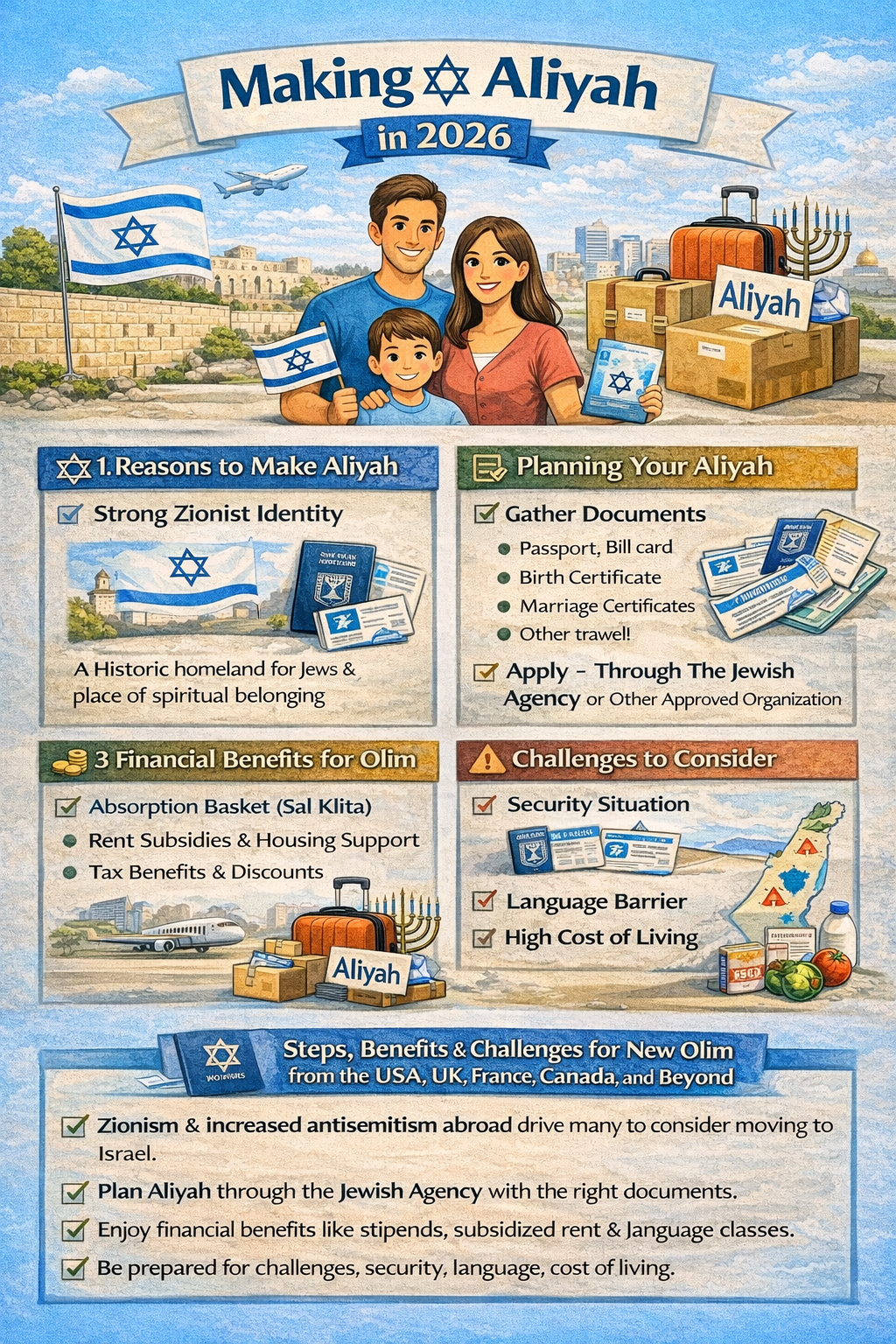
The Complete Guide to Immigration to Israel
Last Updated: January 2026
Introduction
Aliyah, the Hebrew word meaning "ascent," refers to Jewish immigration to Israel under the Law of Return (1950). This historic law grants every Jew the right to immigrate to Israel and receive citizenship. In 2024 alone, The Jewish Agency helped more than 32,000 Jews start new lives in Israel, and 2026 promises to be another significant year for immigration.
This comprehensive guide covers everything you need to know about making Aliyah in 2026, including important tax law changes, the step-by-step process, financial benefits, housing considerations, employment opportunities, and practical tips for integration.
Critical Changes for 2026
New Tax Reporting Requirements
Starting January 1, 2026, a significant change takes effect for new immigrants. While the 10-year tax holiday on foreign income remains intact, new Olim must now report their worldwide income to the Israeli Tax Authority, even if it remains tax-exempt.
This represents a major shift from previous years when new immigrants were exempt from both taxation AND reporting on foreign income. The key differences:
Pre-2026 Aliyah: Full 10-year exemption on foreign-sourced income with NO reporting requirements
2026 and After: 10-year tax exemption remains, but annual reporting of worldwide income is mandatory
Additional Requirements: Reporting for foreign companies, controlled foreign corporations, family companies, trusts, U.S. LLCs, and foreign assets
Proposed New Benefits for 2026 Olim
The Israeli government has published proposals intended to support 2026 immigrants, recognizing the rise in global antisemitism since October 7, 2023. These may include:
Multi-year exemption on Israeli-sourced earned income (2026-2030)
Enhanced tax incentives for high-income professionals
Expanded support programs for skilled immigrants
Note: These proposals are still evolving through the legislative process. Consult with a tax professional for the most current information.
Who Is Eligible for Aliyah?
Eligibility is determined by Israel's Law of Return, which grants immigration rights to:
Jews (born to a Jewish mother or converted to Judaism)
Children and grandchildren of Jews
Spouses of Jews, children of Jews, or grandchildren of Jews
Conversions must be recognized by Israeli authorities. Orthodox conversions require Chief Rabbinate approval, while Conservative and Reform conversions may be accepted under certain circumstances.
Required Documentation
Gathering the correct documents is crucial. Start collecting these 8-10 months before your planned Aliyah date:
Essential Documents
Valid Passport: Must be valid for at least one year from your Aliyah date
Birth Certificate: Original with apostille certification (hospital certificates not accepted)
Proof of Judaism: Letter from a recognized rabbi on official letterhead, written within the past year
Criminal Background Check: Required from all countries where you lived continuously for more than 1 year after age 14
Marriage/Divorce Certificates: If applicable, with apostilles
Personal Status Affidavit: Notarized and apostilled, valid for 6 months
Passport Photos: Four identical photos per person age 16+
Supporting Jewish Documentation
Additional documents that may strengthen your application:
Ketubah (Jewish marriage contract)
Bar/Bat Mitzvah certificate
Synagogue membership records
Parents'/grandparents' birth certificates showing Jewish heritage
Proof of burial in Jewish cemetery (for ancestors)
Step-by-Step Aliyah Process
Step 1: Begin Application (8-10 Months Before)
Complete the online application through Nefesh B'Nefesh (nbn.org.il) or The Jewish Agency
Upload all required documents
Get assigned an Aliyah Advisor who will guide you through the process
Step 2: Interview & Approval
The Jewish Agency will schedule an interview (in-person or via Zoom) to:
Verify your Jewish heritage
Review original documents
Understand your needs and expectations
Upon approval, you'll receive a "Mazal Tov" email with next steps.
Step 3: Obtain Aliyah Visa
Unless you hold an Israeli passport, you'll need an Aliyah visa. Apply 1-2 months before departure. Processing typically takes 18+ business days. The visa is valid for 6 months.
Step 4: Book Your Flight
Nefesh B'Nefesh and The Jewish Agency offer free Aliyah flights from North America. Options include:
Charter Flights: Entire plane of Olim with ceremonies at departure and arrival
Group Flights: NBN staff join the flight and assist with processing
Cluster Flights: Commercial flights with 5-40 Olim
Step 5: Arrival in Israel
At Ben Gurion Airport:
Ministry of Aliyah representatives will greet you
Receive your Teudat Zehut (Israeli ID) and Israeli ID number
Get your Teudat Oleh (Oleh Certificate)
Receive first Sal Klita payment (cash and prepaid card)
Arrange transportation to your destination
Financial Benefits & Support
Sal Klita (Absorption Basket)
The Sal Klita is a financial grant from the Ministry of Aliyah and Integration to help with initial living expenses. As of January 2025:
Family Status Approximate Total (NIS) Single Oleh ~21,194 NIS Couple ~32,000+ NIS Family with children Additional per child
Payment Schedule: Initial payment at airport (~25%), followed by 5-6 monthly installments deposited to your Israeli bank account.
Additional Financial Benefits
Tax Benefits: 10-year exemption on foreign-sourced income; income tax credits for 4.5 years
Health Insurance: Free basic coverage for first 6-12 months through any health fund
Rental Assistance: Subsidies from 7th month after Aliyah, up to 30 months (363+ NIS/month basic; higher in priority areas)
Arnona Discount: 70-90% reduction on municipal tax for first year (up to 100 sqm)
Customs Exemptions: Import personal items tax-free; reduced rates on vehicles for 3 years
Property Purchase Tax: Significant reduction on homes up to 6 million NIS (eligible 1 year before to 7 years after Aliyah)
Education Subsidies: Tuition assistance for BA (up to age 27) and MA (up to age 30) if started within 3 years of Aliyah
Housing in Israel
Rent vs. Buy Considerations
Most experts recommend renting for the first 1-2 years while learning the market and establishing yourself financially. However, those with substantial capital (2+ million NIS) may benefit from buying immediately to take advantage of purchase tax exemptions.
Cost of Living by City (2025-2026)
City 1BR Rent (Monthly) Cost Level Tel Aviv $1,000-1,500+ Very High Jerusalem $700-1,200 High Netanya/Ashdod $650-750 Moderate Haifa $450-650 Moderate-Low Be'er Sheva/Nazareth $450-650 Low
Housing Tips
Cities like Dimona, Afula, and Tiberias offer the most affordable options
National priority areas (Negev, Galilee) qualify for enhanced rental subsidies
Budget additional 190-350 USD/month for utilities (arnona, electricity, water, internet)
Landlords typically require income verification and may ask for 3 months' salary proof
Learning Hebrew: Ulpan Options
Hebrew proficiency significantly improves employment prospects and integration. Olim are entitled to free Hebrew instruction (Ulpan) for up to 18 months after Aliyah.
Types of Ulpan Programs
City-Based Ulpan: 5 days/week, 5 hours/day, for 5 months. Morning or evening options available.
Kibbutz Ulpan: 5-month program combining Hebrew study with kibbutz work and life. Ages 18-35.
University Ulpan: Intensive programs at Israeli universities, often with academic credit options.
Private Ulpan: Flexible schedules and personalized instruction (not government-subsidized).
Online Options: Ministry of Aliyah's 'Absorbing Hebrew' program and private providers like Ulpan-Or.
Pro Tip: Start learning Hebrew online BEFORE making Aliyah. This allows you to enter a higher-level Ulpan class and integrate faster.
Employment in Israel
Job Market Overview
Israel's job market showed strong recovery in late 2024/early 2025, with employment rates near pre-war levels (~60.9%). The minimum wage increased to 6,247 NIS/month as of April 2025.
Top Industries for English-Speaking Olim
High-Tech: Israel's "Startup Nation" accounts for ~18% of GDP. Software engineering, cybersecurity, AI, and data analysis positions often use English as working language.
Healthcare: Constant demand for doctors, nurses, and medical researchers. Licensing process required but government offers guidance and funding for retraining.
Education: Teaching English remains one of the most accessible paths. Schools nationwide need native English speakers.
Finance & Legal: Growing demand in banking, venture capital, fintech, and compliance for those with international backgrounds.
Remote Work: Increasingly popular option with tax incentives and coworking networks for digital nomads.
Job Search Resources
Nefesh B'Nefesh Job Board (nbn.org.il/jobboard) - English-friendly positions for Olim
LinkedIn - Essential for tech, marketing, and professional roles
Indeed Israel, AllJobs, Drushim - General job boards (some Hebrew required)
Janglo, Secret Tel Aviv Jobs (Facebook) - Anglo community job listings
2025-2026 Government Initiatives
The Immigration Ministry has launched several programs to improve Olim employment:
Faster professional licensing reform (February 2025)
Pre-arrival job matching with Israeli companies
170 million NIS integration improvement program
Expanded tax exemptions for immigrant-owned businesses
Key Organizations & Resources
Organization Services Nefesh B'Nefesh Free flights, Aliyah processing, job board, employment support, community events (North America/UK) The Jewish Agency Global Aliyah processing, absorption centers, Ulpan programs, eligibility determination Ministry of Aliyah Sal Klita distribution, rental assistance, employment programs, Ulpan coordination Bituach Leumi National Insurance - health coverage, child benefits, unemployment benefits
Recommended Timeline
When Action Items 10-12 Months Before Research eligibility, begin gathering documents, start learning Hebrew online 8-10 Months Before Submit Aliyah application, request rabbi letter, order apostilles 6 Months Before Complete interview, begin job search, research housing options 3 Months Before Receive approval, consider pilot trip, finalize housing plans 1-2 Months Before Apply for Aliyah visa, book flight, arrange shipping, open Israeli bank account First Week in Israel Provide bank details to Misrad Haklita, choose health fund, register for Ulpan
Top 10 Tips for Success
Triple-check document spelling - inconsistencies (e.g., "Rachel" vs. "Rahel") can cause months of delays.
Budget conservatively - plan for at least one year of living expenses plus setup costs.
Network aggressively - in Israel, "protektzia" (connections) plays a significant role in job hunting.
Learn Hebrew before arriving - even basic Hebrew dramatically improves integration and employment prospects.
Consider a pilot trip - visiting before Aliyah helps with housing decisions and expectations.
Consult a tax professional - especially regarding the 2026 reporting changes and any foreign income.
Join Olim communities - Facebook groups, WhatsApp chats, and local meetups provide invaluable support.
Be patient with bureaucracy - processes take time; follow up consistently but politely.
Keep copies of everything - digital and physical copies of all documents, especially originals.
Embrace the journey - Aliyah is a major life transition. Expect challenges and celebrate milestones.
Conclusion
Making Aliyah in 2026 offers both new opportunities and new considerations. While the tax reporting requirements have changed, Israel continues to provide substantial support for new immigrants through financial grants, tax benefits, housing assistance, free Hebrew education, and employment programs.
The key to a successful Aliyah is thorough preparation, realistic expectations, and patience. With proper planning—starting 8-10 months in advance—you can navigate the process smoothly and begin building your new life in Israel.
For the most current information, always consult official sources like Nefesh B'Nefesh (nbn.org.il), The Jewish Agency (jewishagency.org), and the Ministry of Aliyah and Integration.
Disclaimer: This guide is for informational purposes only and does not constitute legal, tax, or immigration advice. Regulations and benefits may change. Always consult with qualified professionals and official Israeli government sources for the most current and applicable information to your specific situation.