
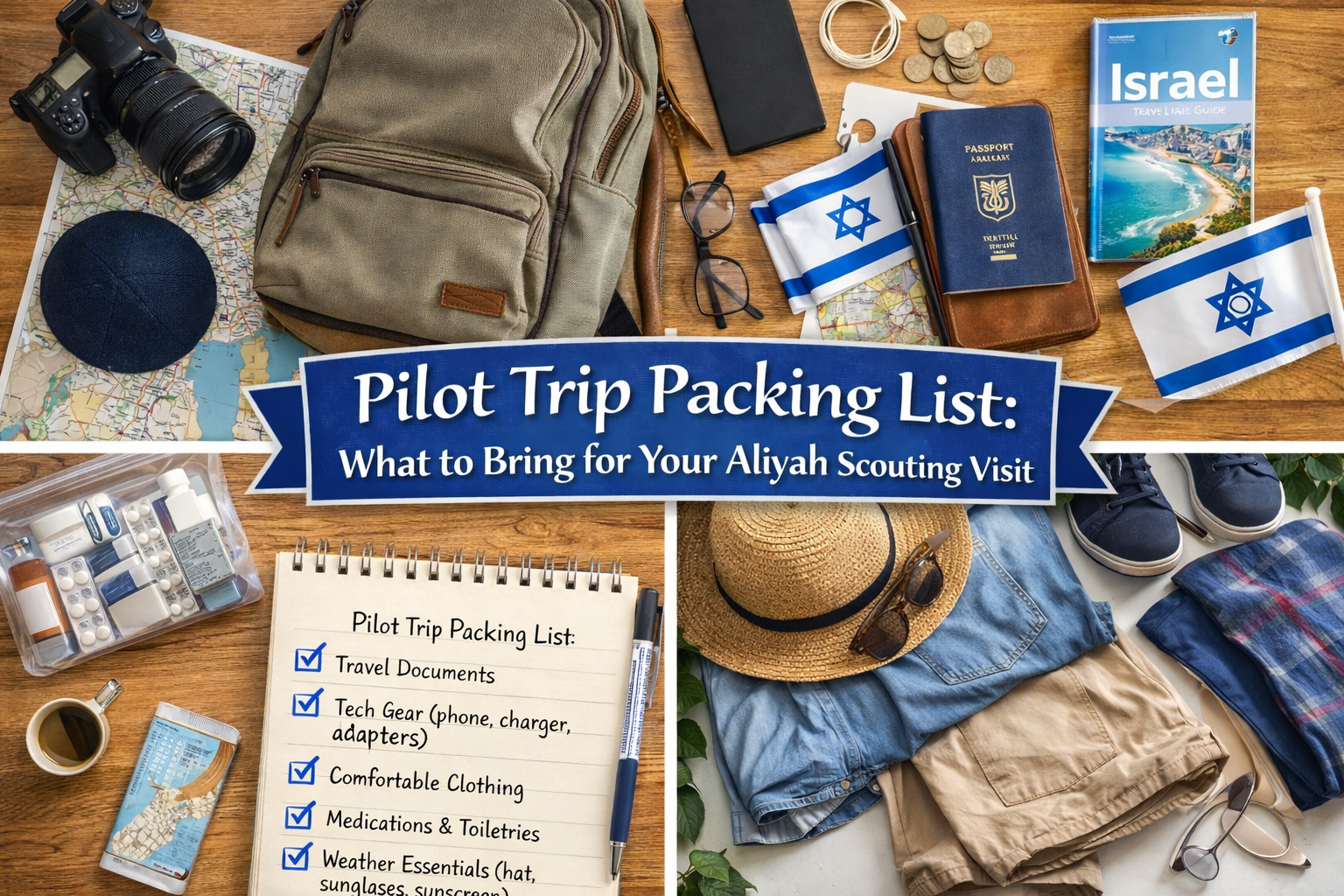
The suitcase you pack for a pilot trip should look nothing like the suitcase you would pack for a vacation to Israel. This is not a trip for your favorite sundress or the novel you have been meaning to read on the beach. Every item you bring should serve the purpose of your visit, which is to gather information, make connections, and evaluate whether this country can become your home. Packing strategically for a pilot trip means anticipating the meetings you will have, the environments you will enter, and the practical challenges you will face, then selecting items that will help you navigate each of these successfully. What follows is a comprehensive guide to what belongs in your pilot trip suitcase, organized not by category of item but by the purpose each item will serve.
You will spend significant portions of your pilot trip walking, often for hours at a time, through neighborhoods that range from flat coastal plains to hilly Jerusalem terrain, on surfaces that include cobblestones, sand, uneven sidewalks, and stairs. Your shoes are therefore the single most important items you will pack, and you should bring at least two pairs that you have already broken in and know to be comfortable for extended walking. Do not bring new shoes hoping to break them in during the trip, as blisters will derail your ability to explore effectively. One pair should be sturdy walking shoes or sneakers suitable for daytime exploration, and the other should be comfortable but slightly more polished, appropriate for meetings with real estate agents, school administrators, and community leaders. If you are Orthodox and will be spending Shabbat in a religious community, you will also need dress shoes that can handle walking distances, as driving is not an option and you may find yourself walking thirty minutes or more to synagogue. Consider the season when selecting your footwear, as sandals may be appropriate for summer visits but will leave you miserable if unexpected rain turns streets into streams.
Clothing for a pilot trip should prioritize versatility, comfort, and the ability to transition between contexts without returning to your accommodation to change. Mornings might find you touring a school in professional attire, afternoons exploring neighborhoods in the heat, and evenings attending community events where you want to make a good impression. Pack items that can be layered, mixed, and matched to create outfits appropriate for each context. For women, this might mean comfortable pants that can be dressed up with a nice blouse or dressed down with a casual top, a modest dress suitable for religious communities, and a light cardigan or jacket that can be added or removed as temperatures and contexts change. For men, pack khakis or dark jeans that can work in both casual and more formal settings, collared shirts that are comfortable enough for walking but presentable enough for meetings, and a light jacket or blazer for evening events. Regardless of gender, pack more socks and underwear than you think you need, as the combination of heat, walking, and possibly unreliable laundry access means you will go through these faster than usual.
Your bag situation requires careful thought, as you will be carrying items with you throughout each day and need something that is both functional and appropriate for the contexts you will enter. A backpack is ideal for its comfort during long walking days, but choose one that looks professional enough to bring into meetings rather than a hiking pack or student backpack covered in patches. Inside this bag, you will carry a smaller pouch or folder containing the documents you need to have accessible at all times. These documents include multiple copies of your passport, both the information page and any pages with Israeli visas or stamps, as you may need to provide copies to real estate agents, schools, or municipal offices. Print out your itinerary with all addresses and contact information, even if you also have this information on your phone, because phones die at inconvenient moments and paper does not require charging. If you have specific professional credentials or certifications that might be relevant to meetings about employment or professional licensing, bring copies of those as well. Include a small notebook dedicated to your pilot trip, where you will record impressions, questions, names of people you meet, and details you will otherwise forget. Do not rely on your phone for notetaking, as the act of handwriting helps cement information in memory and allows you to focus on the person speaking rather than looking at a screen.
Technology deserves its own careful consideration. Your smartphone will be essential for navigation, translation, communication, and documentation, so ensure it is in good working order before you leave. Download offline maps of every area you plan to visit, as you cannot always count on reliable data coverage, particularly in more peripheral areas or underground locations. Install translation apps that work offline, even if your Hebrew is functional, as you may encounter bureaucratic documents or signage that exceeds your language abilities. Download the apps you will need for daily life in Israel, including Moovit for public transportation, Gett or Yango for taxis, Waze for driving navigation, and WhatsApp, which is the primary communication method for virtually everyone in the country. Bring a portable charger with sufficient capacity to fully charge your phone at least twice, as heavy use of maps and cameras will drain your battery far faster than normal use. Bring the appropriate power adapters, as Israel uses Type H plugs that differ from both American and European standards, and bring at least two adapters so you can charge multiple devices simultaneously. Consider bringing a small laptop or tablet if you anticipate needing to do research, review documents, or work remotely during your trip, but recognize that this is optional and adds weight and security concerns to your luggage.
Personal care items for a pilot trip go beyond the basics of toiletries to include items that will help you manage the physical demands of intensive exploration. Sunscreen is essential regardless of season, as the Israeli sun is stronger than most new immigrants expect and sunburn will make every subsequent day of walking miserable. Bring a hat that provides real shade rather than a decorative cap, and consider sunglasses if you are sensitive to bright light. Pack any medications you take regularly, in quantities sufficient for the entire trip plus extra in case of delays, along with over-the-counter remedies for common travel ailments including headaches, digestive issues, and minor injuries. A small first aid kit with bandages, antiseptic, and blister treatments can rescue a day that would otherwise be cut short by a minor injury. If you are prone to allergies, bring antihistamines and any rescue medications you might need, as Israeli plants and pollens differ from what your body is accustomed to and unexpected reactions are common among new arrivals. Bring hand sanitizer and tissues, as public restrooms vary widely in their provision of these basics.
Beyond the practical items, consider bringing materials that will help you process and evaluate what you experience. A camera, whether standalone or your phone camera, allows you to document neighborhoods, buildings, and details that you will want to review when you return home and are trying to remember which apartment was in which building on which street. Develop a system for photographing that includes wider context shots as well as specific details, and consider taking a photo of yourself outside each location you visit seriously so that you can later recall not just what the place looked like but how you felt standing there. Bring materials for each neighborhood you are researching, perhaps printouts from real estate websites showing available properties or school information sheets provided by the institutions you are visiting. These allow you to compare options side by side and to show contacts what you are considering for their input.
Finally, pack items that will help you manage the emotional aspects of a pilot trip. This might include a journal for processing your thoughts and feelings at the end of each day, contact information for supportive friends and family you can call when the trip becomes overwhelming, and small comfort items that help you feel grounded when everything around you is unfamiliar. A pilot trip is fundamentally an optimistic act, an investment in the possibility of a new life in a new country, but it is also exhausting and sometimes discouraging. The item in your suitcase that matters most might not be the practical tools or the professional documents but the reminder of why you are doing this in the first place, whether that is a photograph, a letter, a small meaningful object, or simply the knowledge that whatever you discover during this trip is bringing you closer to clarity about your future.