
Ashdod | Anglo Communities
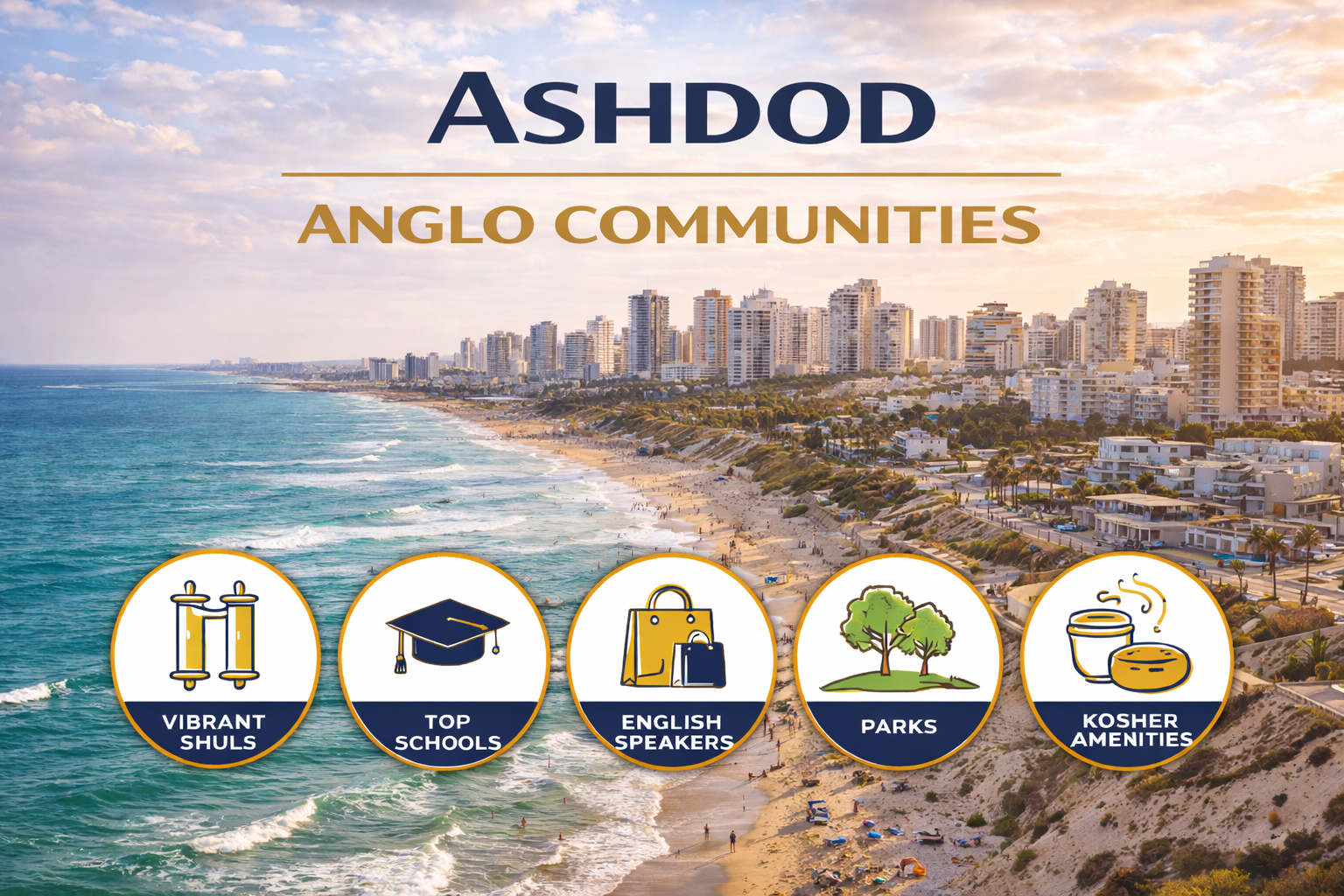
Ashdod is Israel's fifth-largest city, a port city on the southern coast that has transformed significantly over the past two decades from a somewhat gritty industrial town into a more developed urban center with growing appeal for young families, immigrants, and people seeking affordable coastal living.
The city sits about 40 kilometers south of Tel Aviv, making it further from the center than Netanya or the Sharon region but still accessible. The drive to Tel Aviv takes 30 to 45 minutes depending on traffic, and the train connection takes roughly 40 minutes. This distance creates a psychological boundary for some people, as Ashdod feels more distinctly separate from the Tel Aviv metro than places like Ramat Gan or even Netanya. For others, this separation is part of the appeal, creating a sense of living in a real city with its own identity rather than a suburb of Tel Aviv.
The Anglo community in Ashdod is smaller than in the major Anglo centers but has grown in recent years, partly driven by affordability and partly by the same Nefesh B'Nefesh and Jewish Agency efforts that have promoted the periphery. There are Anglo families scattered throughout the city, with some concentration in the newer neighborhoods in the northern parts of Ashdod. The community is organized enough to have active Facebook groups and WhatsApp chats where people share information, ask for recommendations, and organize occasional events. It's not as established or extensive as Ra'anana or even Beer Sheva's Anglo community, but it exists and is welcoming to newcomers.
The French-speaking community is much larger and more visible than the Anglo community. Ashdod has absorbed significant French aliyah over the past decade, particularly as antisemitism in France drove emigration. This has shaped parts of the city, with French-speaking neighborhoods, businesses, and cultural institutions. For Anglos, this means that English doesn't have the same utility it would in Ra'anana, and Hebrew becomes more necessary for daily life. Some Anglos find themselves learning some French phrases simply because it's so prevalent in certain areas.
Housing costs are substantially lower than the center and even cheaper than Netanya in many cases. Apartments that would be completely unaffordable in Tel Aviv or Ra'anana are within reach for middle-class buyers in Ashdod. The city has seen significant construction, with new neighborhoods featuring modern buildings, and older areas undergoing renovation. A three-bedroom apartment can be purchased for prices that might buy a one-bedroom in central Tel Aviv. Rentals are similarly affordable, typically ranging from 4,000 to 7,000 shekels for a family-sized apartment depending on neighborhood and condition. This affordability is one of the main draws for Anglo families, many of whom can own rather than rent and have a higher standard of living than their budget would allow in the center.
The neighborhoods vary considerably in character. The northern neighborhoods, particularly areas like Yud Zayin, Yud Tet, and the newer City neighborhoods, tend to be more desirable, with newer construction, better planning, and a more middle-class feel. The older neighborhoods closer to the port and the original city center are more mixed, with some areas showing wear and others undergoing renewal. The marina area, Ad Halom, has seen development and is considered attractive for its proximity to the water and newer buildings. Anglo families typically concentrate in the newer northern areas, though some find value in older neighborhoods that are gentrifying.
The beach and port define much of Ashdod's character. The city has several beaches along its coastline, and while they may not have the same prestige as Tel Aviv's beaches or the dramatic cliffs of Netanya, they're accessible, less crowded, and part of daily life for many residents. The port is one of Israel's largest, a working industrial facility that provides employment and shapes the local economy. Some areas of the city feel industrial as a result, while others are entirely residential and removed from port activity. The marina area offers a more upscale waterfront experience with restaurants, cafes, and leisure facilities.
For families with children, the school system follows the standard Israeli model with no international or bilingual options in the city. Anglo children attend Hebrew-language schools and typically absorb the language quickly through immersion. Parents often supplement with English tutoring to maintain literacy, especially for reading and writing. The quality of schools varies by neighborhood, and Anglo parents share recommendations within the community. There are religious and secular streams within the public system, and families choose based on their values and preferences. Gan options include municipal and private choices, and Anglo parents often seek out ganim that have experience with immigrant children or that come recommended by other Anglo families.
The religious landscape in Ashdod is diverse. The city has a significant traditional and religious population alongside secular residents. There are synagogues across the religious spectrum, from ultra-Orthodox to traditional to the more limited progressive options. Some synagogues have English-speaking members and can provide some accessibility for Anglos, though there isn't a specifically Anglo congregation. Chabad has a presence and often serves as an entry point for English speakers looking for community and religious services. The religious diversity means that most people can find something that fits, though the dominant character is more traditional than Tel Aviv or the secular kibbutzim.
Employment is a real consideration for Anglos in Ashdod. The local job market is limited compared to the Tel Aviv metro. The port and related logistics industries provide employment, as do local businesses, healthcare, and education, but high-tech opportunities within the city are few. Many professionals commute to Tel Aviv, Herzliya, or other tech centers for work. The commute is manageable for some people, especially with flexible hours or partial remote work, but it adds time and complexity to daily life. Others work remotely for companies based elsewhere, which has become more normalized since the pandemic. The combination of low housing costs and the ability to work remotely has made Ashdod more attractive to some Anglos who can earn Tel Aviv salaries while living on Ashdod budgets.
Healthcare is accessible through the major Kupot Holim, all of which have clinics in Ashdod. Assuta Ashdod Hospital is a major medical center that opened in recent years and provides high-quality care including specialized services. This has been a significant upgrade for the city and means that serious medical needs can be addressed locally rather than requiring travel to Tel Aviv. Finding English-speaking doctors takes some effort and relies on community recommendations, but is possible.
The cultural scene has developed but remains more limited than larger cities. Ashdod has a performing arts center, museums, and cultural programming, but it's not a cultural destination. For concerts, theater, nightlife, and the full range of urban cultural offerings, residents typically travel to Tel Aviv. The city has malls, restaurants, and entertainment options that cover daily needs, but those seeking a vibrant cultural life may find it lacking. Some Anglos appreciate the quieter pace while others feel the cultural limitations keenly.
The social experience for Anglos in Ashdod involves building community across national and linguistic lines. With a smaller Anglo population, friendships often develop with Israelis, French immigrants, and others rather than exclusively with English speakers. Some find this enriching and feel it accelerates their integration into Israeli society. Others, especially those with limited Hebrew, find it isolating and miss the ease of English-language social life available in the major Anglo centers. The Facebook groups and occasional Anglo events help, but the community is small enough that social options are more limited.
The city's trajectory has been positive, with investment in infrastructure, public spaces, and quality of life improvements. The municipality has worked to shake off Ashdod's older reputation as a peripheral development town, and there's a sense of upward development that appeals to some residents. New parks, improved roads, and commercial development have changed parts of the city significantly. However, some areas still struggle with neglect, and the city overall doesn't have the polish of more established affluent areas.
For Anglos specifically considering Ashdod, the calculation involves weighing affordability and coastal living against distance from the center and a smaller Anglo community. Families who prioritize homeownership, space, and beach access over Anglo infrastructure and proximity to Tel Aviv often find Ashdod works well for them. Those who need or want a robust English-speaking community, easy access to the center, and don't mind paying more typically choose Ra'anana or Modi'in instead. Some families use Ashdod as a launching point, establishing themselves in Israel with lower costs before potentially moving closer to the center later if circumstances allow.
The security situation is worth mentioning, as Ashdod is within rocket range from Gaza and has experienced rocket fire during conflicts. The city has bomb shelters and the Iron Dome provides protection, but this is a reality of life that's more present than in central or northern Israel. For some people this is a dealbreaker, while others accept it as part of living in Israel and note that the actual risk, while real, is statistically low. Anglo families in Ashdod during conflicts describe the experience as stressful but manageable, with the community supporting each other through difficult periods.
The climate is Mediterranean coastal, similar to Tel Aviv, with hot summers, mild winters, and sea breezes that help moderate temperatures. The beaches are a real amenity, and many families make regular use of them, developing a coastal lifestyle that becomes central to their quality of life.
Anglo families who've settled successfully in Ashdod often emphasize the sense of community that develops, the ability to own a home and live comfortably on a normal income, and the beach lifestyle. They mention developing close relationships with neighbors and other immigrant families, finding their footing in a city that's less catered to them but where they've carved out a satisfying life. The challenges they cite include the commute for those working in the center, the smaller Anglo community, and the ongoing need to function in Hebrew for most daily activities.
For people considering Ashdod, spending time in the city before committing is essential. Visiting different neighborhoods, understanding the commute, connecting with current Anglo residents through Facebook groups, and getting a realistic sense of daily life all help inform the decision. The city works well for some families and not at all for others, and understanding which category you fall into before making a major move is valuable.