
Tel Aviv Property Market Report Q3 2025 Analysis
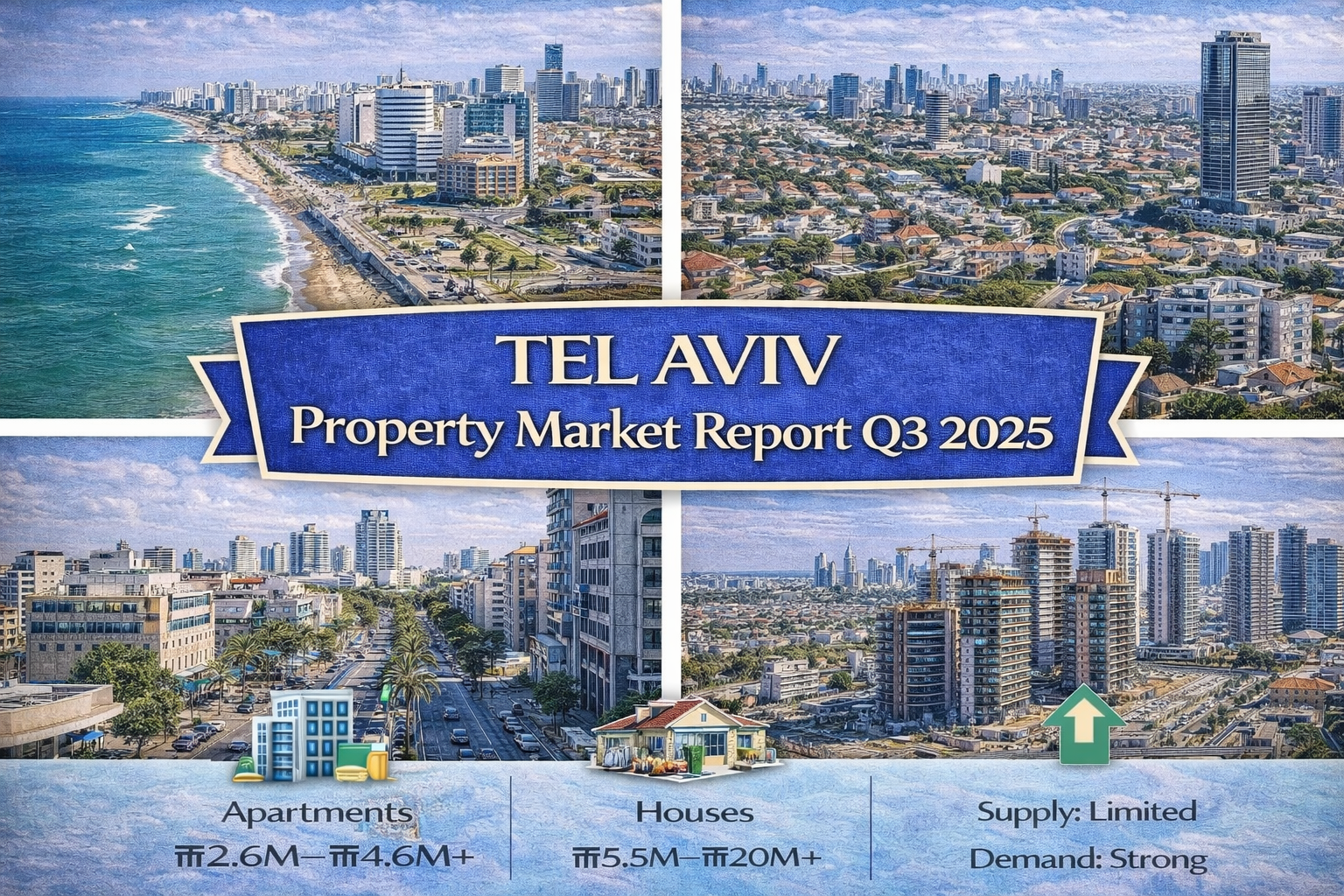
The Tel Aviv property market experienced significant corrections during the third quarter of 2025, marking a notable shift from the strong growth patterns observed in previous years. Average property prices in Tel Aviv reached shekels 3.68 million in Q3 2025, representing a substantial 13% annual decline compared to the same period in 2024. The broader Tel Aviv District recorded an average price of shekels 3.01 million, down 7.6% year-over-year, with a quarterly decline of 0.9% from Q2 to Q3 2025. This correction represents a natural price adjustment from the historically elevated valuations recorded throughout 2024, influenced by multiple economic and geopolitical factors that converged during this period.
The market shift reflects broader economic factors that have fundamentally altered buyer behavior and market dynamics. The Bank of Israel maintained interest rates at 4.5% throughout Q3 2025, resulting in elevated mortgage costs averaging approximately 5%, which significantly impacted buyer affordability and qualification standards. Ongoing regional security concerns, including the June 2025 hostilities with Iran, dampened buyer confidence and contributed to price volatility across premium segments. Perhaps most dramatically, the market faces a record inventory of 83,920 unsold new homes nationwide at the end of Q3 2025, representing an unprecedented 28.8 months of supply that has created substantial downward pressure on pricing. The Central District alone holds 26,740 unsold units, the highest inventory level in Israel, demonstrating the extent of the supply-demand imbalance affecting the Tel Aviv metropolitan area.
Despite declining prices, transaction volumes showed signs of recovery during Q3 2025, suggesting that market corrections have attracted buyers seeking value opportunities. Nationwide transactions reached 23,330 units in Q3 2025, representing a 15.4% quarterly increase from Q2, though still down 12.5% compared to Q3 2024. New home sales proved particularly robust, totaling 8,780 transactions and reflecting a 23% increase over the previous quarter. Tel Aviv-Jaffa itself recorded 608 new unit sales, a striking 53% increase from Q2 2025, largely attributable to the substantial release of units at the Sde Dov development project where large-scale construction and renewed marketing activity drove demand higher. Second-hand homes accounted for 14,550 transactions, up 11.2% over the same period, indicating that both new and resale markets experienced renewed activity despite ongoing price corrections.
The price correction has affected different property types with varying intensity, creating a highly segmented market where investment strategies must account for specific property characteristics. Large apartments of 4.5 to 5 rooms, typically representing 3-4 bedroom units, experienced the steepest decline, dropping 26.4% from Q1 2025 levels to an average of shekels 5.18 million in Q3. This dramatic correction in the premium segment reflects both oversupply in luxury developments and reduced purchasing power among high-end buyers facing elevated mortgage costs. In contrast, small units of 1-2 rooms actually appreciated 4.6% during the same period, rising from shekels 2.85 million in Q1 to shekels 2.98 million in Q3, demonstrating sustained demand for entry-level properties and investor interest in compact rental units. Standard 3-4 room apartments declined more moderately by 7.2%, averaging shekels 3.85 million, while 6+ room properties fell 9.7% to shekels 6.50 million, creating a complex pricing landscape where generalized market assessments fail to capture the nuanced realities affecting different buyer segments.
Neighboring cities within the Tel Aviv metropolitan area demonstrated divergent performance patterns, underscoring the localized nature of real estate corrections. Herzliya, Israel's second most expensive city at shekels 3.66 million average, experienced only a 4.2% annual decline and remarkable quarterly stability with just 0.05% price movement from Q2 to Q3, suggesting that luxury coastal markets with structural supply constraints have proven more resilient than Tel Aviv proper. Ramat Gan averaged shekels 2.92 million with a 5.7% annual decline and 6.2% quarterly drop, reflecting its position as a Tel Aviv alternative without the same premium positioning. Most remarkably, Bat Yam defied broader trends with a 4.2% annual increase and 8.3% quarterly surge to shekels 2.47 million, demonstrating that value-oriented markets near Tel Aviv continue attracting buyers priced out of premium areas. Holon averaged shekels 2.38 million with modest declines of 2.1% annually and 4.4% quarterly, maintaining relative stability in the mid-market segment.
The rental market has remained remarkably strong despite purchase price corrections, indicating continued underlying housing demand and potential investment opportunities for those able to weather near-term volatility. Existing tenants renewing leases experienced 2.5% rent increases, while new tenants entering the market faced more substantial 5.5% increases, reflecting landlords' ability to capture market rates from tenant turnover. The national average rent reached shekels 4,878 in Q2 2025, with Tel Aviv commanding significantly higher rates typical of Israel's most expensive rental market. Gross rental yields improved to 3.38% nationally in Q3 2025, up from 2.53% in Q2 2024, as rental income remained stable while purchase prices declined, creating more attractive cash flow dynamics for investors willing to accept lower capital appreciation expectations. This rental strength suggests that while ownership demand has softened due to affordability constraints, underlying housing needs continue driving tenant activity.
Regional price changes across Israel reveal Tel Aviv's correction as part of a broader market divergence where different districts respond to distinct local dynamics rather than uniform national trends. Jerusalem posted an 8.0% annual increase to shekels 2.90 million, bucking the national correction trend through its unique combination of spiritual significance, limited developable land, and sustained diaspora demand. The Northern District demonstrated the strongest appreciation at 9.5%, rising to shekels 1.56 million as buyers sought affordable alternatives with improving infrastructure. Haifa District grew 5.1% to shekels 1.88 million, benefiting from its position as Israel's third major city with substantially lower entry costs than Tel Aviv. The Southern District showed modest 1.7% growth to shekels 1.57 million, while the Central District declined 3.8% to shekels 2.61 million, affected by its proximity to Tel Aviv's correction dynamics and its own substantial inventory overhang of 26,740 unsold units.
Developer behavior has shifted significantly as market conditions deteriorated, with financing incentives returning as a key competitive tool after years of seller-favorable dynamics. By September 2025, 31% of new apartment transactions included developer financing incentives, up from 27% in August, indicating builders' increasing willingness to offer favorable terms to move inventory. These incentives typically include extended payment schedules, reduced down payment requirements, or subsidized mortgage arrangements that improve buyer affordability without requiring headline price reductions that might affect comparable valuations for other units. The surge in Sde Dov sales demonstrates that well-located, properly priced new developments can still generate substantial activity, but developers across the market increasingly recognize that the 2024 pricing environment of seller dominance and minimal negotiation has given way to a more balanced dynamic where buyer concerns about value and affordability must be directly addressed.
The market entered Q3 2025 following seven consecutive months of national price declines through September, representing the most sustained correction period in recent Israeli real estate history and signaling a fundamental shift from the appreciation dynamics that characterized 2020-2024. This extended decline reflects not temporary volatility but rather structural adjustments to elevated valuations, reduced affordability, and shifting demographic patterns including continued emigration from Tel Aviv that has reduced local demand particularly in premium segments. The monthly price index showed 0.3% declines in August-September 2025, indicating that while the pace of correction may be moderating, downward pressure persists absent significant changes to underlying market conditions. Annual housing price growth nationwide reached only 0.5% by Q3 2025, down dramatically from the 7.8% peak recorded earlier in the year, demonstrating how quickly market sentiment and pricing dynamics can shift when affordability constraints intersect with oversupply conditions.
The taxation environment contributed to unusual market dynamics across 2024-2025, creating artificial volatility as buyers and sellers responded to policy changes. The VAT increase to 18% in January 2025 accelerated late-2024 purchases as buyers rushed to complete transactions before the higher rate took effect, artificially inflating Q4 2024 transaction volumes. This pull-forward effect was followed by predictable Q1-Q3 2025 slowdown as the market absorbed the earlier activity surge and adjusted to the new tax reality. Construction costs also increased substantially, with the residential Construction Cost Index rising 5% over the twelve months through October 2025, driven primarily by 9.2% labor cost increases and 2% material cost growth. These cost pressures have squeezed developer margins, particularly problematic given the current oversupply environment where aggressive pricing is necessary to move inventory, creating financial stress for builders who purchased land or commenced projects based on now-unrealistic price expectations.
Economic conditions beyond the property market have contributed significantly to the current correction, with broader macroeconomic factors creating headwinds for real estate valuations. Israel's Q2 2025 GDP contracted 3.5% year-over-year, influenced substantially by the twelve-day hostilities with Iran in mid-June that weighed heavily on economic activity across all major sectors. This represents a dramatic reversal from Q1 2025's 3.4% growth and Q3 2024's robust 5.7% expansion, demonstrating how quickly geopolitical events can derail economic momentum. The Bank of Israel revised its 2025 GDP growth forecast downward to 3.3% from 3.5%, acknowledging the sustained impact of security concerns on economic performance. Employment stability in Tel Aviv's crucial tech sector faces uncertainty as global technology markets remain volatile, while the broader Israeli labor market demonstrates resilience with government and service sector employment providing stability that partially offsets private sector headwinds.
For prospective buyers, the current market environment presents both opportunities and risks that require careful analysis of individual circumstances and risk tolerance. The 13% annual price decline in Tel Aviv proper, and broader corrections across the district, create potential entry points for those with stable employment, adequate financing, and long-term holding horizons capable of weathering continued near-term volatility. Mid-range properties in the 3-4 room segment appear particularly attractive given 7.2% price reductions from Q1 levels, potentially offering better value than premium segments where 26% corrections may not yet fully reflect oversupply dynamics, or entry-level segments where 4.6% appreciation suggests limited correction opportunity. Buyers should prioritize properties in established neighborhoods with strong rental demand characteristics, ensuring downside protection through rental income potential should personal circumstances or market conditions necessitate conversion to investment properties.
Sellers face a challenging environment requiring realistic pricing aligned with current market conditions rather than 2024 peak valuations that no longer reflect buyer willingness or ability to pay. Properties that languish on the market at aspirational prices risk becoming stigmatized as buyers question why units remain unsold, creating downward pressure that ultimately forces price reductions below levels achievable through immediate realistic pricing. The 28.8 months of unsold inventory nationwide demonstrates the extent of seller-buyer price disagreement, with many sellers holding properties off-market rather than accepting current valuations, reducing available inventory but failing to address underlying supply-demand imbalances. Strategic sellers should consider the opportunity cost of delayed transactions, factoring rental income potential against holding costs and the probability that prices may continue declining through 2026 as elevated supply is absorbed, potentially making today's disappointing prices appear attractive in retrospect.
Investors must carefully evaluate the risk-return profile of Tel Aviv real estate given current market dynamics that differ fundamentally from the appreciation-driven environment of recent years. The improved gross rental yield of 3.38% nationally reflects better cash flow characteristics as rental income remains stable while purchase prices decline, creating more traditional real estate economics where income rather than appreciation drives returns. However, investors must account for elevated supply levels that may pressure both prices and rents if absorption rates remain subdued, potentially creating negative scenarios where both capital values and income streams decline simultaneously. The divergent performance across property types suggests targeted strategies focusing on small 1-2 room units that demonstrated 4.6% appreciation and strong rental demand from young professionals and students, avoiding premium 4.5-5 room segments where 26% corrections and limited buyer pools create continued downside risk.
The market's trajectory through late 2025 and into 2026 will depend significantly on several key variables that currently remain uncertain and subject to rapid change. Monetary policy decisions by the Bank of Israel represent the most immediate catalyst, with any movement toward interest rate reductions potentially stimulating buyer activity and stabilizing prices, though current inflation dynamics and global monetary conditions suggest rates may remain elevated longer than earlier anticipated. Resolution of geopolitical tensions and stabilization of the regional security environment would remove a significant psychological barrier to major purchase decisions, though recent history suggests this factor may persist as an ongoing market headwind rather than resolving cleanly. Most fundamentally, the pace at which the substantial inventory overhang of 83,920 unsold units is absorbed will determine whether current price levels represent a bottom or merely a waypoint in a longer correction process, with absorption rates dependent on all other factors including affordability, confidence, and economic growth.
Government housing policy interventions could significantly alter market dynamics through various mechanisms designed to stimulate demand or constrain supply. Potential measures might include enhanced purchase tax benefits for first-time buyers, subsidized mortgage programs reducing effective interest costs, or restrictions on new construction approvals designed to prevent further inventory buildup. However, policymakers face competing objectives of maintaining housing affordability for residents while supporting the construction industry and preventing sharp market corrections that might trigger broader economic impacts through wealth effects and banking sector stress. The political economy of housing policy in Israel involves balancing interests of current homeowners who benefit from price appreciation, potential buyers seeking affordability, construction industry employment, and macroeconomic stability concerns, creating complex dynamics where policy responses may be delayed, diluted, or differently targeted than market participants anticipate.
International comparison provides useful context for understanding whether Tel Aviv's correction represents a unique local phenomenon or part of broader global real estate cycles affecting major cities worldwide. Major metropolitan areas across developed markets experienced similar dynamics during 2020-2024, with initial pandemic-era price surges driven by low interest rates and changing housing preferences, followed by 2022-2024 corrections as central banks raised rates to combat inflation. Tel Aviv's experience differs in degree rather than kind, with the combination of small market size, geopolitical volatility, and limited geographic constraints creating more dramatic price swings than typical in larger, more diversified markets. The Israeli market's traditional resilience stems from sustained immigration, limited land supply, and strong cultural preferences for homeownership, factors that historically supported prices even during economic stress and suggest that while current corrections may continue near-term, longer-term fundamentals remain constructive for property values.
The construction industry faces particular stress given current market conditions, with builders caught between elevated land and construction costs incurred during the boom period and current market prices that may not support profitable project completion. Dwelling completions dropped 8.8% year-over-year to 12,017 units in Q1 2025, suggesting builders are slowing construction activity in response to softening demand, though this reduction comes too late to prevent the current inventory overhang from projects commenced during more optimistic market conditions. Dwelling starts increased 6.5% to 17,318 units during the same period, indicating that despite current challenges, developers continue initiating new projects, perhaps reflecting long lead times in the planning process and pre-sold units requiring completion regardless of market conditions. The 188,811 dwellings under construction as of Q1 2025, up 8.6% from the prior year, represents substantial future supply that will enter the market over coming quarters, suggesting inventory pressures may intensify before improving.
Demographic trends provide important context for longer-term market dynamics beyond current cyclical corrections, with sustained population growth and household formation supporting underlying housing demand even as near-term affordability constraints reduce effective demand. Israel's homeownership rate stood at approximately 68% in 2024, sharply recovering from the record-low 62.7% in 2021 but remaining below the 73% recorded in 1995, indicating that while recent market strength improved ownership rates, a larger proportion of Israeli households rent compared to historical norms. This suggests that absent policy interventions or significant market corrections improving affordability, homeownership rates may continue pressured by elevated prices relative to incomes, potentially creating larger structural rental markets that support investor demand and rental yields even if purchase price appreciation remains constrained. Immigration patterns, traditionally a key driver of Israeli housing demand, remain subject to geopolitical dynamics that may either accelerate or moderate flows depending on conditions in source countries and Israel's security environment.
Technology sector dynamics deserve particular attention given Tel Aviv's positioning as Israel's premier tech hub and the sector's disproportionate influence on high-end property demand. Global technology markets experienced significant volatility during 2022-2024, with mass layoffs, reduced venture capital funding, and company valuation corrections affecting employment and compensation levels among the professional class that historically drove demand for premium Tel Aviv properties. While Israel's tech sector demonstrated greater resilience than some international markets, continued global uncertainty creates risk that high-income employment levels may soften, potentially exacerbating corrections in premium property segments where 4.5-5 room apartments already declined 26%. Conversely, any stabilization or recovery in tech sector fortunes would likely disproportionately benefit Tel Aviv property values given the concentration of technology employment in the city and surrounding municipalities, creating potential for sharp recoveries if sector dynamics improve more quickly than currently anticipated.
The mortgage market structure and banking sector behavior significantly influence market dynamics, with Israeli banks maintaining relatively conservative lending standards even during boom periods, potentially limiting both the upside during expansions and downside during corrections. Mortgage lending in Israel expanded to approximately 30% of GDP in 2024, broadly stable over recent years but up from 25.8% in 2019, indicating gradual financial deepening without the excessive leverage buildups that characterized property booms in other markets. Bank of Israel regulations limiting loan-to-value ratios to 75% for most borrowers and debt-service-to-income ratios to 30% provide structural constraints preventing the most aggressive lending that might fuel unsustainable price appreciation, though these same restrictions can limit market recovery potential during downturns by restricting access to financing for marginal buyers who might otherwise absorb inventory at lower price points.
Foreign investment in Israeli real estate, particularly from North American and European Jewish diaspora communities, represents an important but variable demand source that responds both to economic factors and emotional or ideological considerations that differ from purely financial calculations. Foreign buyers often purchase properties for part-year personal use, investment diversification, or establishing a foothold in Israel for family members, creating demand dynamics less sensitive to short-term price movements than local buyers focused primarily on immediate housing needs or financial returns. The strong shekel against major currencies during portions of 2024-2025, trading around shekels 3.35 to the dollar compared to shekels 3.78 a year earlier, affects foreign buyer calculations significantly, with currency movements sometimes overwhelming property price changes in determining relative value for international investors. Geopolitical developments and diaspora community sentiment toward Israel influence foreign investment flows in ways difficult to predict through traditional economic analysis, creating both risks and opportunities as these considerations evolve.
The market demonstrates clear signs of bifurcation between new construction and resale properties, with different dynamics affecting each segment's pricing, velocity, and investor attractiveness. New construction benefits from modern amenities, energy efficiency, protected rooms required under current building codes, and developers' willingness to offer financing incentives, but faces headwinds from elevated supply and buyers' price sensitivity to premium positioning. Resale properties offer established locations, immediate availability, and often larger room sizes than modern construction, but may require renovation and lack contemporary safety features increasingly valued in Israel's security-conscious environment. The 53% surge in Tel Aviv new unit sales despite overall market weakness suggests that properly positioned and priced new construction can outperform the broader market, particularly when developers offer incentives that effectively reduce net purchase prices below headline values, creating opportunities for sophisticated buyers who can navigate developer negotiations and understand the true all-in cost including incentives.
The spatial distribution of corrections within Tel Aviv itself deserves analysis, though granular neighborhood-level data remains limited in public reporting, creating challenges for buyers and investors seeking to identify specific opportunities or risks. Anecdotal evidence suggests that central neighborhoods with strong amenity access and proven rental demand have demonstrated greater resilience than peripheral areas or neighborhoods perceived as less desirable, creating divergent performance within the city that averages mask. Properties near future or recently completed infrastructure improvements, particularly light rail extensions and urban renewal projects, may offer better long-term prospects than the citywide average suggests, though near-term construction disruption can create temporary pricing pressure. Buyers with local knowledge or access to professional guidance capable of identifying micro-market dynamics may find opportunities purchasing in temporarily depressed areas likely to recover as specific catalysts materialize, while avoiding areas facing structural challenges beyond cyclical weakness.
Urban planning initiatives and government development priorities shape longer-term supply patterns that will influence market dynamics for years beyond current inventory absorption. Major projects like Sde Dov demonstrate authorities' commitment to intensive development of available land, potentially creating substantial new supply in coming years that may constrain price appreciation even after current inventory is absorbed. Conversely, land scarcity in central Tel Aviv and limitations on vertical development in historic neighborhoods create structural supply constraints supporting values in the most desirable locations, suggesting that while the overall market faces oversupply, certain submarkets may demonstrate resilience or earlier recovery. Environmental and sustainability considerations increasingly influence planning decisions, with green building requirements and public transportation orientation affecting both development costs and the competitive positioning of new versus existing properties, creating evolving dynamics in relative value across different property types and locations.
Transaction costs in Israeli real estate remain substantial, with purchase taxes, legal fees, and agency commissions typically totaling 8-10% of property value for non-first-time buyers, creating significant friction that affects holding period decisions and breakeven timelines. New immigrants benefit from substantial tax breaks on first property purchases up to shekels 6 million, creating distorted incentives where immigrant buyers effectively operate in a different economic environment than local purchasers, potentially supporting certain market segments while creating competitive disadvantages for local first-time buyers. These transaction costs mean that short-term trading strategies face significant hurdles, favoring longer holding periods and requiring stronger conviction that near-term price movements justify the costs incurred in buying and selling, fundamentally affecting market liquidity and the speed at which prices adjust to changing conditions.
Property management and operational considerations affect investment economics beyond purchase price and financing costs, with Israeli apartment buildings typically managed through homeowner associations that assess monthly fees for common area maintenance, building insurance, and shared services. These fees vary substantially based on building age, amenity level, and management quality, ranging from minimal amounts in older buildings to significant monthly expenses in luxury developments with concierge services, pools, and fitness facilities. Prospective buyers and investors must factor these ongoing costs into return calculations, recognizing that nominal purchase prices may mask significant variation in total ownership cost depending on specific property characteristics. Rental properties face additional management complexity including tenant relations, maintenance coordination, and regulatory compliance with tenant protection laws that favor occupants over owners in certain disputes, creating operational risks and costs that affect net investment returns beyond gross rental yields.
The insurance market and risk assessment framework in Israel reflect the unique security environment, with property insurance costs and availability affected by location-specific risks including rocket exposure and terrorism considerations that vary across different municipalities and neighborhoods. Properties with protected rooms command measurable premiums in both sale and rental markets, with recent reporting indicating shekels 3,000 monthly rental premiums in Tel Aviv for units with safety features, and broader estimates suggesting double-digit value gaps between protected and unprotected units. This safety premium represents a structural shift in buyer and tenant preferences post-October 2023, creating lasting changes in relative value across different property types that persist independent of cyclical market conditions. Developers increasingly prioritize safety features in marketing and design, recognizing that properties lacking protected spaces face competitive disadvantages unlikely to reverse absent fundamental changes to Israel's security environment.
Looking forward, the Tel Aviv property market appears positioned for continued near-term volatility as the substantial inventory overhang is absorbed, with potential for either stabilization or further corrections depending on the interplay of interest rates, economic growth, geopolitical developments, and policy responses. Buyers with long time horizons, stable financing, and tolerance for continued near-term price weakness may find current conditions present attractive entry opportunities, particularly in mid-market segments where corrections have been substantial but underlying rental demand remains solid. Sellers should carefully evaluate the opportunity cost of waiting for market recovery against the certainty of current transactions, recognizing that continued inventory buildup from projects under construction may extend the correction period beyond initial expectations. Investors must approach the market with realistic return expectations focused on income rather than appreciation, carefully selecting properties with strong rental fundamentals capable of generating positive cash flows independent of capital value movements.
The market ultimately reflects the intersection of numerous complex factors—interest rates, geopolitics, demographics, psychology, policy, and economics—that interact in unpredictable ways creating both risks and opportunities for different market participants. What appears certain is that the Tel Aviv property market has entered a new phase characterized by greater uncertainty, more balanced buyer-seller dynamics, and return expectations grounded in fundamental value rather than extrapolated appreciation. Stakeholders who approach this environment with realistic expectations, thorough analysis, and appropriate risk management will be best positioned to navigate whatever market conditions ultimately emerge, while those expecting rapid return to 2024 dynamics may find themselves disappointed by a market that has fundamentally shifted toward more sustainable, though less spectacular, long-term patterns.