
Tel Aviv | Anglo Communities
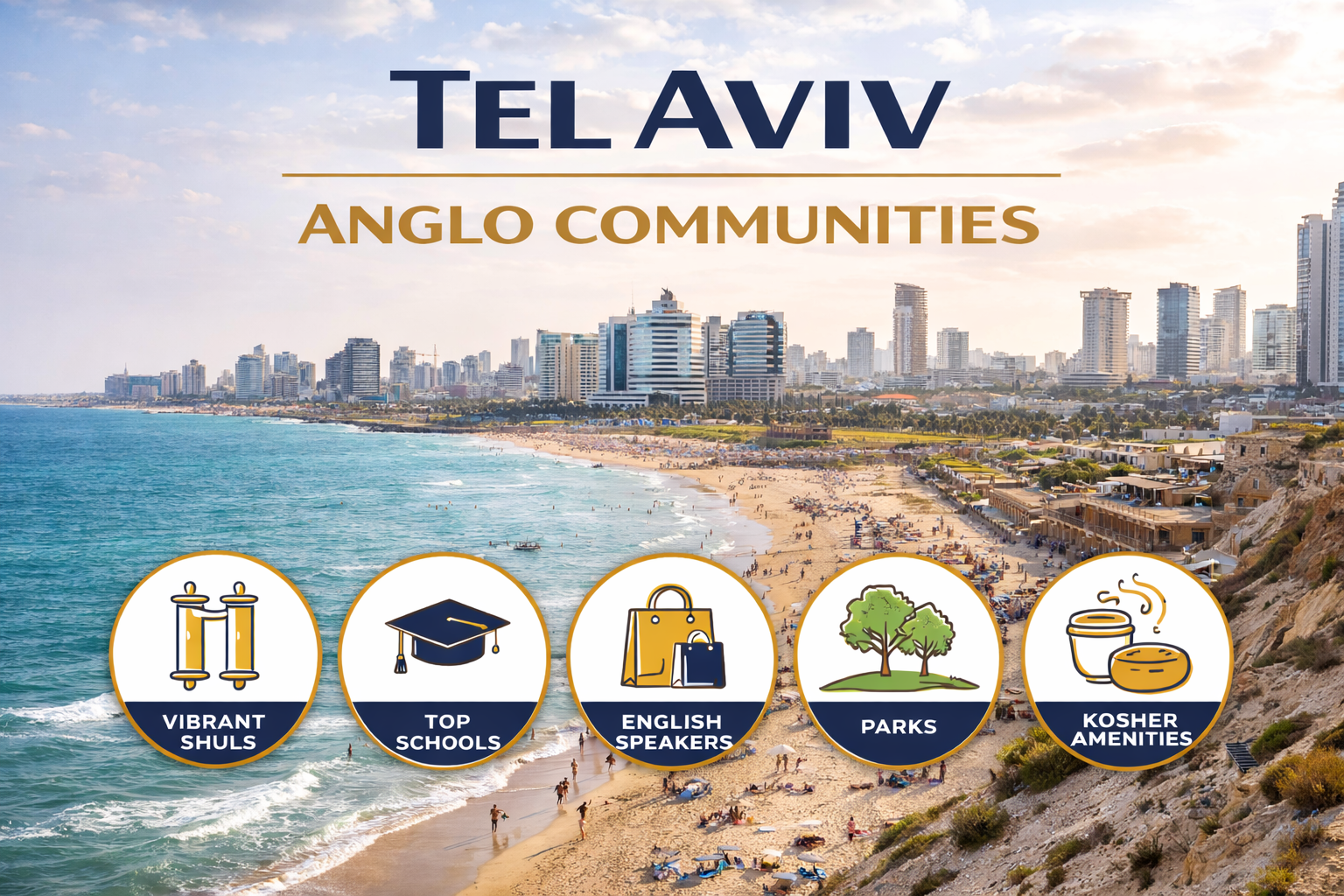
Tel Aviv is Israel's largest metropolitan center, the economic engine of the country, and the city that most closely resembles major global cities in lifestyle, culture, and attitude. For Anglos, it presents a paradox: it's the most familiar-feeling place in Israel for those coming from New York, London, or other major Western cities, yet it lacks the organized Anglo community infrastructure found in places like Ra'anana or Modi'in.
The city proper has about 460,000 residents, but the metropolitan area extends into surrounding cities like Ramat Gan, Givatayim, Bnei Brak, and Holon, creating an urban continuum of several million people. When people talk about living in Tel Aviv, they sometimes mean the city itself and sometimes mean this broader metropolitan area, so understanding the distinction matters when evaluating options.
Tel Aviv's character is secular, liberal, cosmopolitan, and intense. It's the center of Israeli high-tech, finance, media, arts, and entertainment. The nightlife is famous, the restaurant scene is sophisticated, and the cultural offerings rival major European cities. The beach runs along the western edge of the city, providing a counterbalance to the urban intensity and shaping lifestyle in ways that define Tel Aviv identity. People run, swim, and socialize along the tayelet promenade. The Mediterranean is a constant presence.
For Anglos, Tel Aviv offers something that most other Israeli cities cannot: the ability to live a life that feels culturally continuous with major Western cities. English is widely spoken in professional contexts, in trendy restaurants and cafes, and in the tech industry that employs many immigrants. You can get by with limited Hebrew in ways that would be impossible in Netivot or even Beer Sheva. International influences are everywhere, from the food scene to the fashion to the cultural programming. For someone whose reference point is Brooklyn or London, Tel Aviv feels legible in ways that more traditionally Israeli places do not.
The Anglo community in Tel Aviv is substantial in numbers but diffuse in organization. There are thousands of English speakers living in the city, working in tech, startups, finance, and creative industries. But unlike Ra'anana, where the Anglo community has built institutions, services, and social structures specifically for English speakers, Tel Aviv's Anglos are scattered throughout the city and integrated into the broader urban fabric. There's no Anglo neighborhood per se, no dominant Anglo synagogue that serves as a community center, and less of the structured community life that characterizes smaller Anglo-heavy cities.
What exists instead are networks, often organized around professional connections, social interests, or specific institutions. There are Facebook groups for Anglos in Tel Aviv, some quite active. There are professional networking events, particularly in tech, where English is the working language. There are social groups organized around activities like running, cycling, or specific interests. Some synagogues have significant Anglo membership, particularly in areas like the Old North where English speakers have concentrated. But the overall pattern is one of individual navigation rather than community infrastructure.
The neighborhoods of Tel Aviv vary dramatically in character and price, and understanding them is essential for anyone considering the city.
The Old North, roughly from the Yarkon River up through streets like Dizengoff and Ben Yehuda in their northern stretches, has become one of the most desirable residential areas. Tree-lined streets, Bauhaus architecture, good schools, and a family-friendly atmosphere distinguish it from the more intense southern parts of the city. Many Anglo families with children concentrate here, finding a balance between urban living and neighborhood community. Prices are extremely high, with family apartments easily exceeding four million shekels to purchase and rentals running 10,000 to 15,000 shekels or more monthly.
Neve Tzedek is Tel Aviv's oldest neighborhood, gentrified into one of its most expensive and charming. Narrow streets, restored historic buildings, boutiques, and cafes create an atmosphere that draws tourists and wealthy residents alike. Living there requires significant wealth, with prices among the highest in the country. Some Anglos with substantial resources choose Neve Tzedek for its beauty and character.
Florentin has a younger, grittier character, attracting artists, students, and young professionals who appreciate its edgier atmosphere and relatively lower prices compared to the north. Some young Anglos find their first Tel Aviv apartments here, though gentrification has been pushing prices up steadily.
The areas along Rothschild Boulevard and in the financial district combine urban intensity with proximity to the beach and major employers. High-rise towers mix with historic buildings. The atmosphere is busy and professional during the week, lively with cafes and nightlife on evenings and weekends.
South Tel Aviv, including neighborhoods like Shapira, Neve Sha'anan, and the areas around the Central Bus Station, has a different character entirely. These areas have historically housed lower-income populations, including labor migrants and asylum seekers from Africa. Prices are lower, but so is the general standard of infrastructure and safety. Few Anglos choose these areas, though some seeking affordability or proximity to certain cultural scenes do end up there.
The port area and northern beachfront have seen significant development, with new towers offering modern apartments with sea views. These areas attract wealthy buyers and renters seeking the combination of beach access and contemporary living.
Housing costs in Tel Aviv are the highest in Israel and among the highest in the world relative to local salaries. Purchasing a family apartment in desirable neighborhoods requires budgets starting around three million shekels and quickly climbing to four, five, or six million for larger or better-located units. Rentals for family apartments typically run 8,000 to 15,000 shekels monthly, with higher prices in prime areas. For many Anglos, these prices make Tel Aviv inaccessible, pushing them toward surrounding cities or other parts of the country. Those who do afford it often have high-tech salaries, work for international companies with compensation benchmarked to global standards, or have resources from abroad.
Employment is Tel Aviv's primary draw for many Anglos. The city and its immediate surroundings contain the densest concentration of high-tech companies, startups, and international corporations in Israel. If you work in tech, finance, law, media, or other professional fields, the job opportunities in Tel Aviv far exceed anywhere else in the country. Many Anglos come specifically because their careers brought them here, either through Israeli companies, international firms with Israeli offices, or their own entrepreneurial ventures.
The startup ecosystem deserves particular mention. Israel's reputation as the startup nation is concentrated heavily in Tel Aviv. Anglos with entrepreneurial ambitions, tech skills, or interest in venture capital find an ecosystem that operates partly in English and connects to global networks. The density of talent, capital, and opportunity attracts people who might not otherwise consider living in Israel.
Schools in Tel Aviv span the full range of options. The public secular system includes well-regarded schools in the better neighborhoods, though competition for spots can be intense. There are private and alternative schools with various educational philosophies. International schools exist, including the American International School and others that offer English-language education following American or international curricula. These schools serve diplomatic families, expatriates, and wealthy Israeli families who want English-medium education, and they come with significant tuition costs. For Anglo families who can afford it, international schools provide continuity for children's education in English while living in Israel. For those using the public system, children attend Hebrew-language schools with the immersion approach common throughout Israel.
The religious landscape in Tel Aviv is predominantly secular. The city is Israel's center of secular Jewish life, and religious observance is a minority position. Shabbat sees reduced traffic and some business closures, but nothing like the complete shutdown of more religious cities. Restaurants, entertainment venues, and many businesses operate on Shabbat. For secular Anglos, this environment feels comfortable and natural. For observant Anglos, finding community requires more effort.
Synagogues do exist across the religious spectrum. The Great Synagogue on Allenby is a historic landmark, though not particularly Anglo. The Old North has several synagogues with Anglo membership, including some with rabbis who speak English. The Beit Tefila Israeli congregation offers a progressive, egalitarian approach that attracts some Anglos. Chabad has a presence throughout the city and often serves as an entry point for Anglos seeking religious connection. For dati leumi families, Tel Aviv is less natural than communities with stronger religious infrastructure, and many choose to live in nearby cities like Givatayim or Ramat Gan while accessing Tel Aviv for work and entertainment.
Healthcare in Tel Aviv is excellent, with major hospitals including Ichilov (Sourasky Medical Center) providing comprehensive services. The concentration of medical professionals and facilities means that specialized care is readily available. Finding English-speaking doctors is easier in Tel Aviv than almost anywhere else in Israel, though it still requires some research and recommendations.
The lifestyle Tel Aviv offers is urban in a way nowhere else in Israel matches. The density of restaurants, from cheap hummus joints to high-end dining, creates a food culture that rivals major world cities. The bar and club scene is active every night of the week. Cultural programming includes theater, music, museums, and film. The beach integrates into daily life for many residents, whether for morning swims, evening runs, or weekend gatherings. The pace is fast, the options are endless, and the energy is palpable.
This intensity has downsides. Traffic is challenging, parking is a constant frustration, and the density can feel oppressive. The cost of living extends beyond housing to everyday expenses like dining out, entertainment, and services. The competitiveness and hustle that drive the economy also create stress. Some people thrive in this environment, while others burn out and seek quieter places.
The social experience for Anglos in Tel Aviv varies by individual circumstances. Young professionals often find social connections through work, where the tech industry's international character creates natural opportunities. Singles benefit from a dating scene that's active and includes many English speakers. Families can find other Anglo families, particularly in neighborhoods like the Old North, but the connections require more initiative than in organized Anglo communities. The overall pattern is that Tel Aviv rewards social initiative and punishes passivity. You can build a rich social life, but the city won't organize it for you.
For families with children, Tel Aviv presents tradeoffs. The cultural exposure and diversity are valuable, and children grow up with a cosmopolitan sensibility. The beaches and parks provide recreation. The schools, particularly in better neighborhoods, offer quality education. But the urban environment lacks the space and calm of suburban communities. Apartments are smaller for the money, and gardens or yards are rare. Some families choose Tel Aviv while children are young and move to more spacious communities as they grow. Others commit to urban living and raise children through high school in the city.
The comparison to other options helps clarify what Tel Aviv offers and demands. Versus Ra'anana, Tel Aviv has more career opportunity, cultural offerings, and urban energy, but less Anglo community, lower quality of life by some measures, and dramatically higher prices. Versus Jerusalem, Tel Aviv is more secular, more international, and more economically dynamic, but lacks the religious and historical resonance that draws people to Jerusalem. Versus Modi'in, Tel Aviv offers everything Modi'in lacks in terms of urban culture, but Modi'in offers space, community, and calm that Tel Aviv cannot match.
The honest assessment is that Tel Aviv works best for Anglos who prioritize career opportunity in dynamic industries, cultural and entertainment options, beach lifestyle, and cosmopolitan atmosphere, and who either have the financial resources to afford it or are willing to accept smaller living spaces and higher costs. It works less well for those who need organized Anglo community, who want spacious housing, who prefer quiet residential environments, or whose budgets don't stretch to Tel Aviv prices.
Many Anglos pass through Tel Aviv without settling there permanently. They come for jobs, spend a few years enjoying the city's intensity, and eventually move to quieter communities when starting families or seeking different lifestyle priorities. Others make Tel Aviv home for decades, finding that its energy and opportunity continue to suit them. There's no single right answer, only the question of what fits your particular circumstances and values.
Would you like more information about specific neighborhoods, the employment landscape in particular industries, schools, or other aspects of life in Tel Aviv?