
Netanya | Anglo Communities
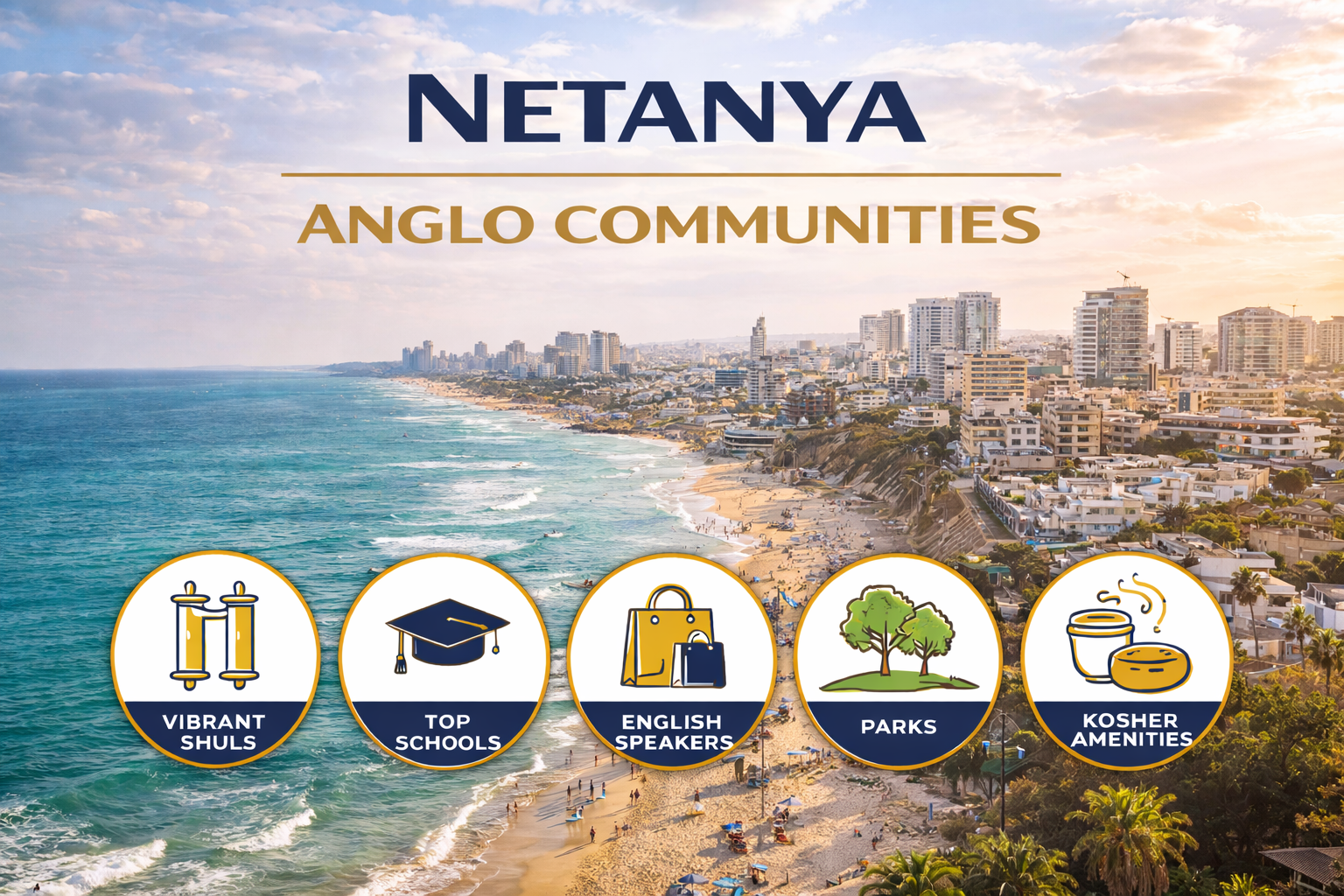
Netanya sits on the coast about 30 kilometers north of Tel Aviv, a mid-sized city known for its beaches, its large immigrant population, and a reputation that varies dramatically depending on who you ask. For Anglos considering it as a place to live, it offers a different proposition than the major Anglo centers, with both advantages and significant considerations.
The city has historically attracted immigrants from France and the former Soviet Union in large numbers, giving it a distinctly international character. French is widely spoken in certain neighborhoods, and Russian can be heard throughout the city. The Anglo community is present but smaller and less organized than in Ra'anana, which is just 15 minutes to the east, or in Modi'in or Jerusalem. Many Anglos who live in the Sharon region choose Ra'anana specifically for its Anglo infrastructure, so Netanya ends up with those who either couldn't afford Ra'anana, preferred the beach lifestyle, or had specific reasons for choosing the city.
The beach is Netanya's defining feature. The city sits on cliffs overlooking the Mediterranean, with a long promenade, multiple beach access points, and the kind of coastal lifestyle that's hard to find elsewhere in Israel at these price points. For people who prioritize being near the sea, who want to walk on the beach regularly, or who find the ocean calming and restorative, Netanya delivers something that Ra'anana and Modi'in simply cannot. The promenade is lively, especially in summer, with cafes, restaurants, and a sense of vacation that persists even for residents.
Housing costs are notably lower than Ra'anana, Tel Aviv, or Herzliya. Apartments near the beach that would be unaffordable in Tel Aviv are within reach for middle-class buyers in Netanya. Rentals similarly cost less, though prices have risen in recent years along with the rest of the country. The difference is enough that some families choose Netanya specifically to be able to buy a larger apartment, be near the beach, and still have money left over compared to what they'd spend in the center. Neighborhoods vary significantly in character and price, from the older, denser city center to newer developments in the south and east of the city.
The Anglo community, while smaller than Ra'anana's, does exist and has some organization. There are Facebook groups for Anglos in Netanya and the surrounding Sharon region where people connect, ask questions, and share information. Some Anglos in Netanya participate in Ra'anana's Anglo community for certain activities, since it's close enough to access easily. Synagogues in Netanya include some with English-speaking members, and there's an AACI (Association of Americans and Canadians in Israel) presence in the region that provides services and programming.
The religious landscape includes a range of options. There are Orthodox synagogues of various types, including some that have attracted Anglo members. The city has a Chabad presence that serves immigrants and provides English-accessible programming. There are also traditional and Masorti options. Finding a synagogue community that fits requires some exploration, and many Anglos visit several before settling on one. For those who are not religiously observant, Netanya is a largely secular city where that's completely normal.
For families with children, schooling follows the standard Israeli system. There are no international or bilingual schools in Netanya itself, so children attend Hebrew-language schools. The quality of schools varies by neighborhood, and Anglo parents typically research carefully and seek recommendations from other families. Some families prioritize certain religious or secular streams within the public system. Supplementing with English tutoring to maintain literacy is common among Anglo families throughout Israel, and Netanya is no different.
Employment is a consideration because Netanya's local job market is limited compared to the Tel Aviv metro. Many residents commute to Tel Aviv, Herzliya, or Ra'anana for work. The train connects Netanya to Tel Aviv, taking roughly 30 to 40 minutes, and many Anglos use this for daily commuting. The train station isn't centrally located, so getting to it adds time. Driving to Tel Aviv can take 30 minutes to an hour depending on traffic, which can be brutal during rush hours. For those working in high-tech, the Herzliya and Ra'anana tech hubs are accessible, and some people manage hybrid arrangements with partial work from home. Remote work has made Netanya more viable for people whose jobs would otherwise anchor them to Tel Aviv.
The city's reputation is mixed, and it's worth being honest about this. Parts of Netanya are lovely, well-maintained, and desirable. Other areas have struggled with crime, neglect, and a sense of decline. The city has had issues with property scams targeting foreign buyers, and there's a perception among some Israelis that Netanya hasn't kept pace with other coastal cities in terms of development and quality of life. This reputation isn't entirely fair, as the city has made improvements in recent years, but it does affect how some Israelis view it and can be relevant when considering resale value of property or overall trajectory of the city.
The French community has shaped certain aspects of life in Netanya. Some neighborhoods have a distinctly French character, with bakeries, cafes, and businesses catering to French speakers. This can be charming or disorienting depending on your perspective. For Anglos, it means that English isn't as widely useful as it might be in Ra'anana, where many service providers specifically cater to English speakers. Hebrew becomes more necessary for daily life, though French speakers sometimes find Netanya easier to navigate than Anglos do.
Healthcare is accessible with major Kupot Holim clinics in the city. Laniado Hospital in nearby Kiryat Sanz provides medical services, and the major hospitals in the Tel Aviv area are accessible for specialized care. Finding English-speaking doctors requires some effort and recommendations but is doable. The medical infrastructure is adequate, though not as extensive as in larger cities.
The social scene for Anglos is more dispersed than in dedicated Anglo communities. There are Anglo families throughout the city, but they're mixed in with the broader population rather than concentrated. Social connections happen through schools, synagogues, online groups, and chance encounters. Some Anglos find this isolating, especially if they don't speak Hebrew well and can't easily tap into the French or Russian communities either. Others appreciate the integration and find that it pushes them to build relationships across language groups.
Culturally, Netanya offers some entertainment and dining options but nothing like Tel Aviv's scene. The beachfront has restaurants and cafes, and there are malls and commercial areas for shopping. For more extensive cultural activities, concerts, or nightlife, residents typically head to Tel Aviv. This is manageable given the proximity but means that Netanya functions more as a residential base than a cultural destination.
The climate is Mediterranean, similar to Tel Aviv, with hot summers, mild winters, and humidity from the sea. The beach access and sea breezes make summer more bearable than inland cities. Some people find the coastal climate perfect, while others note that the humidity can be oppressive.
For Anglos specifically considering Netanya, the decision often comes down to priorities. If beach access and coastal lifestyle are paramount, and if budget constraints make Ra'anana difficult, Netanya offers something valuable. If Anglo community infrastructure, English-language services, and a critical mass of English speakers are priorities, Ra'anana is likely a better fit despite being more expensive. Some families choose Netanya initially for affordability and plan to move to Ra'anana later if finances allow, while others settle in Netanya and build satisfying lives there.
The neighborhoods matter significantly. The southern neighborhoods tend to be newer and more desirable, with modern buildings and better infrastructure. The areas near the beach vary from lovely to run-down depending on the exact location. The city center has older buildings and a more urban feel, with some areas undergoing renewal and others still struggling. Visiting different neighborhoods and spending time in the city before making decisions is strongly recommended.
Anglo families who've lived in Netanya successfully often mention the beach lifestyle as transformative, with regular walks along the water, children growing up with the sea as part of daily life, and a sense of vacation that doesn't fade. They also mention developing a core group of friends, often other immigrants from various countries, and building community across national lines rather than within an Anglo bubble. The challenges they mention include feeling disconnected from the Anglo centers, working harder to find English-speaking services, and navigating a city that doesn't specifically cater to them.
For people considering Netanya, connecting with current Anglo residents through Facebook groups before making any decisions is valuable. Visiting for an extended period, renting in different neighborhoods, and getting a real sense of daily life is essential. The city isn't for everyone, but for those whose priorities align with what it offers, it can provide a quality of life that's hard to achieve elsewhere in Israel on a middle-class budget.