
Why America Is No Longer Safe for Jews
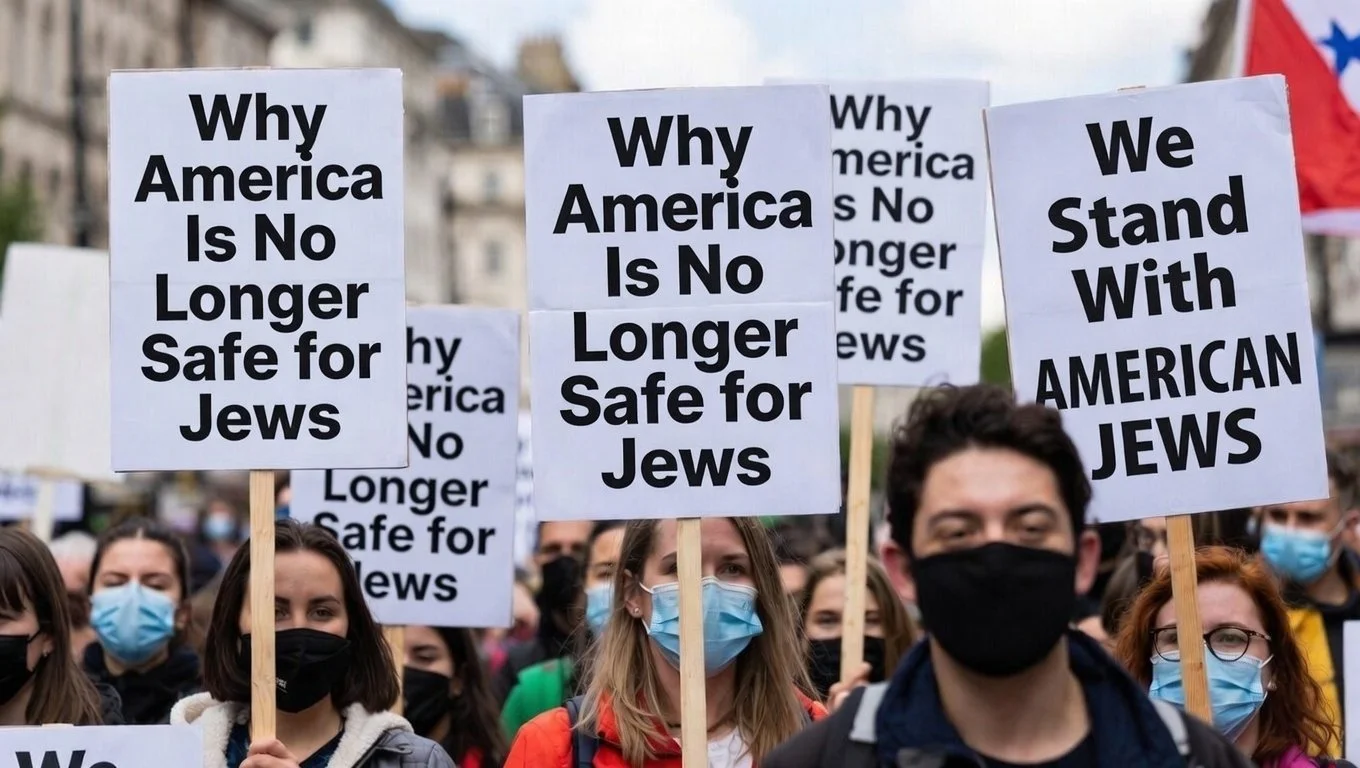
The land of the free is becoming a land of fear for its six million Jewish citizens
On the evening of May 21, 2025, a young couple walked out of the Capital Jewish Museum in Washington, D.C. They had just attended a reception for young diplomats — an event meant to build bridges between the Jewish community and the international corps. Yaron Lischinsky, 30, a German-Israeli researcher at the Israeli embassy, had bought a ring and planned to propose to Sarah Milgrim, 26, a Jewish-American from Kansas, the following week. Neither would live to see it. A gunman opened fire, shooting them repeatedly. When Milgrim tried to crawl away, the killer followed her and fired again. Then he walked into the museum and, while being restrained by security, chanted: "I did it. I did it for Gaza."
It was not an isolated event. It was the centrepiece of a year that would shatter any remaining illusion that America's Jews are safe.
The arithmetic of hatred in the United States is now so stark that it barely needs interpretation. The Anti-Defamation League recorded 9,354 antisemitic incidents in 2024 — the highest total in the 46 years it has tracked such data, and the fourth consecutive year that the record was broken. The tally works out to more than 25 incidents per day, more than one every hour, around the clock, in a country whose founding promise is the equal dignity of all persons. Assaults rose 21 per cent. Vandalism rose 20 per cent. The FBI's own hate crime statistics for 2024 confirmed the crisis: 1,938 anti-Jewish hate crimes out of 3,096 religiously motivated offences — meaning that Jews, who constitute roughly two per cent of the American population, were the targets of nearly two-thirds of all religious hate crimes.
And that was before 2025 turned deadly.
The year opened with a sense of dread and the dread was vindicated, attack by attack, in a sequence so relentless it began to feel like a siege.
In April, on the first night of Passover, Cody Balmer walked more than an hour to the official residence of Pennsylvania Governor Josh Shapiro — the most prominent Jewish elected official in the state, a man whose embrace of his faith was visible and unapologetic. Balmer carried beer bottles filled with gasoline and a hammer he intended to use on the governor's body. He firebombed the very room where, hours earlier, the Shapiro family had hosted their seder. The governor, his wife, and their guests were asleep upstairs. On a 911 call after the attack, Balmer declared he would not take part in what Shapiro "wants to do to the Palestinian people." He was later sentenced to 25 to 50 years in prison. The governor, who holds no foreign policy portfolio whatsoever, had been targeted because he is Jewish.
Then came the museum shooting in May. Then, on June 1, in Boulder, Colorado, Mohamed Sabry Soliman disguised himself as a gardener, filled a weed sprayer with gasoline, and approached a group of mostly elderly Americans participating in a weekly solidarity walk for the Israeli hostages held by Hamas. He threw Molotov cocktails into the crowd and unleashed a makeshift flamethrower. Witnesses described seeing human beings on fire, clothing singed from their bodies, skin that appeared to have melted. At least 15 people were injured, including a Holocaust survivor. Among them was Karen Diamond, 82, who died of her wounds 24 days later. As he burned them, Soliman screamed that he wanted to kill all Zionists.
Three major antisemitic attacks in the span of three months. Three dead. Dozens wounded. An elderly woman burned alive in the Colorado sunshine for the crime of carrying a sign reading "Let them go now."
The American Jewish Committee's 2025 report, released this month, measures the psychic toll. Ninety-one per cent of American Jews say that the violent attacks of 2025 made them feel less safe. Two-thirds report that Jews in the United States are less secure than the year before. Nearly one in three has personally been the target of antisemitism in the past twelve months, a figure that rises to an astonishing 47 per cent among those aged 18 to 29. More than half — 55 per cent — have changed their behaviour out of fear: avoiding certain places, concealing visible signs of their identity, censoring what they post online.
The numbers are damning enough in their aggregation. But they are most devastating in their granularity. They represent the Orthodox mother who tucks her Star of David inside her shirt before taking the subway. The college freshman who removes the mezuzah from his dorm room door. The family in Houston that no longer displays a menorah in the window. The synagogue that now conducts High Holiday services behind metal detectors and armed guards — not in a conflict zone, but in suburban New Jersey, in the Research Triangle, in the neighbourhoods of Los Angeles.
"No one in America should have to change their behaviour because of what they believe," said AJC's chief executive, Ted Deutch. "But that's how most Jews are living their lives."
American universities, once promised as arenas of intellectual freedom and civic formation, have become some of the most hostile environments for Jewish students in the country. The ADL recorded 1,694 antisemitic incidents on college campuses in 2024, an 84 per cent increase from the previous year and a larger share of total incidents than in any prior audit. For the first time, the majority of all recorded antisemitic incidents nationally — 58 per cent — contained elements related to Israel or Zionism, and a disproportionate number of these occurred at or near campus protests.
The distinction between political critique and ethnic targeting has collapsed. At Portland State University, Jewish students were heckled as "f---ing kikes." At the University of Pittsburgh, a student wearing a Star of David necklace was assaulted by a group who identified him as Jewish. At Suffolk University, protesters carried signs reading "Zionists not welcome here." Attacks on visibly Orthodox Jews surged 150 per cent.
One in four Jewish college students reports having been excluded from a group or event because of their identity. Seventy-eight per cent of Jewish students worldwide have hidden their religious identity, according to a 2024 ADL study. These are not numbers from a distant century. They describe the lived experience of young Americans in 2025, at institutions their parents are paying tens of thousands of dollars to attend.
It would be comforting to attribute the crisis to a single source — to locate the hatred in one ideological camp and direct the national energies accordingly. But American antisemitism refuses such tidiness. It is hydra-headed.
The far right remains, as federal authorities have repeatedly stated, the most lethal domestic terrorism threat. The Tree of Life synagogue massacre of 2018, which killed 11 worshippers in Pittsburgh, was carried out by a white supremacist. That attack remains the deadliest antisemitic incident in American history, but the far right's obsession with Jewish conspiracy theories — Great Replacement ideology, QAnon-adjacent fantasies of shadowy elites — continues to generate threats and violence.
Simultaneously, the far left has produced a strain of anti-Zionist politics that, in practice, has made Jewish life on campuses and in progressive spaces increasingly untenable. The slippage from criticising Israeli policy to holding individual American Jews collectively responsible for events in Gaza has become endemic. Slogans like "Globalize the Intifada" — which the AJC for the first time asked respondents about in 2025 — are experienced by most American Jews not as political speech but as a call for violence against their persons.
And then there is the Islamist extremist threat, which found its most lethal expression in 2025. The Capital Jewish Museum gunman, the Boulder firebomber, the Passover arsonist — all explicitly framed their violence in the language of Palestinian solidarity. Each attacked Jews who had no involvement in Israeli government policy. Each chose targets — a museum event for young professionals, a hostage awareness walk for senior citizens, a governor asleep after seder — that underscored the indiscriminate nature of the hatred.
To focus on one source while ignoring the others is not political courage. It is intellectual dishonesty. And it leaves Jews vulnerable on every flank.
Perhaps the most disturbing finding of the year came from an ADL survey conducted after the wave of violent attacks. Nearly one in four Americans — 24 per cent — said the attacks against Jews were "understandable." Not justified, necessarily, but comprehensible, explicable, within the realm of reason. This is the sound of a civilisation normalising violence against a minority. It is the murmur that precedes the roar.
Every democracy that has failed its Jews has done so not because it lacked laws or institutions but because it lacked the cultural will to enforce them. The laws existed in Weimar Germany. The institutions existed in pre-war France. What collapsed was the consensus that Jews were full members of the national community and that violence against them was intolerable. That consensus is now under severe strain in the United States.
Congress has appropriated $274.5 million for the Nonprofit Security Grant Program. Legislators in both parties have joined bipartisan antisemitism task forces. Federal prosecutors have pursued hate crime charges and, in the museum shooting case, terrorism-related counts that could carry the death penalty. These are not nothing. But they are reactive — the response of a system that catches some of the perpetrators after the blood has been spilled, rather than a society that prevents the conditions in which the blood is spilled in the first place.
The deepest failure is cultural, and it is this: America has not yet decided whether its Jews are truly its own.
For much of the twentieth century, the answer seemed to be a resounding yes. American Jews built institutions, enriched the arts, advanced the sciences, served in the military, shaped the law, won elections, and integrated themselves into the fabric of national life more thoroughly than in any diaspora community in history. America was, for many Jews, the golden land — the goldene medina — the place where the ancient cycle of persecution might finally end.
That hope is not dead. But it is wounded. It is wounded by the young couple shot dead on the steps of a museum in the capital of the free world. It is wounded by the grandmother set ablaze in a Colorado plaza for attending a vigil. It is wounded by the governor forced to flee his burning home on Passover night. It is wounded by the college student who removes his kippah before crossing the quad. It is wounded by the nine out of ten American Jews who now say, simply and plainly, that they feel less safe.
America faces a choice it has never had to make so starkly. It can continue to respond to each atrocity with moments of silence and interagency task forces, hoping the fever breaks on its own. Or it can recognise that what is happening to its Jews is not a series of isolated incidents but a pattern — a pattern sustained by ideologies of dehumanisation from multiple directions, amplified by social media, emboldened by institutional paralysis, and made lethal by the easy availability of weapons and the slow erosion of the norm that political violence is unacceptable.
The oldest hatred has found new hosts in the new world. Whether America has the moral clarity to defeat it — not merely to deplore it — will determine what kind of country it becomes. For six million American Jews, the question is no longer abstract. It is the question they ask themselves every morning when they decide whether to wear a Star of David to work, whether to post about Shabbat online, whether to walk their children to Hebrew school without looking over their shoulder.
No American should have to live this way. That so many do is not merely a Jewish crisis. It is an American one.