
The Complete Guide to Aliyah Eligibility: Understanding Israel's Law of Return
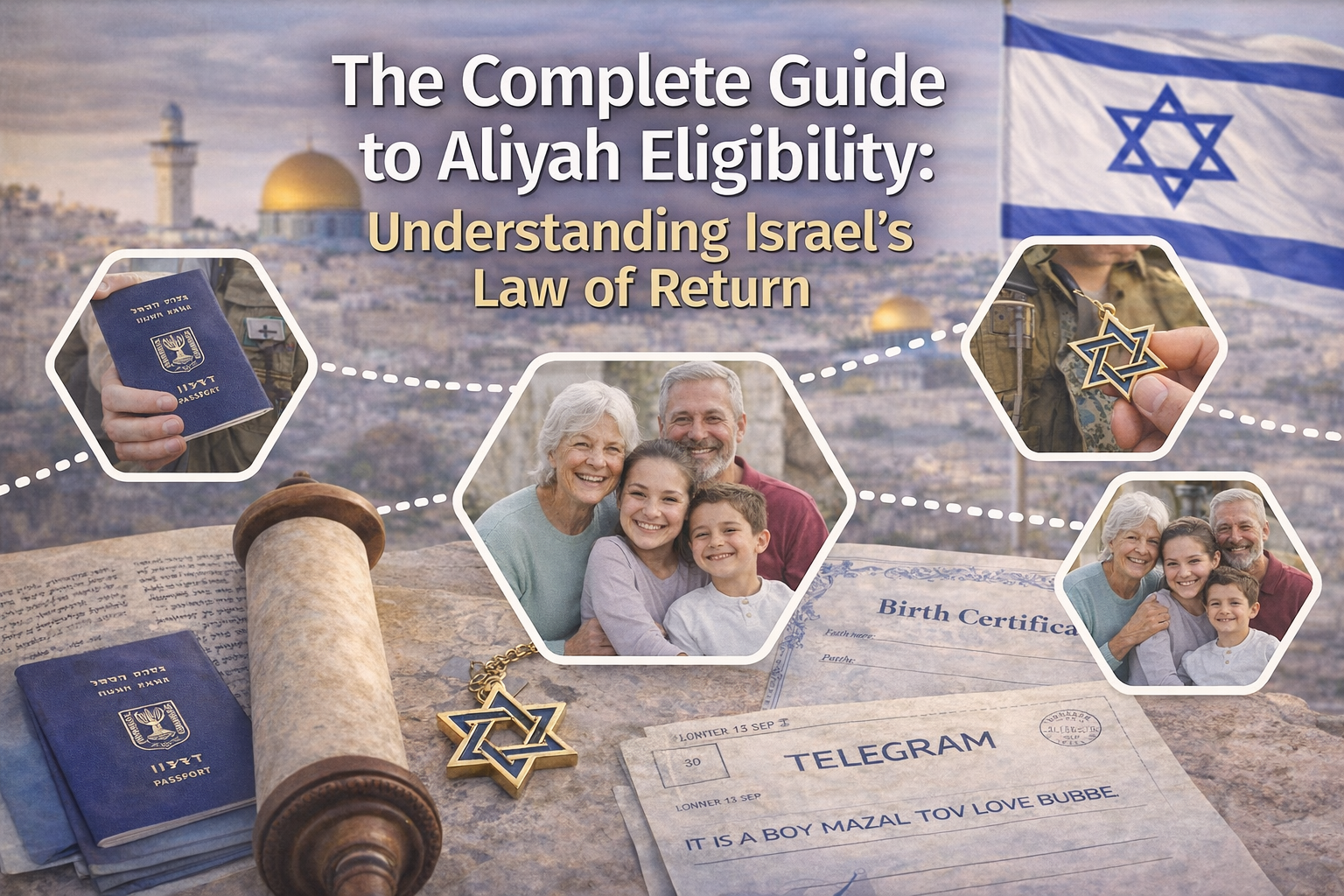
Table of Contents
Introduction
Historical Background
The Law of Return: Core Provisions
Who is Eligible for Aliyah
Documentation Requirements
The Aliyah Process: Step by Step
Special Cases and Exceptions
Rights and Benefits
Challenges and Potential Issues
Practical Considerations
Frequently Asked Questions
Resources and Contact Information
Introduction
The State of Israel's Law of Return stands as one of the most significant pieces of legislation in modern Jewish history. Enacted in 1950, just two years after Israel's establishment, this law grants Jews worldwide the fundamental right to immigrate to Israel and obtain citizenship. Understanding Aliyah eligibility under this law is crucial for anyone considering making Israel their home.
This comprehensive guide examines every aspect of the Law of Return, from its historical foundations to practical application in today's world. Whether you're exploring your own eligibility, helping family members understand their options, or simply seeking to understand this cornerstone of Israeli law, this guide provides the detailed information you need.
The term "Aliyah" itself means "ascent" in Hebrew, reflecting the spiritual and physical journey of moving to the Land of Israel. For many, it represents not just immigration, but a return to ancestral roots and participation in the ongoing story of the Jewish people.
Historical Background
Pre-State Foundations
The concept underlying the Law of Return predates the State of Israel itself. The Zionist movement of the late 19th and early 20th centuries was built on the principle that Jews had an inherent right to return to their ancestral homeland. This vision was articulated in various forms, from Theodor Herzl's writings to the Balfour Declaration of 1917.
During the British Mandate period (1920-1948), Jewish immigration was often restricted through quotas and regulations, leading to significant tension and the development of both legal and illegal immigration networks. The Holocaust and its aftermath made the need for a Jewish refuge even more urgent and morally compelling.
Legislative History
The Law of Return was among the first major pieces of legislation passed by the new Israeli Knesset. David Ben-Gurion, Israel's first Prime Minister, considered it fundamental to the state's mission. The law was passed on July 5, 1950, with broad consensus across the political spectrum.
The original law was brief and declarative: "Every Jew has the right to come to this country as an oleh." However, over the decades, amendments and interpretations have refined and expanded its scope, particularly regarding the definition of "Jew" and the inclusion of family members.
Major Amendments
1970 Amendment: Perhaps the most significant change came in 1970, when the law was amended to include not only Jews but also their children, grandchildren, and spouses. This amendment recognized the reality of intermarriage and sought to prevent the separation of families.
Grandchild Clause: The inclusion of grandchildren was particularly significant, as it extended eligibility to individuals who might have only one Jewish grandparent but were still considered at risk due to their Jewish ancestry.
The Law of Return: Core Provisions
Basic Right
The fundamental principle of the Law of Return is elegantly simple: every Jew has the right to immigrate to Israel. This right is considered inherent and not subject to the discretionary decisions of immigration officials, unlike typical immigration laws worldwide.
Automatic Citizenship
Upon arrival, Jewish immigrants can immediately claim Israeli citizenship through the Law of Return, rather than going through a lengthy naturalization process. This automatic citizenship right is unique in international law and reflects Israel's character as the Jewish homeland.
Legal Text
The current version of the Law of Return, as amended, states:
Section 1: "Every Jew has the right to come to this country as an oleh."
Section 4A: "The rights of a Jew under this Law and the rights of an oleh under the Nationality Law, 5712-1952, as well as the rights of an oleh under any other enactment, are also vested in a child and a grandchild of a Jew, the spouse of a Jew, the spouse of a child of a Jew and the spouse of a grandchild of a Jew, except for a person who has been a Jew and has voluntarily changed his religion."
Exclusions
The law includes specific exclusions. A person is not entitled to immigrate under the Law of Return if they:
Engage in activity directed against the Jewish people
Are likely to endanger public health or security
Have a criminal past that might threaten public welfare
Who is Eligible for Aliyah
Primary Eligibility: Jewish Identity
The cornerstone of eligibility remains Jewish identity. The law defines a Jew as "a person who was born of a Jewish mother or has become converted to Judaism and who is not a member of another religion."
Matrilineal Descent: Traditional Jewish law (halakha) recognizes Jewish identity through the maternal line. A person born to a Jewish mother is considered Jewish regardless of the father's religion or ethnicity.
Conversion: Individuals who have converted to Judaism are eligible, provided their conversion is recognized. The question of which conversions are accepted has been a source of ongoing debate, with Orthodox, Conservative, and Reform conversions having different levels of recognition in various contexts.
Religious Practice: Importantly, the law does not require active religious practice. Secular Jews, cultural Jews, and even those who have distanced themselves from Jewish community life retain their eligibility.
Extended Eligibility: Family Members
The 1970 amendment significantly expanded eligibility beyond Jews themselves:
Children of Jews: Both biological and adopted children of Jewish parents are eligible, regardless of their own religious status.
Grandchildren of Jews: Individuals with at least one Jewish grandparent qualify for Aliyah. This provision has been particularly relevant for immigrants from the former Soviet Union.
Spouses: The Jewish spouse's husband or wife is eligible, even if they are not Jewish themselves.
Children's Spouses: The spouse of a child of a Jew is also eligible.
Grandchildren's Spouses: The spouse of a grandchild of a Jew qualifies for immigration.
The "Except" Clause
A crucial limitation exists: these extended rights do not apply to "a person who has been a Jew and has voluntarily changed his religion." This clause primarily affects Jews who have converted to another religion, though its interpretation and application can be complex.
Voluntary vs. Involuntary: The emphasis on "voluntary" conversion is significant. Forced conversions, particularly those that occurred during periods of persecution, may not disqualify someone from eligibility.
Children of Converts: The status of children born to Jews who converted to other religions can be complicated and often requires individual case review.
Documentation Requirements
Proving Jewish Identity
Establishing eligibility requires comprehensive documentation, and the requirements can vary depending on your specific circumstances and country of origin.
Primary Documents for Jewish Identity:
Birth certificates showing Jewish parentage
Parents' or grandparents' birth certificates
Jewish marriage certificates (ketubah)
Records from Jewish community organizations
Synagogue membership records
Holocaust survivor documentation
Jewish cemetery burial records
Conversion Documentation:
Certificate of conversion from a recognized rabbi
Supporting documentation from the converting rabbi
Community witnesses to the conversion process
In some cases, additional verification may be required
Family Relationship Documentation
For family members of Jews, establishing the family connection is crucial:
Marriage Certificates: Required for spouses, showing marriage to an eligible Jew or their descendant.
Birth Certificates: Necessary to establish parent-child relationships.
Adoption Papers: For adopted children of Jews.
Death Certificates: Sometimes required to establish relationships when parents or grandparents are deceased.
Additional Requirements
Passport: A valid passport with at least six months remaining validity.
Criminal Background Check: Required from all countries where you've lived for more than six months since age 16.
Medical Examination: Conducted by approved physicians to ensure you don't pose a public health risk.
Military Service Records: If applicable, documentation of military service in your country of origin.
Country-Specific Considerations
Different countries present unique documentation challenges:
Former Soviet Union: Often requires extensive genealogical research due to destroyed records and Soviet-era documentation issues.
Western Countries: Generally have better-preserved records, but may require notarization and translation.
Developing Nations: May require additional verification due to questions about document authenticity.
The Aliyah Process: Step by Step
Phase 1: Initial Assessment and Preparation
Self-Assessment: Begin by honestly evaluating your eligibility based on the criteria outlined in this guide. Consider consulting with Jewish genealogy experts if your family history is unclear.
Document Gathering: Start collecting required documentation early, as this process can take months or even years, particularly for complex family situations.
Language Preparation: While not required, beginning Hebrew study can significantly ease your transition.
Phase 2: Contacting Authorities
Jewish Agency: The Jewish Agency for Israel handles most Aliyah cases worldwide. Contact your local office to begin the formal process.
Israeli Consulate: In some countries, you may work directly with the Israeli consulate rather than the Jewish Agency.
Nefesh B'Nefesh: For immigrants from North America and the United Kingdom, this organization provides additional support and streamlined services.
Phase 3: Application Submission
Formal Application: Submit your completed application with all required documentation.
Interview Process: Most applicants undergo an interview to verify their eligibility and assess their commitment to Aliyah.
Background Checks: Israeli authorities conduct security and criminal background investigations.
Phase 4: Approval and Visa Issuance
Approval Notification: Once approved, you'll receive formal notification of your eligibility.
Aliyah Visa: You'll be issued an Aliyah visa, which allows you to enter Israel as an immigrant rather than a tourist.
Pre-Arrival Services: Many organizations offer job placement assistance, housing help, and other pre-arrival services.
Phase 5: Arrival and Integration
Airport Reception: New immigrants are welcomed at Ben Gurion Airport with special processing.
Immediate Citizenship: You can claim Israeli citizenship immediately upon arrival.
Identity Documents: Receive your Israeli identity card and temporary passport.
Government Benefits: Access various integration benefits and services.
Timeline Expectations
The entire process typically takes 6-18 months, depending on:
Complexity of your case
Quality of documentation
Country of origin
Current processing volumes
Need for additional verification
Special Cases and Exceptions
Complex Family Situations
Intermarriage Scenarios: When Jewish and non-Jewish family members are involved, each case requires individual assessment to determine who qualifies.
Adoption Cases: Both Jewish parents adopting non-Jewish children and non-Jewish parents adopting Jewish children create unique eligibility questions.
Divorce and Remarriage: Complex family structures resulting from divorce and remarriage may require detailed legal analysis.
Conversion Issues
Denominational Differences: While Israeli law recognizes conversions performed by Orthodox, Conservative, and Reform rabbis abroad, questions sometimes arise about specific conversions.
Conversion Abroad vs. In Israel: Conversions performed outside Israel are generally more readily accepted than those performed within Israel, where Orthodox requirements are strictly enforced.
Military Service Implications: Converted Jews may face different military service requirements than those born Jewish.
Religious Conversion Away from Judaism
Christianity: Jews who have converted to Christianity face automatic disqualification, though their non-converted family members may still be eligible.
Islam: Similar restrictions apply to conversion to Islam.
Other Religions: Any formal conversion away from Judaism typically disqualifies the convert but not necessarily their family members.
Return to Judaism: Those who converted away but later returned to Judaism may regain eligibility, though each case requires individual review.
Holocaust Survivors and Their Descendants
Special Considerations: Holocaust survivor documentation often receives special handling due to the destruction of records.
Hidden Identity: Some Holocaust survivors or their children concealed their Jewish identity for safety, creating documentation challenges.
Righteous Gentiles: While Righteous Gentiles (non-Jews who saved Jewish lives) are honored by Israel, this status doesn't grant Aliyah eligibility unless they meet other criteria.
Former Israeli Citizens
Expatriates: Former Israeli citizens who emigrated retain the right to return, though they may face military service obligations.
Dual Citizenship: Israel recognizes dual citizenship, so former citizens don't lose eligibility by acquiring other citizenships.
Rights and Benefits
Immediate Rights Upon Arrival
Israeli Citizenship: Automatic citizenship upon request, including the right to vote and hold public office.
Passport: Immediate eligibility for an Israeli passport, providing visa-free travel to numerous countries.
Work Rights: Unrestricted right to work in any field (subject to professional licensing requirements).
Healthcare: Immediate access to Israel's universal healthcare system.
Education: Access to public education for children and subsidized higher education.
Financial Benefits
Absorption Basket (Sal Klita): A financial grant to help with initial settlement costs, paid over the first year.
Rent Assistance: Subsidized housing or rental assistance for the first few years.
Hebrew Education: Free intensive Hebrew language courses (Ulpan).
Job Training: Vocational training programs and job placement assistance.
Tax Benefits: Reduced tax rates for new immigrants for up to 10 years.
Long-Term Benefits
Military Service: While required for most new immigrants under 26, military service provides significant benefits including professional training and social integration.
University Access: Reduced tuition rates and special programs for new immigrants.
Mortgage Assistance: Special loan programs for purchasing homes.
Business Development: Grants and loans for starting businesses.
Social Integration Support
Community Absorption: Programs to help integrate into Israeli society and find community connections.
Cultural Activities: Subsidized cultural events and activities designed for new immigrants.
Family Reunification: Assistance in bringing other eligible family members to Israel.
Challenges and Potential Issues
Documentation Difficulties
Lost Records: Family documents lost during wars, persecution, or natural disasters can make proving eligibility difficult.
Language Barriers: Documents in foreign languages require certified translation, which can be expensive and time-consuming.
Government Bureaucracy: Dealing with multiple government agencies and their requirements can be overwhelming.
Religious and Cultural Challenges
Secular vs. Religious Tension: Israel's complex relationship between secular and religious Judaism can be challenging for new immigrants to navigate.
Recognition of Conversions: Non-Orthodox conversions may face challenges in certain contexts, particularly regarding marriage and divorce.
Cultural Adjustment: Adapting to Israeli culture, which differs significantly from Diaspora Jewish communities, requires significant adjustment.
Economic Challenges
Professional Recognition: Foreign professional credentials may not be recognized, requiring additional training or certification.
Language Requirements: Many professional fields require Hebrew proficiency, which can take years to develop.
Cost of Living: Israel's high cost of living, particularly housing, can be shocking to new immigrants.
Military Service Obligations
Age Requirements: Most new immigrants under 26 are required to serve in the Israeli Defense Forces.
Exemptions: Limited exemptions exist for certain religious, medical, or family circumstances.
Impact on Career: Military service can delay career development and education goals.
Security Clearance Issues
Background Investigations: Extensive security background checks can delay or complicate the immigration process.
Previous Travel: Travel to certain countries may raise security concerns.
Political Activities: Past political activities, particularly those critical of Israel, may be scrutinized.
Practical Considerations
Timing Your Aliyah
Personal Readiness: Consider your emotional, financial, and professional readiness for such a major life change.
Family Considerations: Ensure all family members are committed to the move and understand the implications.
Career Timing: Plan your move around career considerations, including professional licensing and job market conditions in Israel.
Children's Education: Consider the impact on children's education and social development.
Financial Planning
Cost Estimates: Budget for both immigration costs and initial settlement expenses, which can be substantial.
Currency Exchange: Plan for currency exchange and international money transfers.
Retirement Planning: Understand how Aliyah affects pension rights and retirement planning.
Insurance: Ensure continuity of insurance coverage during the transition period.
Housing Decisions
Rental vs. Purchase: Understand the Israeli housing market and decide whether to rent or buy.
Location Selection: Research different cities and regions to find the best fit for your family's needs.
Temporary Housing: Plan for initial temporary housing while you search for permanent accommodation.
Employment Preparation
Professional Licensing: Research requirements for practicing your profession in Israel.
Hebrew Proficiency: Assess your Hebrew skills and plan for language improvement.
Networking: Build professional networks before arrival through Israeli professional associations.
Career Transition: Be prepared for potential career changes or starting over professionally.
Education Planning
School Systems: Understand Israel's education system and choose appropriate schools for your children.
Higher Education: Research Israeli universities and their requirements for foreign students.
Credential Recognition: Ensure your educational credentials will be recognized in Israel.
Frequently Asked Questions
Eligibility Questions
Q: I have one Jewish grandparent. Am I eligible for Aliyah? A: Yes, having one Jewish grandparent makes you eligible under the Law of Return, provided that grandparent's Jewish identity can be documented.
Q: I'm married to a Jew but am not Jewish myself. Can I make Aliyah? A: Yes, spouses of Jews are eligible for Aliyah under the 1970 amendment to the law.
Q: I converted to Judaism through a Reform rabbi. Will this be accepted? A: Reform conversions performed outside Israel are generally accepted for Aliyah purposes, though you may face issues with Orthodox authorities regarding marriage and other religious matters within Israel.
Q: I was adopted by Jewish parents. Am I eligible? A: Adopted children of Jews are eligible for Aliyah, provided proper adoption documentation is available.
Q: My Jewish ancestor converted to Christianity. Does this affect my eligibility? A: If you are descended from someone who voluntarily converted away from Judaism, you may not be eligible. However, each case is evaluated individually, and forced conversions are treated differently.
Process Questions
Q: How long does the Aliyah process take? A: Typically 6-18 months, depending on the complexity of your case and the quality of your documentation.
Q: Can I visit Israel while my Aliyah application is being processed? A: Yes, you can visit Israel as a tourist while your application is pending.
Q: Do I need to speak Hebrew to make Aliyah? A: No, Hebrew proficiency is not required for Aliyah, though it significantly helps with integration.
Q: Can I maintain my current citizenship after making Aliyah? A: Israel allows dual citizenship, so you typically don't need to renounce your current citizenship.
Benefits Questions
Q: Will I receive financial assistance after making Aliyah? A: Yes, new immigrants receive various financial benefits including the absorption basket, rent assistance, and tax benefits.
Q: Am I immediately eligible for Israeli healthcare? A: Yes, new immigrants are immediately eligible for Israel's universal healthcare system.
Q: Do I have to serve in the military? A: Most new immigrants under 26 are required to serve, though exemptions exist for certain circumstances.
Family Questions
Q: Can I bring my elderly parents who aren't eligible themselves? A: Elderly parents of Israeli citizens may be eligible for temporary or permanent residence, though not citizenship through the Law of Return.
Q: What if my spouse doesn't want to make Aliyah? A: This is a common challenge. Family counseling and gradual transition planning may help, but ultimately both spouses need to be committed for successful Aliyah.
Q: Can my non-Jewish children from a previous marriage make Aliyah with me? A: Minor children typically can accompany their parent making Aliyah, even if they're not independently eligible.
Resources and Contact Information
Government Agencies
Ministry of Aliyah and Integration Website: gov.il/en/departments/ministry_of_aliyah_and_integration Services: Official government information and services for new immigrants
Population and Immigration Authority Website: gov.il/en/departments/population_and_immigration_authority Services: Immigration status, citizenship, and documentation
Major Organizations
The Jewish Agency for Israel Global headquarters and local offices worldwide Website: jewishagency.org Services: Aliyah processing, pre-immigration counseling, integration support
Nefesh B'Nefesh (North America and UK) Website: nbn.org.il Services: Streamlined Aliyah process, job placement, community integration
Keren Klita (Absorption Centers) Services: Temporary housing and integration programs for new immigrants
Educational Resources
Ulpan Programs Hebrew language learning programs available both in Israel and abroad
Pre-Aliyah Programs
Masa Israel Journey programs
Birthright Israel follow-up programs
Professional development programs
Legal and Professional Services
Immigration Lawyers Specializing in complex Aliyah cases and appeals
Genealogy Services Professional researchers specializing in Jewish family history
Professional Licensing Bodies For doctors, lawyers, engineers, and other licensed professionals
Online Communities and Support
Aliyah Facebook Groups Country-specific groups for sharing experiences and advice
Professional Networks LinkedIn groups for professionals making Aliyah
Religious Communities Orthodox, Conservative, and Reform communities offering support
Financial Services
Israeli Banks Most major Israeli banks have dedicated immigrant services
Currency Exchange Services Specialized services for large international transfers
Insurance Companies Offering coverage during transition and beyond
Conclusion
The Law of Return represents more than immigration legislation; it embodies the fulfillment of a dream spanning millennia. For those eligible, it offers the opportunity to participate in one of history's most remarkable national revivals while building a future in the ancestral Jewish homeland.
Making Aliyah is among life's most significant decisions, requiring careful consideration of personal, professional, and family factors. This guide has provided comprehensive information about eligibility, processes, and practical considerations, but each individual's situation is unique.
The journey from decision to integration can be challenging, but Israel's support systems, combined with the resilience and adaptability that characterize the Jewish experience, help most new immigrants successfully build new lives. Whether motivated by religious conviction, Zionist ideology, family connections, or simply the desire for new opportunities, those who make Aliyah join the ongoing story of the Jewish people in their homeland.
For those still considering whether Aliyah is right for them, remember that eligibility under the Law of Return doesn't expire. You can take time to plan, prepare, and ensure you're making the best decision for yourself and your family. The door to Israel remains open, representing not just a legal right, but a standing invitation to come home.
This guide serves as an educational resource and should not replace professional legal advice. Immigration law can be complex, and individual circumstances vary significantly. Always consult with qualified professionals when making decisions about Aliyah.
Document Version: 2025 Edition
Last Updated: January 2026
Word Count: Approximately 6,500 words
For the most current information, always consult official Israeli government sources and authorized immigration professionals.