
Israel War: Effect on Immigration in 2026 — Comprehensive Analysis
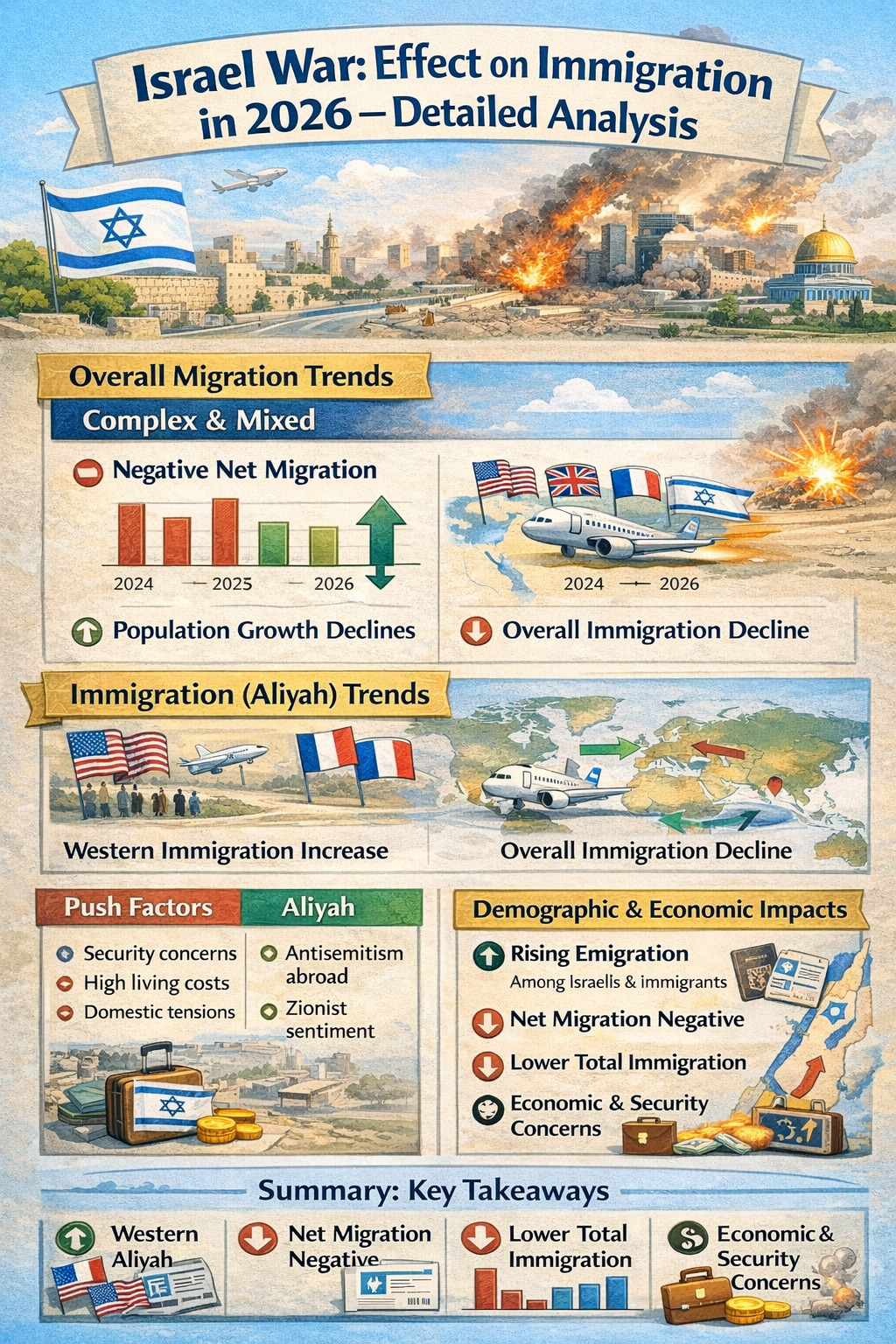
The year 2025 marked a historic turning point in Israel's demographic trajectory. The ongoing Gaza conflict that began after the October 7, 2023 Hamas attacks, combined with the 12-day war with Iran in June 2025, fundamentally reshaped migration patterns. For the second consecutive year, more people left Israel than arrived, producing a negative net migration balance unprecedented in the country's modern history. While immigration from Western countries surged due to rising global antisemitism, this was overwhelmed by a massive wave of emigration, particularly among educated professionals and native-born Israelis.
Part I: Immigration to Israel (Aliyah) in 2025
Overall Numbers
Total new immigrants in 2025 reached approximately 21,900 to 24,600 (figures vary slightly between the Immigration Ministry and Central Bureau of Statistics). This represents a decline of roughly one-third compared to 2024, when approximately 32,000 new immigrants arrived. The drop is even more stark when compared to 2022, when over 74,000 immigrants arrived—a two-decade high driven by the Russia-Ukraine war.
Immigration by Country of Origin
Russia: Russia remained the largest source country, as it has been every year since the 1990s, but numbers collapsed dramatically. Approximately 8,300 Russians immigrated in 2025, representing a 57% decline from the 19,500 who came in 2024. This is a fraction of the 43,500 who arrived in 2022 following Russia's invasion of Ukraine. The decline in Russian immigration accounts for most of the overall drop in aliyah numbers. Many Russian immigrants who arrived in 2022-2023 have since left Israel, contributing to the negative migration balance.
United States: American immigration showed modest growth, with approximately 3,500 arrivals—a 5% increase from 2024 and a 30% increase from 2023. Nefesh B'Nefesh, which facilitates North American immigration, reported that 4,150 Jews from the United States and Canada made aliyah in 2025, the highest annual figure in four years and a 12% increase from 2024. More than half of North American applicants cited solidarity with Israel following the outbreak of war as a primary motivation. Between 2022 and 2025, the number of aliyah applications from North Americans rose approximately 50%, from 8,943 to 13,389. Most American immigrants came from New York, New Jersey, California, Maryland, Florida, and Illinois.
France: French immigration surged by approximately 45% to 3,300 arrivals, compared to 2,200 in 2024. France has Europe's largest Jewish community, with roots stretching back to Roman times. Surveys indicate that 38% of French Jews—representing nearly 200,000 individuals—are actively considering aliyah. Antisemitic incidents in France soared by 1,100% following the October 7 attacks. Immigration fairs attracted over 13,000 participants in France alone. French olim are described as possessing strong professional skills, democratic social orientation, and deep attachment to Jewish identity, making them particularly valuable immigrants.
United Kingdom: British immigration rose 19% to approximately 840 arrivals, reflecting an ongoing upward trend. The Yom Kippur attack on a Manchester synagogue in 2025 intensified concerns about Jewish safety in the UK. Large increases in immigration file openings were noted in the UK throughout the year.
Other Western Countries:
Germany: 204 arrivals (up 19%)
Canada: 388 arrivals (up 5%)
Australia: Significant increase in immigration file openings, particularly following the December 2025 Hanukkah massacre in Sydney
South Africa: Continued steady immigration
Total Western Immigration: Immigration from Western countries more than doubled, jumping to 9,256 in the first 11 months of 2025 from 4,570 in the corresponding period of 2024. Non-Russian immigration reached approximately 13,600, a 23.6% increase from about 11,000 in 2024 and an 81% increase from 7,500 in 2023.
Ukraine: Ukrainian immigration dropped by 14% to approximately 805 arrivals, continuing a decline as the initial surge following the 2022 Russian invasion subsided.
Other Sources: Approximately 1,200 members of India's Bnei Menashe community are expected to immigrate in 2026. Immigration fairs were held in the US, Australia, UK, Ukraine, Georgia, Argentina, Mexico, and South Africa, with over 20,000 participants worldwide. About 30,000 Jews globally opened immigration files in 2025.
Demographic Profile of New Immigrants
About one-third of all new immigrants were aged 18-35, highlighting a continued trend of younger Jews making aliyah. Among North American arrivals specifically:
297 families
946 children
1,476 single adults
548 retirees
Average age: 31 years
Youngest immigrant: 4 months old
Oldest immigrant: 96 years old
Professional Immigration: Ninety-three physicians from North America immigrated through the International Medical Aliyah program, part of a total of 541 physicians from around the world who immigrated through this program in 2025.
Settlement Patterns: Through the "Go Beyond" program, 1,505 North American olim settled in the Negev, the Galilee, and Jerusalem—areas considered national priority zones.
Drivers of Western Immigration
Rising Global Antisemitism: Jewish communities worldwide, especially in Europe, faced a troubling surge in antisemitic incidents and anti-Israel sentiment following October 7, 2023. Incidents ranged from vandalism of murals and businesses to violent physical assaults. High-profile deadly attacks included the Yom Kippur attack on a Manchester synagogue and the December 2025 massacre at a Hanukkah event in Sydney, Australia.
Solidarity with Israel: More than half of North American applicants cited solidarity with Israel during wartime as their primary motivation. Many immigrants expressed a sense of mission rather than victimhood, viewing their move as participation in a national and historic endeavor.
Push Factors in Origin Countries: French Jews, particularly those who are less affluent, live in proximity to hostile populations and experience daily harassment. The far-right's electoral gains in Germany deepened anxieties among German Jews. Some religious leaders have declared that there is no future for Jews in certain European countries.
Part II: Emigration from Israel in 2025
Overall Numbers
More than 69,000 Israelis left the country in 2025, while only 19,000 returned. This produced a net emigration of approximately 50,000 Israeli citizens. Combined with immigration figures, the overall international migration balance was negative by approximately 20,000 people.
For context, the average number of long-term emigrants between 2009 and 2021 was approximately 40,500 per year. The current wave represents a dramatic acceleration:
2022: 59,400 departures
2023: 82,800 departures (all-time high)
2024: 82,700 departures
2025: 69,300 departures
Between early 2022 and mid-2024, Israel's net migration balance of citizens fell by 125,200 people—the country's largest-ever loss of human capital in such a short period.
Who is Leaving?
By Origin: Most emigrants are Israelis who were not born in Israel. A third are not considered Jewish according to halakha (Jewish religious law). The emigration rate among non-Jews is 8.1 times higher than that of Jewish Israelis. A substantial proportion of emigrants are people who came from Russia and Ukraine because of the war there and left shortly after arriving.
Native-Born Israelis: The concerning trend is the sharp rise in emigration among those born in Israel. While less than 20,000 native Israelis left in 2022, the numbers rose to approximately 30,000 in 2025. This represents a long-term challenge that cannot be dismissed as temporary.
By Age: The largest share comes from the 25-59 age group (the core workforce), followed by young adults. This demographic concentration raises particular concerns about economic and social sustainability.
By Religiosity: Among those considering emigration:
Non-religious: 39%
Traditional but non-religious: 24%
Traditional religious: 19%
Orthodox: 14%
Ultra-Orthodox: 4%
The less individuals identified as religious, the more likely they were to consider emigration.
By Political Orientation: Respondents identifying as left-wing were more likely to consider leaving than those on the right. This demographic is politically isolated in a country governed by a right-wing coalition.
By Income and Passport Status: Among younger secular Jewish Israelis, 60% said they would consider leaving. Among those with high income and a foreign passport, the figure jumped to 80%. Higher education correlated with greater likelihood of considering emigration.
Destination Countries
Traditional destinations such as the United States, Australia, and the United Kingdom are seeing relatively fewer Israeli emigrants. More Israelis are choosing Germany, Cyprus, and countries in East Asia. This shift suggests changing motivations—primarily a search for lifestyle change rather than purely economic considerations.
Reasons for Leaving
Security Concerns: The war that erupted following the Hamas massacre on October 7, 2023, has been the primary driver. The 12-day war with Iran in June 2025 added another layer of security anxiety, with missiles hitting civilian population centers and displacing over 13,000 Israelis.
Political Discontent: Disillusionment with the government's judicial overhaul plans has been cited as a major factor. Critics say these policies undermine democracy. The political unrest culminated in mass protests in 2023 and continued through 2025.
Cost of Living: Israel has one of the highest costs of living among developed countries. Survey respondents consistently cited this as a top consideration.
Future Concerns: "The lack of a good future for my children" emerged as one of the most common reasons cited by those considering departure.
Public Services: Concerns about the quality of public services, education, and healthcare contributed to emigration decisions.
International Standing: Israel's deteriorating international reputation and the controversies surrounding the Gaza war weighed on some emigrants' decisions.
Democratic Concerns: Worries about the state of democracy, free speech, and Israel's identity as a Jewish democratic state featured in emigration considerations.
Intent to Emigrate
A landmark survey by the Israel Democracy Institute in April 2025 found that 27% of Israelis are considering moving out of the country. Notably, the majority of those considering emigration believe that mass emigration would be dangerous for the state's future, yet they are still contemplating leaving.
A larger percentage of Arab Israelis (30%) are considering leaving than Jewish Israelis (26%). Of those considering departure, 69% of Jews and 62.5% of Arabs said they had no specific pull abroad—it was simply a matter of getting out.
The European Union emerged as the most popular destination among those thinking of leaving (43%), higher than North America or Canada (27%).
The biggest consideration for staying in Israel for both Jewish and Arab Israelis was the desire to remain close to family. Both groups were far more likely to say they might leave if relatives had already left in recent years, suggesting potential cascade effects.
Part III: Brain Drain and Economic Impact
Educational Profile of Emigrants
About 12% of those who attained PhDs in Israel over a 28-year period (1990-2018) were living abroad for at least three years as of 2024. Among those with mathematics doctorates, 25% have left the country. Overall, 6.2% of all graduates of Israeli universities and colleges lived abroad at the end of 2024.
A comprehensive study by Tel Aviv University found that approximately 90,000 Israelis left between January 2023 and September 2024, including:
Hundreds of PhDs
Hundreds of medical doctors
Thousands of engineers
High-Tech Sector Impact
From October 7, 2023 through July 2024, approximately 8,300 high-tech employees departed Israel for long-term relocation, representing about 2.1% of the local high-tech workforce. In the immediate aftermath of October 7, monthly departures doubled to 1,207 before moderating to an average of 826 per month during the first half of 2024. Even before October 7, departures had increased to 571 high-tech employees per month, up from an average of less than 500 per month in May-December 2022.
Fiscal Impact
The outflow of Israeli citizens led to an estimated loss of NIS 1.5 billion ($461 million) in income taxes for the government, not including VAT or corporate taxes. Requests to terminate residency with the National Insurance Institute more than tripled from an average of 2,500 before 2021 to 8,400 in 2024.
Expert Warnings
Nobel laureate Aaron Ciechanover warned of an "existential threat" posed by the brain drain. Economists predict that a continued departure could ignite a negative cycle, risking turning Israel into countries that have suffered from brain drain such as Lebanon, Venezuela, South Africa, or Argentina.
One Knesset member called the trend "not a wave of emigration" but "a tsunami of Israelis choosing to leave the country." Without a change in leadership and policies, experts warn of a much larger spike in emigration that could pose a strategic threat to Israel's developed and prosperous economy.
Part IV: Population and Demographic Impact
Overall Population
Israel's total population reached 10.178 million by the end of 2025, an increase of approximately 112,000 from the previous year. The population composition includes:
Jews and others (including non-Arab Christians): 7.771 million (76.3%)
Arabs: 2.147 million (21.1%)
Foreign residents: 260,000 (2.6%)
Growth Rate
The population grew by only 1.1% in 2025, matching 2024's rate. The Taub Center for Social Policy Studies estimated the growth rate may have been as low as 0.9%, which would mark the first time in Israel's history that annual growth fell below 1%.
For historical context, Israel's growth rate has remained well above 1.5% for most of its history, dipping below that level only briefly in the early 1980s (1.42% in 1981 and 1.35% in 1983). The current rate represents a dramatic departure from historical norms.
Natural Increase
Between 2016 and 2025, Israel's annual natural increase rate fell from 1.6% to 1.3%. The decline is particularly sharp among the Arab population, where the rate dropped from 2.1% to 1.6%. This is attributed to stability in birth numbers alongside a 43% increase in deaths, driven by rapid growth of the elderly population.
In 2025:
Births: approximately 182,000 (76% to Jewish mothers, 24% to Arab mothers)
Deaths: approximately 50,000 (slightly down from 52,000 in 2024)
Life expectancy in Israel stood at 83.7 years in 2023, surpassed by only Switzerland, Spain, and Japan among OECD countries.
Historic Significance
Israel has entered a new demographic phase marking a break from patterns that defined its development since 1948. Throughout most of the state's history, there have been more Jews moving to Israel than leaving, with exceptions only during certain periods in the 1950s and 1980s.
The current slowdown reflects the convergence of three structural forces: declining fertility, rising mortality, and negative net migration. Together, these signal the end of an era in which rapid natural increase served as Israel's primary demographic engine.
In the two decades before COVID-19, at least 80% of Israel's annual demographic growth stemmed from natural increase, with the remainder from net migration. Now the country must rely increasingly on immigration to maintain even modest growth rates.
Part V: Impact of the June 2025 Iran War
The Conflict
The 12-day war between Israel and Iran (June 13-24, 2025) began when Israel launched a surprise attack bombing military and nuclear facilities across Iran, including the main nuclear facility at Natanz. The Israeli Air Force used more than 200 fighter jets to drop more than 330 munitions on about 100 targets, assassinating prominent military leaders, nuclear scientists, and politicians.
Iran retaliated with over 550 ballistic missiles and over 1,000 suicide drones, targeting civilian population centers, one hospital, and at least twelve military, energy, and government sites in Israel. The United States joined on June 22, bombing three Iranian nuclear facilities. Iran responded by firing missiles at a US base in Qatar. A ceasefire was announced on June 24 under US pressure.
Casualties and Damage in Israel
In Israel, 24-32 people were killed and more than 3,000 wounded. At least 36 missiles penetrated Israeli air defenses and hit populated areas. Damage included:
2,305 homes in 240 buildings
Two universities
One hospital
Over 13,000 Israelis displaced
Property damage claims totaling NIS 5 billion ($1.47 billion) were expected—approximately twice the total value of all damage claims since the October 7, 2023 war began.
Impact on New Immigrants
Among the 10,000 Israelis displaced by the Iran war, approximately 2,000 were new immigrants. Many buildings that suffered direct damage were in residential areas populated by new immigrants. The government extended visas for non-Israeli residents through September 30, 2025, and translated emergency warning messages into English, Arabic, and Russian.
Despite the conflict, immigration flights continued. Officials worked to reschedule immigration for those whose plans were postponed due to the war, emphasizing that Israel was doing everything possible to bring immigrants even during wartime.
Regional Migration Consequences
The war triggered significant regional displacement:
Thousands of Iranians fled Tehran and other cities under attack
Traffic jams formed on major roads out of Tehran
Fuel shortages hampered movement across Iran
More than 1.5 million Afghan refugees and migrants were expelled from Iran in 2025
Over 410,000 were pushed out since the June 24 ceasefire
Iran hosts approximately 3.5 million refugees, including 750,000 registered Afghans and over 2.6 million undocumented individuals
Iranian authorities blamed Afghans for alleged collaboration with Israel, using the war as justification for accelerated deportations. Some Afghans reported being beaten, having documents shredded, and being deported without their savings or belongings.
Part VI: Government Response
Ministry Efforts
The Immigration and Absorption Ministry has implemented several initiatives:
Held a drill testing readiness for massive emergency immigration
Organized immigration fairs attracting over 20,000 participants worldwide
Expanded tax exemptions for immigrants who own businesses
Offered personal assistance to potential immigrants throughout Europe
Coordinated with the Jewish Agency, which reported 30,000 people opening immigration files in 2025
Structural Limitations
The Immigration and Absorption Ministry acknowledged that it is "not a ministry for preventing emigration" and does not have a mandate to stop Israelis from leaving. Its focus is on immigrants and returning residents, not on retention of current citizens.
The Knesset's Immigration and Absorption Committee has called for:
A strategic plan to encourage Israeli citizens abroad to return
A mechanism to monitor academic staff who leave to work at foreign universities
Better information accessibility for immigrants in multiple languages
Policy Challenges
Experts emphasize that migration policy is becoming increasingly important for strengthening demographic growth. However, effective policy requires better data about the characteristics of both those leaving and those arriving. Currently, the government lacks comprehensive information about emigrant profiles, limiting its ability to address the trend.
The government has significant influence over migration through economic policies, cost of living measures, and political climate, but has "very little impact on mortality" and only moderate influence on fertility rates through subsidies and social policies.
Part VII: Future Outlook
Projected Trends
The negative migration balance is expected to continue. The Taub Center projects the gap between departures and arrivals to widen to approximately 37,000 people in 2026. Given the CBS methodology for calculating migration (counting emigrants only after a year abroad), negative figures are expected to persist into 2026 and possibly beyond.
Natural increase is projected to continue declining, reaching about 1% by 2040. Without significant immigration, Israel faces historically low population growth for the foreseeable future.
Immigration Potential
Despite challenging circumstances, significant immigration potential exists:
38% of French Jews (nearly 200,000 people) are considering aliyah
30,000 people worldwide opened immigration files in 2025
Rising antisemitism continues to push Jews toward Israel
The Immigration Ministry is preparing for potential emergency immigration waves
Challenges
Several factors could limit immigration potential:
Security concerns from ongoing regional conflicts
Cost of living in Israel significantly higher than origin countries
Economic hardship for less affluent immigrants, particularly from France
Competition with Western countries offering superior social benefits
Political instability and concerns about democratic institutions
Ongoing war and uncertainty about future conflicts
Expert Assessments
Demographers note that people will continue to come to Israel as long as it promises an attractive way of life, socially and economically. However, tensions from social divisions, a war carried disproportionately by a small educated and productive minority, and a cost of living far above the OECD average threaten this attractiveness.
The country faces an existential dilemma as its traditional growth engines—high fertility and strong immigration—cool simultaneously. An aging population, cultural shift toward smaller families, and prolonged geopolitical uncertainty combine to produce the slowest population growth in the country's history, signaling a fundamental transformation in Israel's demographic future.
Conclusion
The year 2025 represents a watershed moment in Israeli migration history. While Western immigration surged due to rising global antisemitism and solidarity with Israel during wartime, this was more than offset by unprecedented emigration driven by security concerns, political discontent, economic pressures, and quality-of-life considerations.
The departure of highly educated professionals—engineers, physicians, PhDs, and high-tech workers—poses particular risks to Israel's economic future and technological competitiveness. The concentration of emigration among younger, educated, secular, and politically liberal Israelis threatens to reshape the country's demographic and political landscape.
Israel now faces the challenge of reversing these trends while simultaneously absorbing new immigrants during ongoing conflict. Success will require addressing the underlying factors driving emigration: achieving security and stability, resolving political divisions, reducing the cost of living, and restoring confidence in democratic institutions. Without significant policy changes, demographers warn that the current migration patterns could fundamentally alter Israel's demographic trajectory and economic prospects for decades to come.