
From Diaspora to Home: The Case for Making Aliyah Now
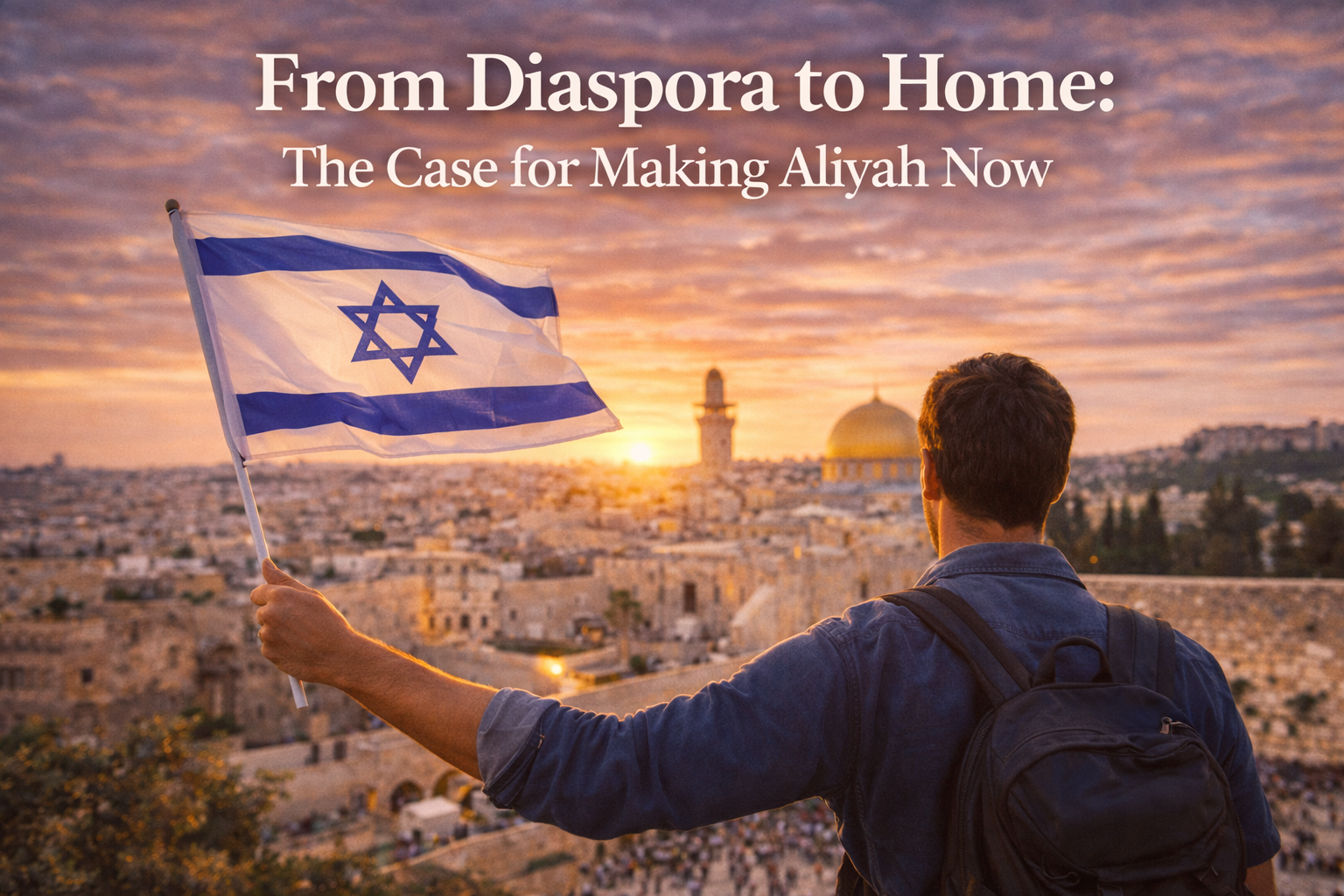
Why Living as a Minority No Longer Makes Sense for Jews Today
For two thousand years, Jews had no choice but to live as minorities in lands belonging to others. We adapted remarkably, contributing enormously to host societies while maintaining our distinct identity. We built communities, established institutions, and found ways to flourish even in challenging circumstances. But we always knew we were guests.
Today, that reality has fundamentally changed. For the first time in two millennia, Jews have a sovereign homeland where we are the majority, where our language is spoken, where our calendar is the national calendar. The question facing Diaspora Jews is no longer how to survive as a minority, but whether to continue living as one when an alternative exists.
The Diaspora Experience
Living as a Jew in the Diaspora requires constant navigation. You explain your holidays to employers. You negotiate time off for Shabbat. You watch your children face questions about why they're different. You calculate how visible to make your identity—the mezuzah on the door, the kippah in public, the Star of David around your neck.
None of this is necessarily traumatic, but it is constant. Even in the most welcoming societies, Jews remain a minority group requiring special accommodations. Our survival depends on the goodwill of the majority. History teaches us how quickly that goodwill can evaporate.
The Israeli Alternative
In Israel, Jewish life is simply life. Shabbat is the weekend. Holidays are national celebrations. Hebrew fills the air. Kosher food is everywhere. Your children's schools teach Jewish history as their history. The stress of explaining yourself, of standing out, of being other—it simply doesn't exist.
This isn't about Israel being perfect—no country is. It's about the fundamental difference between living as a minority and living as part of a majority in your own homeland. In Israel, you don't have to fight for Jewish continuity—it surrounds you. You don't have to artificially construct Jewish identity—it's simply absorbed.
Rising Antisemitism Demands Action
The recent years have witnessed alarming increases in antisemitism worldwide. Attacks on synagogues. Harassment of Jews on streets and campuses. Vandalism of Jewish institutions. Conspiracy theories spreading online. Political extremism incorporating anti-Jewish elements on both left and right.
Many Diaspora Jews respond by doubling down on integration, becoming less visibly Jewish, hoping the storm will pass. But hoping isn't a strategy. History shows that antisemitism doesn't simply disappear—it waxes and wanes, but it never vanishes entirely. Israel offers not just refuge but normalcy—a place where being Jewish isn't a vulnerability.
The Assimilation Challenge
Beyond external threats, Diaspora communities face internal challenges. Intermarriage rates climb higher with each generation. Jewish education struggles for resources and relevance. Young Jews drift away from community identification. The vibrancy that once characterized Jewish neighborhoods fades as populations disperse.
These aren't moral failings—they're natural results of minority status in open societies. When full participation in society requires no Jewish identification, maintaining that identification requires active effort against a strong current. In Israel, that current flows in the opposite direction. Remaining Jewish is effortless; becoming non-Jewish would require conscious decision.
Your Role in Jewish History
Jewish history is the story of a people who refused to disappear. Through exile, persecution, and dispersion, Jews maintained their identity and their hope for return. Previous generations couldn't act on that hope—the conditions didn't exist. Your generation can.
Making aliyah isn't abandoning Diaspora communities—they'll continue to exist and contribute. But it is choosing to participate in the most significant Jewish project of our era: building and strengthening the Jewish homeland. It is moving from being a supporter of Israel to being a builder of Israel, from being a visitor to being a citizen.
The Time Is Now
Every day you spend in the Diaspora is a choice—perhaps an unconscious one, but a choice nonetheless. It's a choice to remain a minority, to continue navigating between identities, to expose yourself and your family to the uncertainties of minority existence.
You have another option. You can come home. You can live in a country that's yours by right and by history. You can raise children who never have to explain who they are. You can participate fully in Jewish life without compromise or navigation.
The case for aliyah has never been stronger. The path has never been smoother. The only question is whether you're ready to move from Diaspora to home.