
Ramat Beit Shemesh Property Market Report Q3 2025
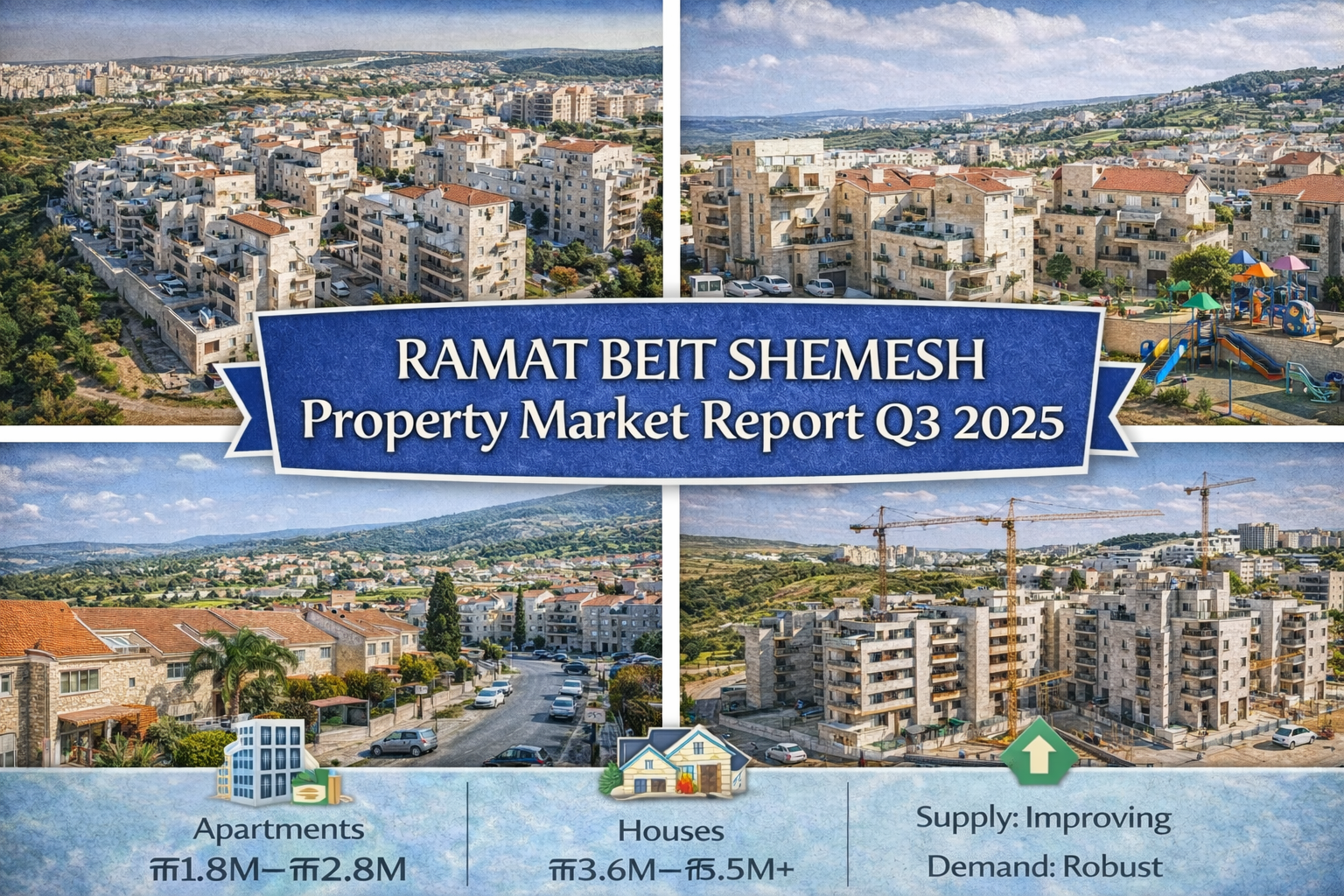
Ramat Beit Shemesh stands as Israel's fastest-growing city, a remarkable urban phenomenon experiencing approximately five percent annual population growth and demonstrating exceptional real estate market performance that defies national correction trends through sustained appreciation and robust transaction activity. With a population of one hundred seventy thousand six hundred eighty-three residents as of June 2024 and projected to reach two hundred fifty thousand under government master planning, the city represents a hyper-development environment where rapid expansion creates both extraordinary opportunities and unique challenges for property buyers, investors, and sellers navigating one of Israel's most dynamic and complex real estate markets. The city's character as expansion of original Beit Shemesh, known as the House of the Sun, creates distinctive neighborhoods serving different religious and demographic segments while maintaining overall market coherence driven by sustained demand from religious families, Anglo immigrants, and buyers seeking value relative to Jerusalem's substantially higher costs.
The property market in Ramat Beit Shemesh during Q1 2025, the most recent period with comprehensive data available, demonstrated exceptional performance with average prices reaching 2.11 million shekels representing remarkable 9.2 percent annual growth compared to Q1 2024, dramatically outperforming national markets experiencing corrections and positioning the city as Israel's strongest major real estate market by appreciation metrics. Transaction volume reached seven hundred thirty-five units during the quarter, up an impressive 13.5 percent year-over-year, indicating robust buyer activity when most Israeli markets faced transaction declines from affordability constraints and elevated interest rates. The price per square meter averaged sixteen thousand six hundred shekels with 10.3 percent annual growth, demonstrating sustained upward pressure on valuations driven by demand outpacing supply despite active construction across multiple expansion neighborhoods. Properties moved in under sixty days on average, reflecting fast market velocity where well-priced quality units attracted immediate buyer interest, a stark contrast to markets where inventory languished for extended periods awaiting price-sensitive buyers hesitant to commit during uncertain conditions.
The value proposition relative to Jerusalem represents perhaps Ramat Beit Shemesh's single most powerful market driver, with new construction in the city priced thirty to forty percent below comparable Jerusalem properties while maintaining only thirty-five minute commute proximity to the capital through improved transportation infrastructure. This dramatic cost differential creates compelling arbitrage opportunity for religious families prioritizing Jerusalem employment, religious institutions, and cultural connections while seeking affordable housing that remains financially accessible on typical religious community incomes where large family sizes create substantial housing space requirements. For a family comparing four-room Jerusalem apartment at four million shekels versus equivalent Ramat Beit Shemesh unit at 2.5 million shekels, the 1.5 million shekel savings represents transformative financial difference enabling earlier homeownership, reduced mortgage burden, or allocation of resources to other family priorities including children's education, religious expenses, and lifecycle celebrations central to Orthodox Jewish family life.
Neighborhood segmentation in Ramat Beit Shemesh reflects the city's evolution and religious diversity, with six distinct districts serving different community needs while maintaining overall religious character distinguishing the city from secular Israeli municipalities. Ramat Beit Shemesh Aleph, the original development housing approximately five thousand families, represents the mixed religious Anglo hub where modern Orthodox and Dati Leumi populations predominate, with properties ranging from 2.2 to 3.9 million shekels and established community infrastructure including English-speaking synagogues, Anglo-oriented schools, and cultural amenities appealing to North American immigrants seeking religious community with Western cultural sensibilities. Ramat Beit Shemesh Bet serves primarily Haredi and Hasidic populations with properties priced 2.0 to 2.8 million shekels, featuring extensive yeshiva infrastructure, strictly kosher commercial districts, and community character reflecting ultra-Orthodox lifestyle priorities around religious study, large family accommodation, and separation from secular Israeli society.
Ramat Beit Shemesh Gimmel, a mature development serving young families, offers properties ranging from 2.35 to 2.6 million shekels with modern planning and strong resale market demonstrating sustained demand for established neighborhoods with proven community character and comprehensive amenity access. Ramat Beit Shemesh Dalet represents the high-growth frontier with properties priced 2.1 to 2.8 million shekels, attracting buyers seeking newer construction and willingness to accept developing neighborhood character in exchange for modern housing at competitive pricing. Neve Shamir, also designated Ramat Beit Shemesh Hey, constitutes the newest district with mixed modern character, featuring properties from 2.4 to 3.65 million shekels and distinctive Ella Valley views, pools, gyms, and contemporary amenities appealing to affluent religious buyers seeking premium product within Ramat Beit Shemesh rather than pursuing Jerusalem alternatives at dramatically higher costs. Mishkafayim, designated M3 and adjacent to Aleph, serves religious populations with properties ranging from 3.8 to 6.6 million shekels in established locations commanding premiums for proven community character and superior positioning.
Property type pricing in Ramat Beit Shemesh demonstrates clear segmentation across unit configurations serving different family sizes and affluence levels within the overall religious community buyer base. Three-room apartments of ninety-five to one hundred fifteen square meters typically range from 2.2 to 2.9 million shekels, experiencing high demand from young couples and smaller families establishing initial homeownership within religious communities where early marriage and family formation create substantial entry-level buyer pools. Four-room apartments of one hundred twenty to one hundred thirty-one square meters, representing the most common transaction category, range from 2.1 to 3.6 million shekels depending on location and building quality, serving core family segment with children requiring space for growing households typical of religious demographics where three to six children represent normal family sizes rather than exceptional outliers. Five to six-room apartments of one hundred thirty-five to one hundred sixty-five square meters appeal to large families and affluent buyers, priced between 3.2 and 6.5 million shekels and providing space for substantial households common in Haredi communities where eight to twelve children occur with meaningful frequency creating housing requirements far exceeding secular Israeli family norms.
Cottages and semi-detached homes of two hundred to two hundred eighty square meters command 6.0 to 7.0 million shekels representing premium segment, while private villas of three hundred to four hundred square meters reach 10.0 to 12.0 million shekels constituting ultra-luxury category serving the wealthiest religious families and successful professionals within community hierarchy. Historical appreciation data demonstrates sustained value growth, with four-room apartments appreciating sixty-six point four percent since 2017, providing dramatic wealth creation for early buyers who purchased during initial development phases and benefited from subsequent demand growth as the city's reputation and infrastructure matured. This appreciation trajectory, while not guaranteed to continue at historical rates, demonstrates market strength supporting buyer confidence that Ramat Beit Shemesh properties represent stores of value capable of generating meaningful returns over multi-year holding periods appropriate for family buyers planning extended residence rather than short-term speculation.
The rental market in Ramat Beit Shemesh demonstrates robust activity reflecting sustained tenant demand from diverse populations including young couples awaiting permanent housing, families in transition between properties, and students attending local yeshivot requiring temporary accommodations. Representative rental rates from 2025 data show Mishkafayim three-room apartments at 6,450 shekels monthly, Ramat Beit Shemesh Aleph four-room units at 6,630 shekels, Ramat Beit Shemesh Gimmel cottages at 12,000 shekels and above, and Sheinfeld slash Nofei Aviv villas commanding 8,000 to 12,000 shekels or more depending on size and amenities. Projected Q2 2025 rental growth of seven to nine percent reflects sustained upward pressure on rents from population expansion outpacing housing construction despite active development, creating landlord-favorable dynamics where rental income appreciation supplements capital gains in total investment returns. The rental strength indicates underlying housing demand continues exceeding supply additions, supporting property values through fundamental scarcity rather than speculative excess, and providing income cushion for investors capable of generating positive cash flows supplementing potential appreciation.
Market projections for Q2 2025 anticipated residential price growth of eight to ten percent, transaction volume increases of eleven to thirteen percent, and rental rate expansion of seven to nine percent, demonstrating analyst expectations for continued exceptional performance extending beyond Q1 results into subsequent quarters. While Q3 2025 comprehensive data remains unavailable at report compilation, these projections combined with Q1 actual results paint picture of market operating at intensity levels far exceeding national norms and suggesting Ramat Beit Shemesh continues defying broader correction trends through fundamental demand-supply imbalances favoring sellers and supporting sustained appreciation. The exceptional performance versus national market corrections reflects unique factors insulating Ramat Beit Shemesh from forces affecting secular markets, including religious community demographics with high birth rates creating organic housing demand independent of economic cycles, Jerusalem value arbitrage attracting sustained buyer flows, and government master planning supporting infrastructure investment legitimizing continued development.
Growth drivers supporting Ramat Beit Shemesh market strength operate across multiple reinforcing dimensions creating sustained upward momentum resistant to cyclical headwinds affecting broader markets. The explosive five percent annual population growth, among Israel's highest for established cities, creates continuous housing demand that absorbs new construction faster than most markets where population stability or modest growth allows supply additions to pressure prices. The thirty to forty percent value discount versus Jerusalem new construction, combined with only thirty-five minute commute proximity, creates compounding arbitrage where each Jerusalem price increase makes Ramat Beit Shemesh relatively more attractive, driving additional buyer flows that support local appreciation in virtuous cycle. Comprehensive religious infrastructure including extensive yeshiva networks, numerous synagogues across denominations, complete kosher shopping ecosystems, and mikvah facilities creates self-contained religious community where families can maintain Orthodox lifestyles without compromise, attracting buyers prioritizing religious community cohesion over secular amenity access.
The strong Anglo community presence particularly in Aleph, Sheinfeld, and portions of Gimmel provides soft landing infrastructure for English-speaking religious immigrants from North America seeking Israeli communities combining religious observance with Western cultural sensibilities, creating sustained international buyer demand less cyclical than purely domestic markets. Government-backed master planning toward two hundred fifty thousand residents provides legitimacy and infrastructure investment commitment supporting buyer confidence in long-term viability, while transportation improvements including train station proximity, upgraded Highway 38 connectivity, and future light rail planning enhance accessibility reducing perceived isolation that might otherwise limit market appeal. New construction pipelines delivering hundreds of units in Dalet and Neve Shamir neighborhoods provide inventory meeting sustained demand, though absorption rates suggest supply additions remain insufficient to satisfy buyer pools creating scarcity dynamics supporting prices.
Demographic strengths create structural demand supporting Ramat Beit Shemesh market resilience independent of economic cycles affecting secular populations where housing demand correlates more directly with employment and income volatility. Haredi communities demonstrate over eleven percent price growth driven by large family sizes requiring substantial housing space and religious lifestyle priorities emphasizing community proximity over geographic flexibility, creating buyer pools with inelastic housing demand continuing through economic downturns. Religious Zionist sectors show vigorous activity combining religious infrastructure requirements with modern amenity expectations and professional employment generating incomes supporting property purchases, creating affluent religious demographic capable of paying premium prices for properties meeting both religious and lifestyle requirements. Mixed and secular areas including city center and Givat Sharett neighborhoods provide diversity, though these segments remain smaller portions of overall market compared to religious community dominance shaping city character and market dynamics.
International buyer presence, with significant foreign purchaser segment from English-speaking countries, provides capital inflows and demand stability from buyers whose purchase motivations incorporate religious and ideological considerations beyond pure financial optimization, creating less price-sensitive buyer pools willing to accept lower returns or higher costs to achieve community integration objectives. Cultural diversity spanning Sephardic, Ashkenazi, Ethiopian, and Anglo-Saxon communities creates demographic richness while maintaining overall religious character, appealing to various Jewish ethnic backgrounds seeking religious community without specific denominational homogeneity excluding certain populations. Mortgage activity demonstrates market vibrancy, with 1.48 billion shekels in new mortgages during Q1 2025 indicating robust financing supporting purchases and suggesting buyer pools maintain access to credit despite elevated interest rates constraining financing availability in some markets.
Market considerations requiring buyer attention include infrastructure strain from rapid population growth creating temporary pressures on roads, schools, and municipal services during expansion phases before supporting infrastructure fully catches up with residential development, though master planning aims to coordinate growth minimizing these challenges. Construction delays represent common occurrence in hyper-development environments where multiple projects proceed simultaneously and labor, materials, regulatory approvals, and contractor capacity constraints create timeline extensions beyond initial projections, requiring buyers to build time buffers into planning and avoid rigid relocation deadlines dependent on specific completion dates. Commute times of thirty-five to sixty minutes to Jerusalem and Tel Aviv respectively require acceptance of suburban lifestyle and transportation dependency, potentially limiting appeal to buyers requiring frequent urban access or preferring walkable urban density over car-oriented suburban patterns dominant in Ramat Beit Shemesh. Community segmentation across neighborhoods serving different religious denominations and cultural orientations requires careful matching of buyer preferences with appropriate areas, as purchasing in mismatched neighborhood can create isolation or discomfort when community norms and expectations differ substantially from family practices.
Pre-construction purchase risks require particular attention given extensive new development, with builder financial stability representing critical due diligence consideration as contractor failures can leave buyers without completed properties or require additional capital injections to fund completion through alternative arrangements. Buyers should verify builder track records, inspect financial statements where available, review guarantee structures, and consider legal protections before committing substantial deposits on properties requiring extended construction periods before delivery. The rapid development environment creates winners and losers across neighborhoods, with some areas benefiting from completed infrastructure and maturing communities while others face ongoing construction disruption and uncertainty around ultimate character, requiring sophisticated local knowledge or professional guidance to identify optimal micro-locations maximizing appreciation potential while minimizing execution risks.
Investment strategies for buyers entering Ramat Beit Shemesh market should reflect the city's unique characteristics and exceptional growth trajectory creating opportunities differing substantially from typical Israeli real estate investment frameworks. Religious families establishing permanent residence should prioritize neighborhood matching religious observance levels and cultural preferences, recognizing that community fit affects quality of life more than pure property characteristics and that successful integration requires alignment between family practices and neighborhood norms around Shabbat observance, modesty standards, educational philosophies, and social expectations. The rapid appreciation potential, demonstrated through historical sixty-six point four percent gains since 2017 on four-room units, creates wealth-building opportunities for buyers capable of identifying emerging neighborhoods before full maturation, though this requires accepting higher execution risk and potential construction delays compared to established areas with proven track records.
The Jerusalem value arbitrage, offering thirty to forty percent cost savings versus capital city pricing, creates compelling entry point for families prioritizing affordability over Jerusalem prestige addresses, though buyers should verify commute viability for specific employment situations and confirm that thirty-five minute travel time aligns with lifestyle preferences and daily schedule constraints. Rental investors benefit from sustained tenant demand and projected seven to nine percent annual rental growth creating income appreciation supplementing capital gains, though should account for religious tenant preferences around property characteristics including proximity to synagogues, kosher shopping access, and community character affecting rental appeal to target demographics. The fast market velocity with properties moving in under sixty days suggests well-priced quality units attract immediate interest, indicating buyers should act decisively when appropriate opportunities arise rather than attempting extended negotiations or prolonged decision processes risking losing properties to competing offers.
For sellers, the exceptional market strength creates favorable positioning with sustained buyer demand supporting pricing power, though realistic assessment of property condition, location advantages, and comparable sales remains essential to maximizing proceeds rather than overpricing based on aspirational expectations disconnected from market realities. Properties should emphasize proximity to religious infrastructure including synagogues, yeshivot, and kosher facilities when marketing to religious buyers, while highlighting community character and cultural fit appropriate for target demographics. The Anglo buyer segment represents important market with specific preferences around property configurations, finishes, and community characteristics, requiring specialized marketing through English-language channels and agents familiar with Anglo buyer expectations differing from typical Israeli purchaser priorities. Timing sales to align with peak buying seasons including periods before school year starts and around Jewish holiday cycles when families plan relocations can optimize buyer traffic and competitive dynamics.
Interest rate considerations affect Ramat Beit Shemesh differently than secular markets given religious community demographics and financing patterns creating unique dynamics around mortgage utilization and affordability constraints. While Bank of Israel rates at 4.5 percent create mortgage costs averaging approximately five percent affecting all buyers requiring leverage, religious families often benefit from community gemach lending networks providing interest-free or low-cost loans supplementing conventional mortgages and reducing effective financing costs below market rates. Large family sizes creating substantial housing space requirements mean religious buyers prioritize space over luxury finishes, creating willingness to accept basic specifications in exchange for additional rooms accommodating children, differing from secular buyer preferences emphasizing quality over quantity and affecting relative price positioning across property types. The cultural emphasis on homeownership within religious communities, combined with extended family financial support networks helping younger generations establish housing, creates buyer pools maintaining purchase capacity even during economic downturns when secular markets dependent on conventional financing face severe affordability constraints.
Government policy toward Ramat Beit Shemesh development appears supportive given master planning targeting two hundred fifty thousand residents and infrastructure investments including transportation improvements and institutional facility development legitimizing continued expansion. The religious community political influence at national and local levels creates advocacy for policies supporting large family housing needs, potentially resulting in more favorable regulatory treatment and infrastructure prioritization compared to secular municipalities lacking similar political organization. The city's positioning as solution to Jerusalem housing affordability crisis aligns with government objectives around capital region development and religious community accommodation, suggesting policy headwinds appear unlikely barring dramatic political shifts altering current priorities around religious community support and Jerusalem region planning.
Environmental and quality of life considerations in Ramat Beit Shemesh reflect the city's rapid development character, with newer construction providing modern building standards and energy efficiency while extensive ongoing development creates temporary disruption from construction activity, traffic congestion during infrastructure expansion, and community transition dynamics as neighborhoods evolve from raw development to established character. The Judean Hills location provides attractive scenery and moderate climate compared to coastal humidity or desert heat, though geographic positioning requires car dependency for most daily needs given limited walkability and public transportation options currently available. Air quality and environmental conditions generally meet acceptable standards though construction dust and traffic emissions during peak development periods can create temporary degradation requiring patience from residents accepting development trade-offs in exchange for housing affordability and community access.
Long-term viability considerations around Ramat Beit Shemesh center on successful execution of master planning and absorption of projected population growth without overwhelming infrastructure or degrading community character that currently attracts buyers. The ambitious two hundred fifty thousand resident target requires absorbing an additional eighty thousand people beyond current population, representing massive expansion requiring sustained development, infrastructure investment, and community institution growth over coming decades. Success depends on continued religious community demographic growth, sustained Jerusalem housing cost differentials maintaining arbitrage economics, transportation infrastructure improvements supporting commute viability, and municipal governance capable of managing complex development coordination preventing quality deterioration. The historical track record demonstrates successful expansion from initial development to current scale, suggesting institutional capacity and market dynamics support continued growth, though past performance cannot guarantee future results given changing circumstances and potential challenges emerging at larger scale.
Comparison to alternative religious community destinations helps contextualize Ramat Beit Shemesh value proposition and relative positioning within competitive landscape of Orthodox Jewish residential options. Jerusalem neighborhoods serving religious populations command premium pricing but provide unmatched access to Western Wall, yeshivot, religious institutions, and spiritual significance justifying costs for families prioritizing these connections over affordability, creating distinct market segment with limited direct competition despite geographic proximity. Modi'in Illit represents alternative Haredi city at comparable or lower price points, though with exclusively ultra-Orthodox character potentially limiting appeal to modern Orthodox or religious Zionist families comfortable in Ramat Beit Shemesh mixed religious environment. Beitar Illit offers additional Haredi alternative with different community character and pricing, while various Jerusalem suburbs and smaller religious communities provide options at varied scales and affordability levels creating complex decision matrices where optimal choice depends on specific family requirements around religious stringency, community character, employment access, and budget constraints.
Looking forward, Ramat Beit Shemesh property market trajectory appears positioned for continued strength based on fundamental demand drivers including sustained population growth, Jerusalem cost arbitrage, religious demographic dynamics, and government planning support, though absolute performance will depend on broader economic conditions, interest rate policies, and successful infrastructure development execution. The exceptional Q1 2025 results showing 9.2 percent price appreciation, 13.5 percent transaction volume growth, and under sixty day market velocity demonstrate market momentum suggesting near-term continuation of favorable dynamics absent dramatic negative shocks. The projected Q2 2025 performance targets of eight to ten percent price growth and eleven to thirteen percent transaction increases indicate analyst confidence in sustained strength, though actual results may vary based on evolving conditions and potential obstacles emerging during implementation of ambitious development plans.
Ramat Beit Shemesh emerges from this analysis as Israel's fastest-growing city delivering exceptional real estate performance through unique combination of religious community demographics, Jerusalem value arbitrage, comprehensive religious infrastructure, and government-supported master planning creating sustained demand exceeding supply despite active construction across multiple neighborhoods. The market serves religious families prioritizing community cohesion, large family accommodation, and affordability over luxury positioning or secular amenity access, delivering tangible value through thirty to forty percent cost savings versus Jerusalem while maintaining reasonable commute proximity and comprehensive religious institutional infrastructure. For religious Jewish buyers seeking Israeli homeownership, Anglo immigrants requiring soft landing communities, and investors pursuing high-growth market exposure, Ramat Beit Shemesh provides compelling proposition combining rapid appreciation, strong rental dynamics, and demographic tailwinds that few alternative markets can match across all dimensions simultaneously. The city ultimately rewards those who value what Ramat Beit Shemesh specifically offers—affordable religious community living with Jerusalem access—and align purchase decisions with these attributes rather than expecting urban sophistication, secular amenities, or luxury positioning more appropriately associated with different market segments operating at alternative price points and serving distinct buyer demographics.