
Where Urban Vitality Meets Garden Serenity
TEL AVIV 003
There are streets in Tel Aviv that announce themselves boldly—arterial roads humming with commerce and commotion, boulevards lined with cafés spilling onto sidewalks, avenues where the city's ceaseless energy finds its fullest expression. And then there are streets like Minz, tucked into the Hadar Yosef neighborhood, where the rhythm slows just enough to let residents breathe.
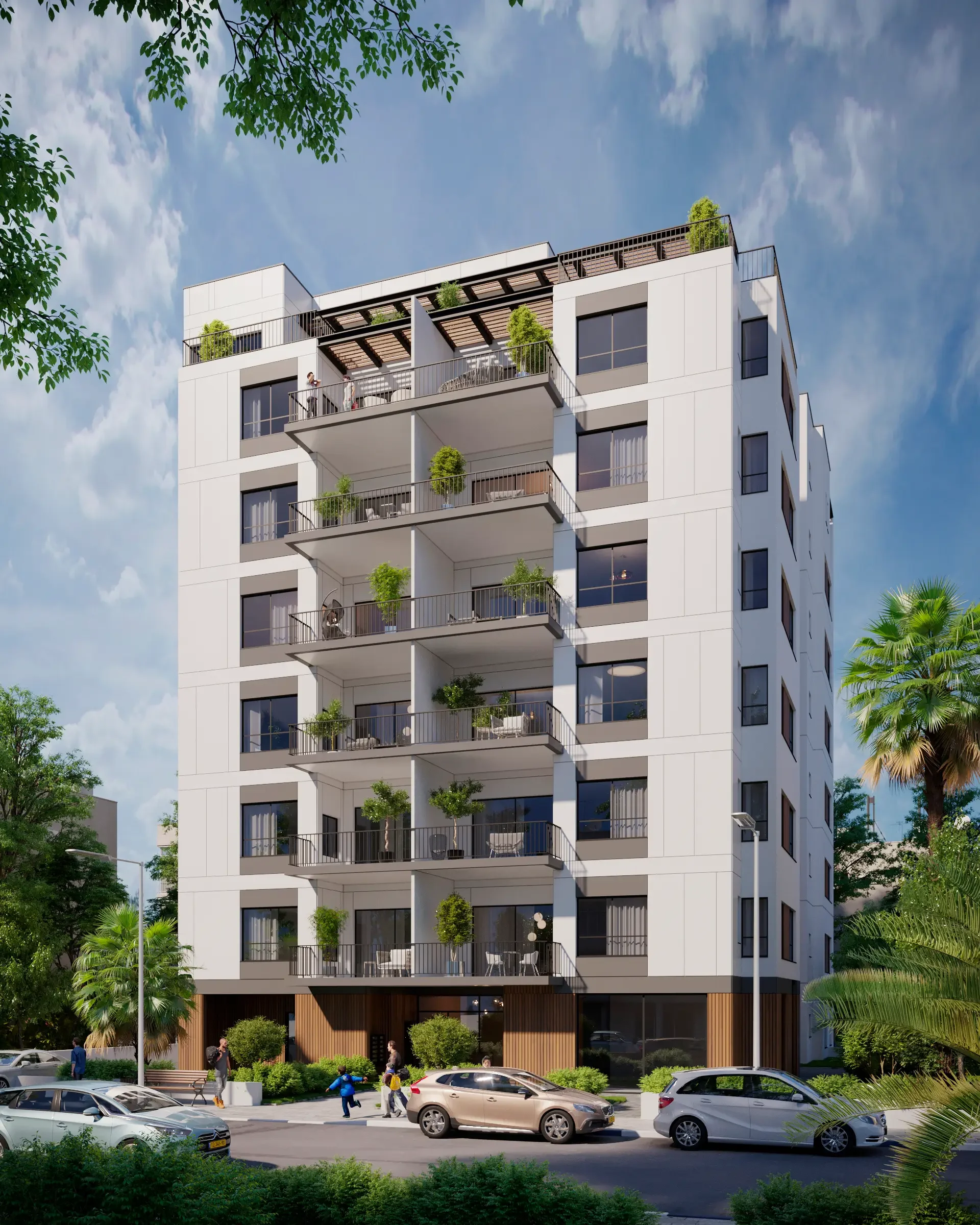
It is here, at number 12, that a residential project is now rising from the earth—a building that will ultimately stand eight stories tall and house twenty-eight families in what promises to become one of the most compelling addresses in an already rejuvenating corner of the city.
The plot itself tells part of the story. This is not merely a building site; it is a generous parcel of land that borders Frankfurt Garden, that pocket of cultivated green space that has become increasingly precious as Tel Aviv densifies. To live at 12 Minz is to wake each morning with views that extend not into concrete canyons but into canopies of trees, manicured lawns, and the particular quality of light that filters through leaves. In a city where every square meter of green space is contested and cherished, this adjacency to Frankfurt Garden represents something approaching luxury.
The project proceeds under the regulatory framework known as TAMA 38/2, a national planning initiative that has transformed Israel's approach to urban renewal. Under this mechanism, older buildings—many constructed before modern earthquake safety standards—are demolished and replaced with new structures that meet contemporary building codes while adding residential capacity to established neighborhoods. It is a process that serves multiple purposes simultaneously: improving seismic safety, increasing housing stock, and revitalizing aging urban fabric without destroying the character of existing communities.
Kahana Architects has taken on the design challenge, creating a building that must satisfy the demands of modern living while respecting the quiet residential character that makes Minz Street attractive in the first place. The results, now taking physical form as construction progresses, suggest a structure of considerable sophistication—contemporary in its amenities and aesthetic, yet scaled to fit comfortably into its surroundings.
The location rewards examination. Hadar Yosef occupies a strategic position in Tel Aviv's geography, offering that rare combination of centrality and calm that experienced city dwellers know to value. The neighborhood sits within easy reach of Ramat HaHayal, the northern tech hub where much of Israel's innovation economy clusters. Yarkon Park—that magnificent green corridor that serves as Tel Aviv's collective backyard—lies nearby, offering kilometers of paths for running, cycling, and simply escaping the urban intensity. The Exhibition Gardens provide cultural programming and open space. Tel Aviv University anchors the intellectual life of the broader area. And the city center, with all its commercial and cultural offerings, remains accessible without requiring the kind of commute that frays nerves and consumes hours.
Yet despite this connectivity, Minz Street itself maintains a residential tranquility that can feel almost suburban. This is a place where one might actually hear birdsong in the morning, where children can play in relative safety, where the stress of metropolitan life recedes just enough to make daily existence more pleasant. The building at number 12 will amplify rather than compromise these qualities, adding new residents to a community without overwhelming its essential character.
The apartments themselves have been designed with a consistency that speaks to a clear vision of how people live in Tel Aviv today. The typical floors—levels one, two, and six—offer five-room apartments of approximately 110 to 111 square meters, each paired with 14-square-meter balconies. These are family-sized homes, spaces where bedrooms can be assigned to children, where a home office can coexist with a proper living room, where the kitchen might serve as the heart of household life without feeling cramped.
Five rooms at 110 square meters represents a specific calculation about space and proportion. It is generous without being grandiose, practical without feeling austere. The floor plans suggest open layouts where living, dining, and kitchen areas flow into one another—the contemporary approach to domestic space that acknowledges how families actually spend their time together. The bedrooms retreat to quieter corners, providing privacy without isolation. The balconies, while not enormous, offer that essential threshold between interior comfort and outdoor air that makes apartment living in the Mediterranean climate genuinely pleasant.
The sixth floor apartments mirror their lower counterparts in size and configuration, but their elevation changes the experience subtly. From six stories up, the views extend further, the sense of privacy deepens, and the relationship to Frankfurt Garden next door shifts from immediate proximity to aerial perspective. The treetops become companions rather than walls, and the broader geography of northern Tel Aviv reveals itself—the park systems, the university campus, the distant glimmer of the sea on clear days.
It is on the seventh floor, however, that the project reaches its most expansive expression. Here, the apartments grow substantially larger—137 and 140 square meters respectively—and the outdoor spaces become truly extraordinary. One unit offers 105 square meters of exterior space; the other provides 100 square meters. These are not balconies in any conventional sense; they are outdoor rooms, terraces where one might host gatherings, cultivate gardens, install lounging areas that function as genuine extensions of the living space.
To have 100 square meters of private outdoor space in Tel Aviv is to possess something genuinely rare. The city's density generally precludes such luxuries, pushing those who crave outdoor space toward the suburbs or the smaller towns along the coast. Yet here, at the top of 12 Minz, residents will enjoy outdoor domains that rival many backyards—all while remaining embedded in the urban fabric, connected to the amenities and opportunities that draw people to Tel Aviv in the first place.
The current status—in progress—means that the building exists in that particular state of becoming that characterizes active construction sites. The foundations have been laid, the structure is rising, and the eventual residents can begin to imagine their lives within walls that are taking shape day by day. There is something compelling about this phase, when architectural renderings give way to physical reality, when the vision encoded in blueprints begins to manifest in concrete and steel and glass.
For the Hadar Yosef neighborhood, this project represents part of a broader transformation. The area has been experiencing a renaissance as urban renewal mechanisms like TAMA 38 have enabled the replacement of aging buildings with modern structures. What was once a somewhat overlooked corner of Tel Aviv has become increasingly attractive to buyers who recognize the value of its location—close to employment centers, adjacent to parks, yet somehow removed from the intensity that can make other Tel Aviv neighborhoods exhausting.
The choice of this particular site—large enough to create a building of substance, positioned to engage with Frankfurt Garden, located on a quiet street yet connected to the broader city—reflects a sophisticated understanding of what makes residential real estate valuable in contemporary Tel Aviv. This is not a project that relies solely on novelty or luxury finishes to attract buyers; it draws on fundamentals that will remain relevant regardless of market cycles or design trends. Green space will always be precious. Quiet streets will always appeal to families. Proximity to employment and amenities will always matter. The building at 12 Minz is positioned to deliver on all these criteria.
Twenty-eight apartments. Eight floors. Five-room homes for families ready to invest in their futures. And at the top, those remarkable penthouses with their expansive terraces overlooking a garden that grows more valuable with each passing year.
The construction continues, floor by floor, as the building reaches toward its ultimate form. Soon enough, the cranes will depart, the scaffolding will come down, and the residents will begin moving in. They will discover what the architects and planners already know: that this address offers something special, a combination of location and design and amenity that elevates daily life in ways both tangible and subtle.
At 12 Minz, in the heart of a rejuvenating neighborhood, a community is taking shape—one family at a time, one floor at a time, until the building stands complete and the garden next door has twenty-eight new households who will come to cherish it as their own.
Need our help?
Navigating the Israeli property market as an English speaker doesn't have to be overwhelming. Whether you're searching for your first home in Ashkelon, exploring investment opportunities along the marina, or simply trying to understand what's realistic for your budget — we're here to guide you every step of the way.
Fill in the form below, and start your journey the easy way.
Our team speaks your language, understands your concerns, and knows this market inside out. From initial consultation to handing you the keys, we'll make your Israeli property dream a reality.