
What Does It Actually Cost to Rent or Buy Anywhere in Israel?
Introducing the Israel Realty Market Intelligence App — live property data for 33 cities, free, and it fits in your pocket.
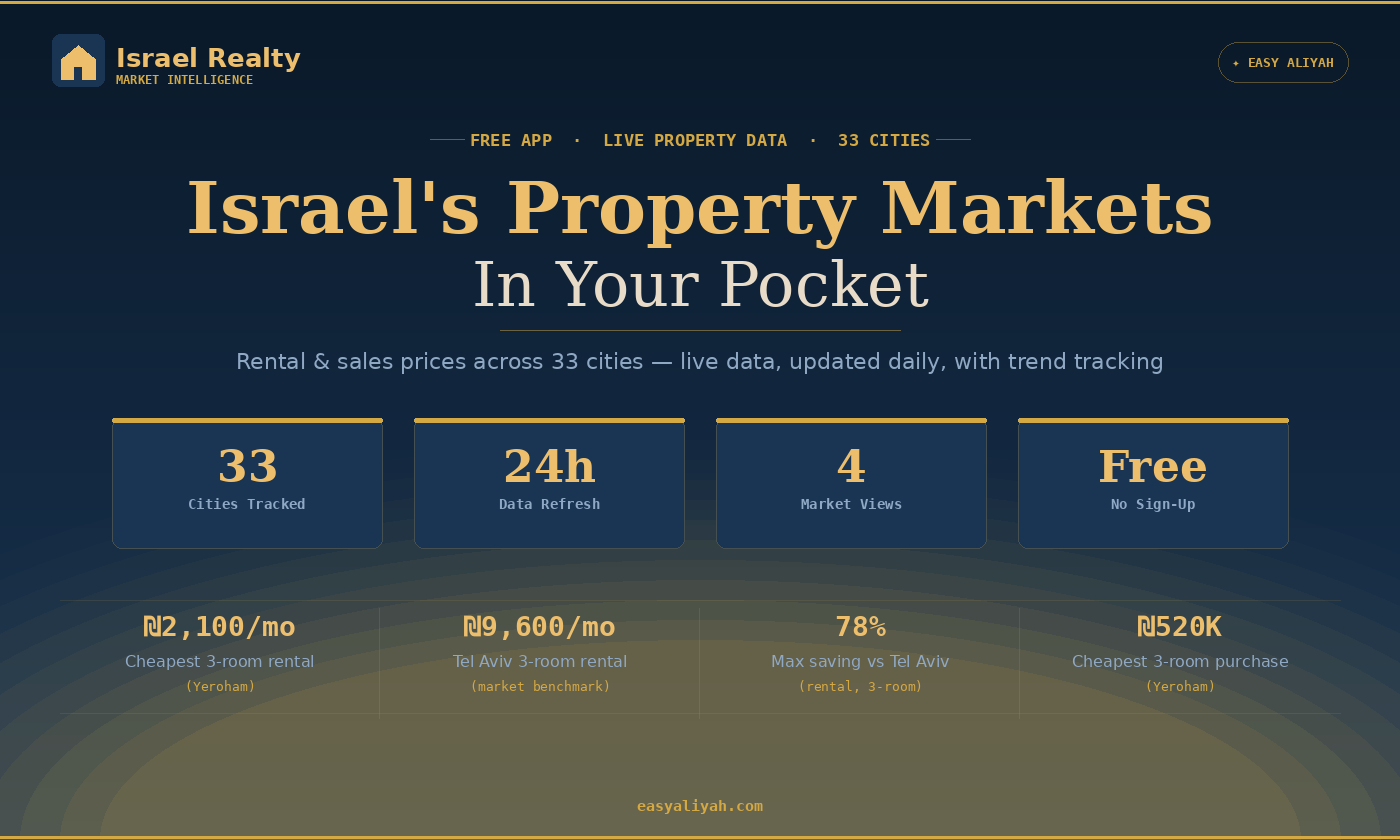
The Israel Realty app — live rental and sales data across 33 Israeli cities, free to download and install on any device.
The Question Everyone Asks Before Making Aliyah
At some point in every aliyah journey — usually around 2am, somewhere between the NBN consultation and the third WhatsApp group you've joined — the question becomes concrete. Not 'should I move to Israel?' but 'where in Israel can I actually afford to live?'
The answer is not simple, and until now it has been frustratingly hard to find in one place. You'd piece it together from Facebook groups, outdated blog posts, Yad2 searches in a language you're still learning, and the anecdotal evidence of whoever happened to answer your post. 'Tel Aviv is expensive.' 'Beer Sheva is cheap.' 'Modi'in is good for families.' Fine. But what are the actual numbers?
The Israel Realty Market Intelligence app answers that question with live data, ranked tables, and trend tracking — and it installs to your home screen in under 60 seconds, with no App Store, no account, and no subscription.
What the App Does
The app contains four league tables, each one a different way of looking at the Israeli property market:
Premier Rentals: Israel's 13 most active rental cities, ranked from most to least expensive. Average monthly rents for 2, 3, 4 and 5-room apartments, updated from live listings every 24 hours. Tel Aviv at the top. Beer Sheva near the bottom. Every city in between where it belongs.
Premier Sales: The same 13 cities, but for purchase prices. Asking prices anchored to CBS Q3 2025 transaction data, ranked highest to lowest, with week-on-week trend arrows so you can see whether prices in a given city are rising or falling.
Affordable Rentals: Israel's 20 cheapest rental areas, ranked cheapest first — from Yeroham at ₪2,100 a month for a 3-room apartment, through the northern and southern periphery, up to Ashdod at ₪5,200. Every city shows the exact monthly saving versus Tel Aviv at that room size.
Affordable Sales: The same 20 areas, but for purchase prices. From ₪520,000 for a 3-room in Yeroham to ₪1.75 million in Ashdod — with gross yield estimates so property investors can see which markets make the most sense on paper.
All data is fetched from live listings every 24 hours. Statistical outliers are removed. Week-on-week trends are tracked locally on your device and appear after the first week of use.
The Rental Market: What Landlords Are Actually Asking
The premier rental table covers the 13 cities where most Israelis and olim are looking — from the high-demand coastal and central belt down to Beer Sheva. Here is what a 3-room apartment costs in each of them right now:
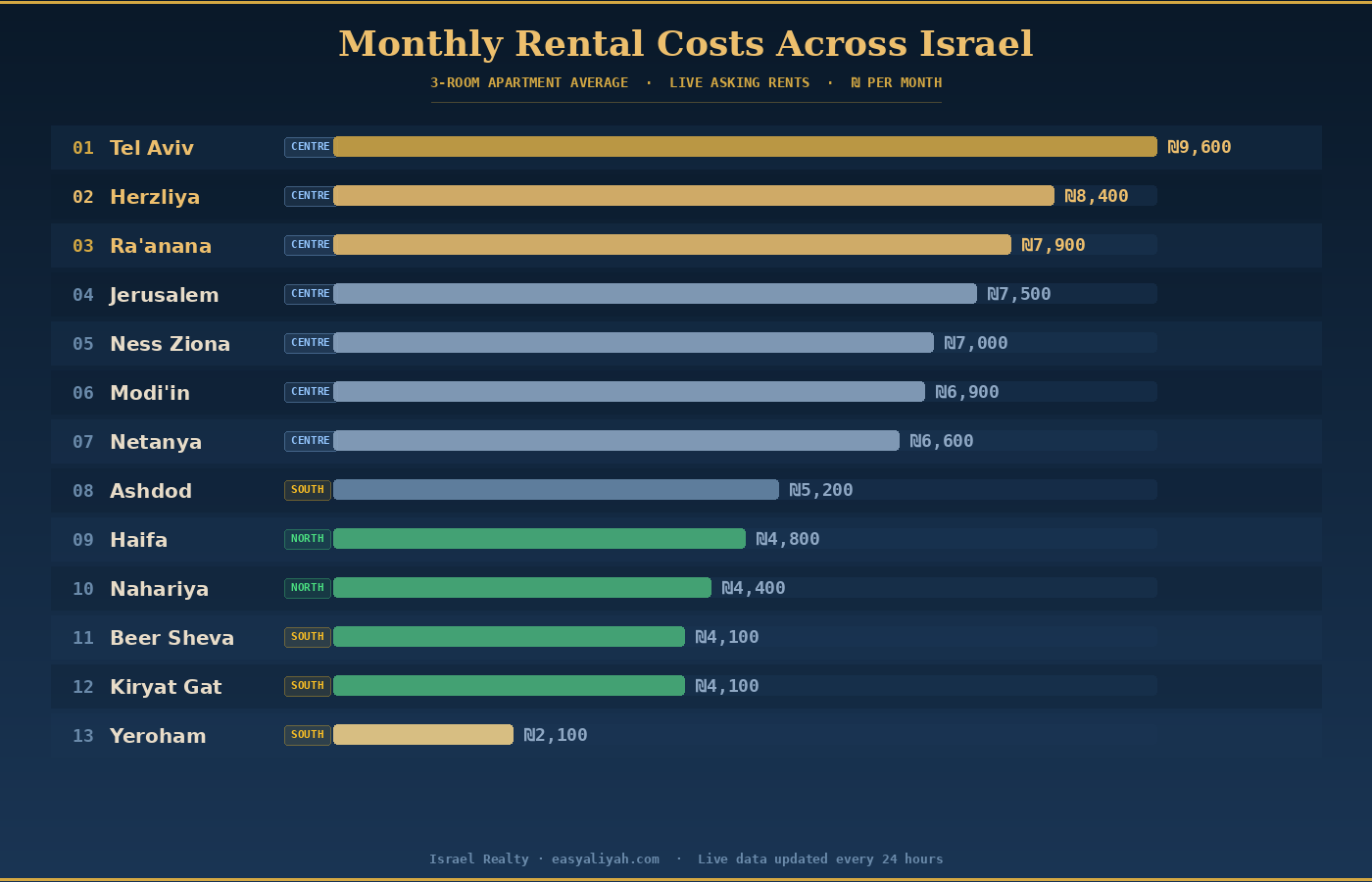
Average 3-room monthly asking rents across Israel's 13 most active rental markets — updated every 24 hours from live listings.
The gap between the top and bottom of this table is stark. A 3-room in Tel Aviv averages ₪9,600 per month. In Beer Sheva, the same apartment averages ₪4,100 — 57% cheaper, a saving of ₪5,500 every month, ₪66,000 per year. And Beer Sheva is a city of 200,000 people with a university, a hospital, a functioning high-tech sector, and a train to Tel Aviv.
Herzliya sits just below Tel Aviv at ₪8,400 — reflecting its position as Israel's de facto tech hub. Ra'anana, popular with English-speaking olim for its established Anglo community, comes in at ₪7,900. Jerusalem, always its own market, holds at ₪7,500.
The app lets you filter by room size — so if you want to compare 2-room prices across all 13 cities, or see what a 5-room costs in Modi'in versus Netanya, a single tap shows you exactly that. The 'vs Tel Aviv' column appears in room-filtered mode, showing the saving in shekels and percentage for every city.
Reading the Trend Arrows
Next to each price, the app shows a week-on-week trend arrow: ▲ for rising, ▼ for falling, — for stable. These trends are tracked locally in your browser's storage and appear from the second week of use onward. Over time, you can see not just what a city costs today but which direction it is heading — which matters considerably if you are about to sign a 12-month lease or make an offer on a property.
The Savings Table: How Much Does Location Actually Cost You?
This is the number most people never sit down to calculate. The difference between renting in Tel Aviv and renting 45 minutes away is not just a lifestyle choice — it is a financial decision worth tens of thousands of shekels per year.
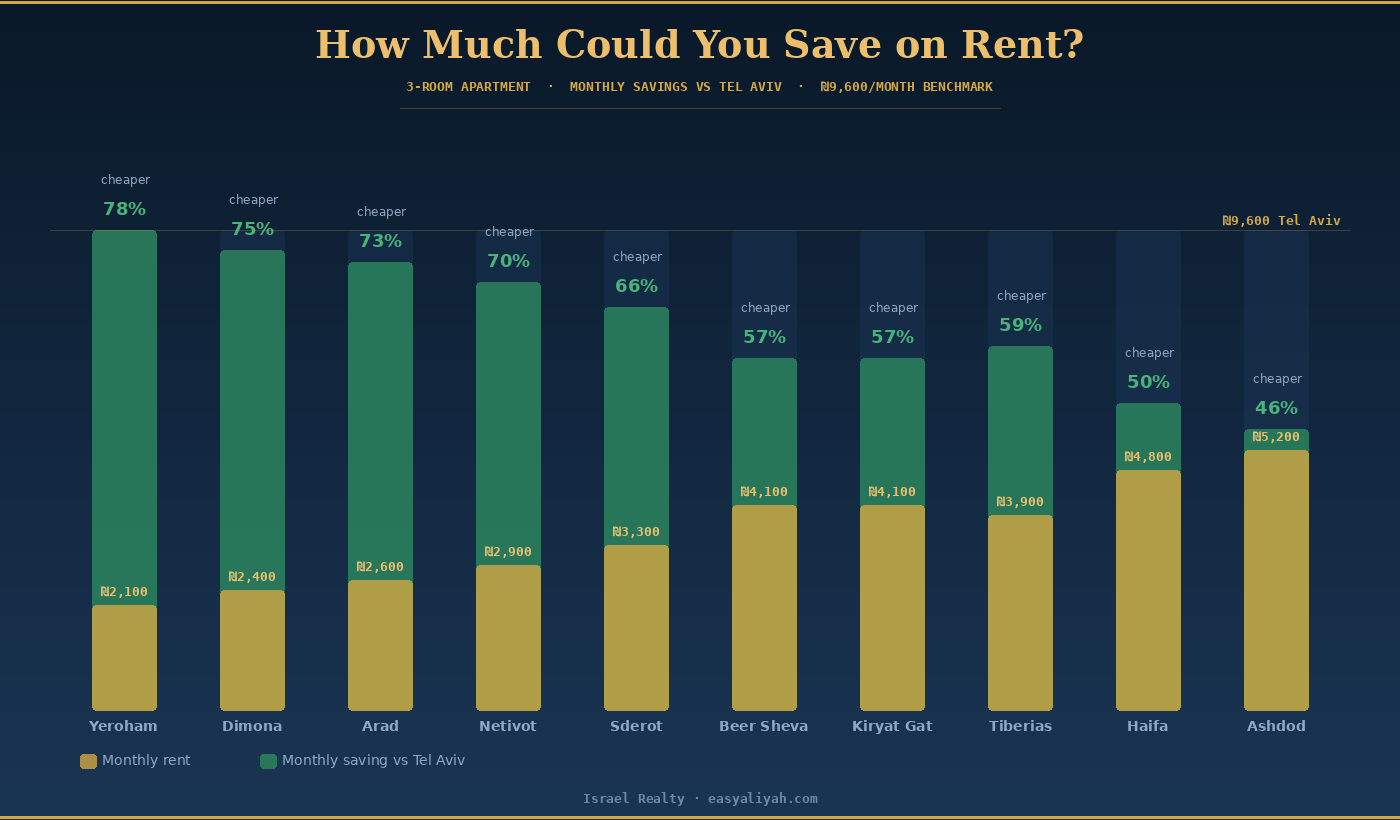
Monthly savings on a 3-room apartment compared to Tel Aviv — the green bar shows how much cheaper each city is every month.
The savings are significant at every point on the spectrum. Yeroham, in the northern Negev, is 78% cheaper than Tel Aviv for a 3-room apartment — a monthly saving of ₪7,500, or ₪90,000 per year. Over five years, that is ₪450,000 that stays in your pocket rather than going to a Tel Aviv landlord.
Even the middle-of-the-road options deliver meaningful savings. Haifa — Israel's third-largest city, with a port, a university, the Technion, and a Bahá'í garden that gets two million visitors a year — is 50% cheaper than Tel Aviv. ₪4,800 per month for a 3-room versus ₪9,600. Same country. Same healthcare system. Same sunrise.
Kiryat Gat deserves particular attention. Often overlooked in the Tel Aviv-versus-periphery conversation, it sits 45 minutes from Tel Aviv by train, houses an Intel manufacturing facility that employs thousands of high-skilled workers, and offers 3-room rentals at ₪4,100 per month — 57% cheaper than Tel Aviv. The affordable rentals table ranks it 12th cheapest in Israel out of 20 tracked areas, which puts it in a different conversation from the remote periphery while remaining dramatically cheaper than the centre.
Use the app's region filter (South / North / Centre) to narrow the affordable tables to the geography you are considering. The savings column stays live regardless of which filter you choose.
The Sales Market: What It Costs to Own
The Israeli property market is one of the most discussed, most politically charged, and most misunderstood topics in the country. Prices in Tel Aviv and Herzliya make headlines. Prices in the periphery rarely do.
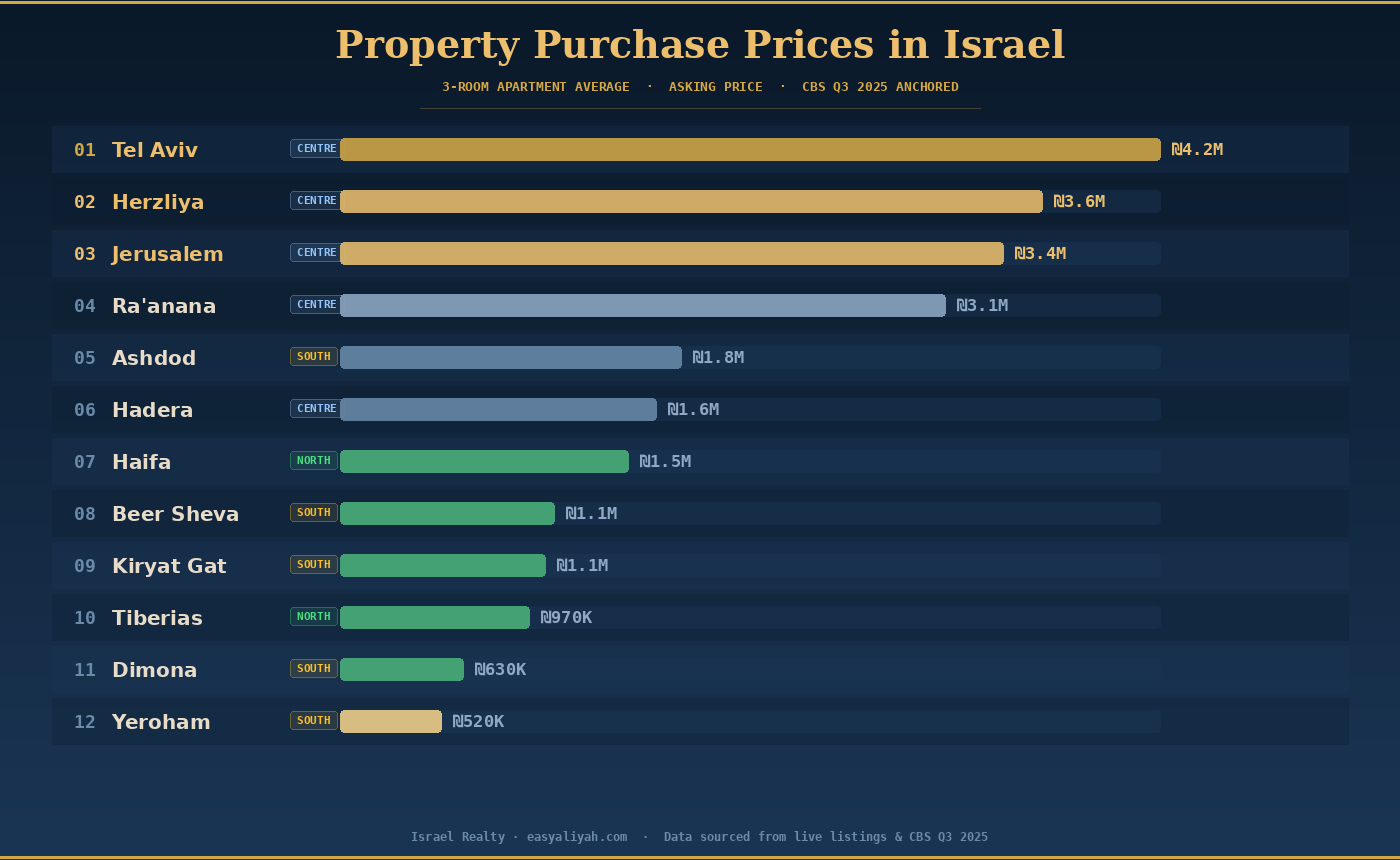
Average 3-room apartment purchase prices across Israel — ranked highest to lowest, anchored to CBS Q3 2025 transaction data.
The premier sales table tells the full story. A 3-room in Tel Aviv averages ₪4.2 million. In Jerusalem, ₪3.4 million. In Herzliya, ₪3.6 million. These are real numbers — derived from live listings and cross-referenced against published CBS Q3 2025 transaction data, not aspirational asking prices from outlier properties.
But scroll down the affordable sales table and the picture changes dramatically. Haifa: ₪1.48 million for a 3-room. Beer Sheva: ₪1.1 million. Kiryat Gat: ₪1.05 million. Tiberias: ₪970,000. Dimona: ₪630,000. Yeroham: ₪520,000.
For an oleh who arrives with savings, a mortgage entitlement, and a willingness to live somewhere other than the Tel Aviv bubble, the numbers in the affordable sales table are the difference between owning property in Israel and not owning it. A 3-room in Yeroham at ₪520,000 requires a mortgage conversation of a fundamentally different kind to a 3-room in Tel Aviv at ₪4.2 million.
CBS Data and Price Trends
The sales prices in the app for major cities are anchored to published CBS (Central Bureau of Statistics) Q3 2025 transaction data — not just listing prices. For Beer Sheva, CBS Q3 2025 records a 3-room average of ₪875,000 and a 4-room average of ₪1.28 million. The northern district as a whole showed price growth of 9.5% year-on-year in Q3 2025, the strongest regional performance in the country. Tel Aviv district: down 7.6%.
These are not trends you would know without going to the CBS website and reading the Hebrew data tables. The app surfaces them in the trend arrows next to each city — and the week-on-week tracking builds a personalised trend history on your device from the moment you install it.
Installing the App: 60 Seconds on Any Device
The Israel Realty app is a Progressive Web App — a single HTML file that installs to your home screen on any device, on any platform, without requiring an App Store download, a Google account, or a subscription. Here is how to do it on each platform:
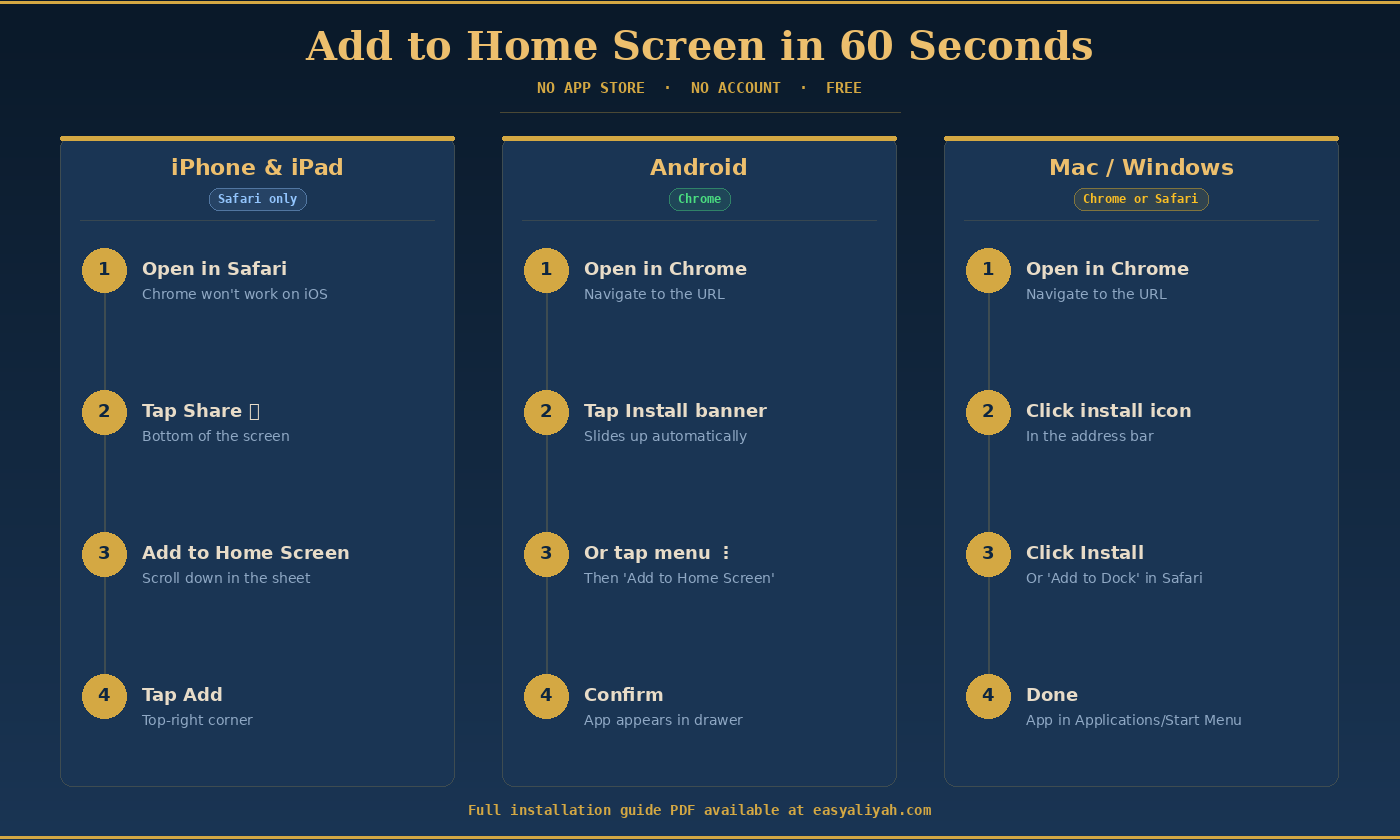
Step-by-step installation guide for iPhone, Android, and desktop — add to home screen in under 60 seconds.
iPhone and iPad
Open the app URL in Safari (not Chrome — Apple requires Safari for home screen installs). Tap the Share icon at the bottom of the screen — the box with an upward arrow. Scroll down in the Share sheet and tap 'Add to Home Screen'. Edit the name if you want, then tap Add in the top-right corner. The Israel Realty icon appears on your home screen and opens in full-screen mode with no browser chrome.
Android
Open the app URL in Chrome. After a few seconds, an Install banner slides up from the bottom of the screen. Tap Install. Alternatively, tap the three-dot menu in the top right and select 'Add to Home Screen'. The app appears in your home screen and app drawer and opens in its own window.
Mac and Windows
Open the app URL in Chrome. Look for the small install icon in the address bar on the right side — it looks like a screen with a downward arrow. Click it, then click Install. On Mac with Safari (Sonoma 14 and later), go to File → Add to Dock. The app appears in your Applications folder or Start Menu and can be pinned to your Dock or Taskbar.
A full step-by-step installation guide PDF is available to download from easyaliyah.com, covering every platform in detail including troubleshooting for the most common issues.
For Investors: Gross Yield by City
If you are looking at the Israeli property market as an investor rather than a primary-residence buyer, the combination of the affordable sales and affordable rentals tables gives you everything you need to start building a picture of where the numbers work.
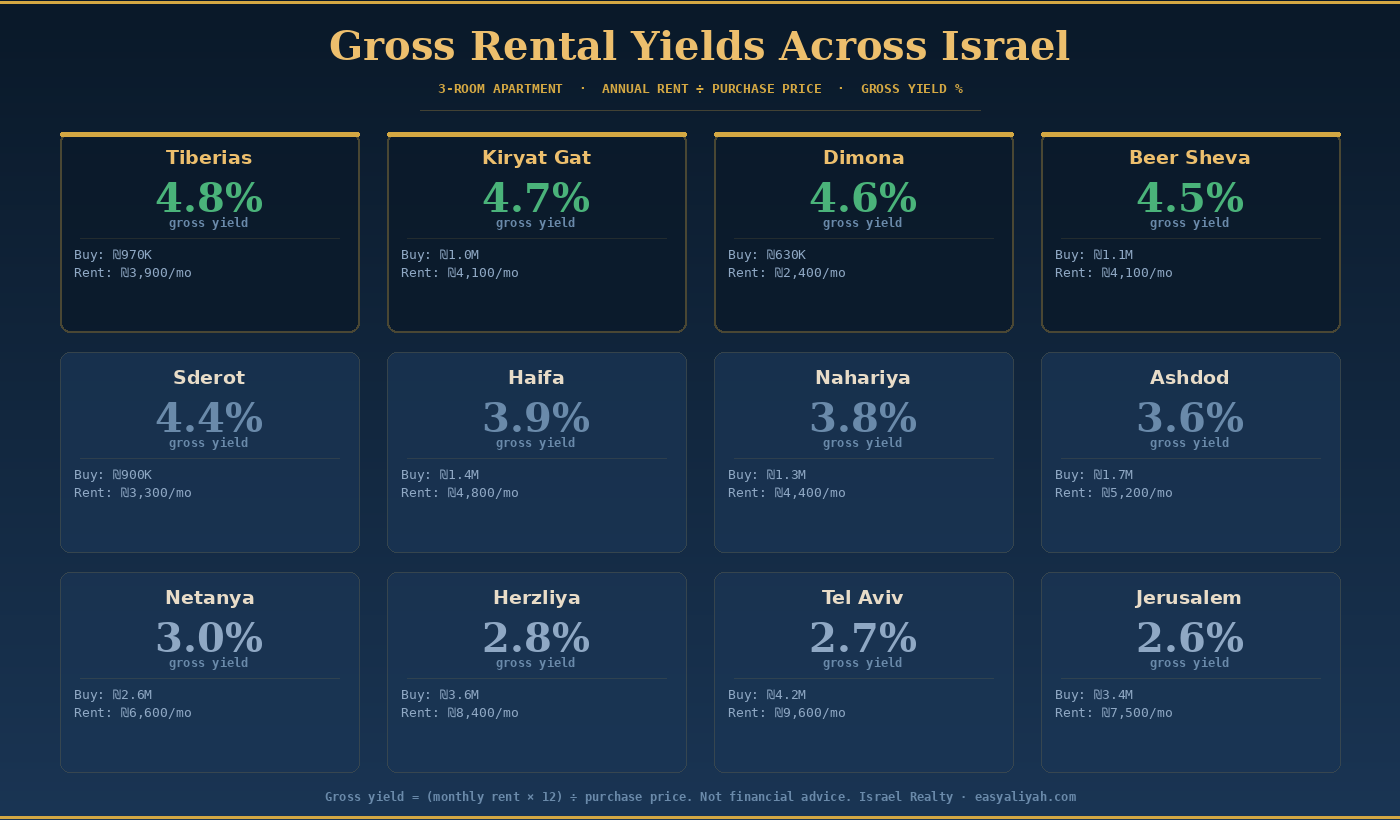
Gross rental yield by city — calculated as (monthly rent × 12) ÷ purchase price. Not financial advice.
Gross yield is the simplest starting point for any buy-to-let analysis: take the annual rent, divide it by the purchase price, and express it as a percentage. A gross yield of 4% means the property generates 4% of its purchase price in rent per year, before expenses, maintenance, and taxes.
In the Israeli context, Tiberias currently leads the tracked markets at approximately 4.8% gross yield — a purchase price of around ₪970,000 and a monthly rent of approximately ₪3,900. Kiryat Gat comes in close at 4.7%, with a ₪1.05 million purchase price and ₪4,100 monthly rent. Dimona offers around 4.6% on a ₪630,000 purchase price.
Beer Sheva, Israel's largest southern city and home to Ben-Gurion University, Ben-Gurion airport, and a rapidly growing tech sector, sits at around 4.5% gross yield — ₪1.1 million to buy, ₪4,100 per month to rent. That compares to Tel Aviv's gross yield of approximately 2.7% (₪4.2 million purchase price, ₪9,600 monthly rent).
The Northern District Story
CBS Q3 2025 data shows the northern district recording 9.5% price growth year-on-year — the strongest regional performance in Israel. For investors who bought in Tiberias, Nahariya, or Acre two years ago, that growth combined with a 4%+ yield represents a meaningful total return. The app's trend arrows will show you whether that momentum is continuing city by city.
Ashdod is worth a specific mention in the opposite direction. CBS data for Q2 2025 showed a 7.97% year-on-year price decline in the city. For a contrarian investor, a city with falling prices, a functioning rental market, and a port that handles more cargo than any other in Israel is a different kind of opportunity. The data is in the app. The decision is yours.
Yield figures are indicative gross yields only, calculated from average asking prices and average asking rents. They do not account for purchase costs, maintenance, property management, arnona, vacancy periods, or Israeli property tax. Always consult a qualified Israeli accountant and real estate professional before making any investment decision.
Who Built This and Why
The Israel Realty app was built by the team behind Easy Aliyah — a resource platform for people making aliyah and navigating life in Israel. The property market is one of the most consistently difficult parts of that navigation, and the resources that existed were either outdated, incomplete, or hard to understand without fluent Hebrew.
The goal was simple: one app, all the key markets, live data, always on your phone. No paywall. No account. No advertising. Just the numbers, updated daily, for anyone who needs them.
The app tracks 33 cities across four tables. It uses live listing data from Yad2 via public APIs, cross-referenced against published CBS transaction data for major markets. It runs on every device — iPhone, Android, Mac, Windows, Linux — and installs in under 60 seconds.
Download it free at easyaliyah.com.
The installation guide PDF is available on the same page, with step-by-step instructions for every platform.
Frequently Asked Questions
Is the app really free?
Yes. No subscription, no account, no in-app purchases. It is a single HTML file. Download it, install it, use it. If the data is useful to you, the best thing you can do is share it with someone else who needs it.
How accurate is the data?
Prices are derived from live asking prices on Yad2 — Israel's largest property listing platform. Statistical outliers (unusually high or low listings, commercial listings accidentally included, etc.) are removed before the averages are calculated. For major cities, the sales prices are cross-referenced against CBS published transaction data. Asking prices and transaction prices are not the same thing — transaction prices are typically lower — but asking prices are the most useful indicator of what you will actually be quoted when you start looking.
What if the live data doesn't load?
The app always shows data. If the live fetch fails — because you are offline, or because the proxy service is temporarily unavailable — the app displays its researched baseline data from February 2026, sourced from CBS publications and market surveys. You will see a 'Market Rates' badge instead of 'Live'. The numbers are still useful; they simply are not from today's listings.
Does it work offline?
Yes, once it has been installed to your home screen and opened at least once while connected to the internet. The app caches itself locally via a service worker, so it opens instantly even without a connection, displaying the most recent data it fetched during your last online session.
I'm making aliyah in six months. Is it too early to use this?
Six months before is exactly the right time. Use the app now to understand the market structure — which cities are expensive, which are affordable, how the periphery compares to the centre. Check the trend arrows regularly to see which markets are moving. By the time you arrive, you will have six months of trend data on your device and a clear picture of where your budget positions you in each market.
Can I share it with my partner / family / aliyah group?
Please do. Send them the URL. The app installs from any browser. There is no limit on how many people can use it.
Israel Realty Market Intelligence · Part of the Easy Aliyah resource network
Not financial advice. Data sourced from live property listings and CBS published figures. Updated every 24 hours. Always consult a qualified Israeli real estate professional before transacting.