
Why Having a Jewish Grandparent Does Not Guarantee Aliyah
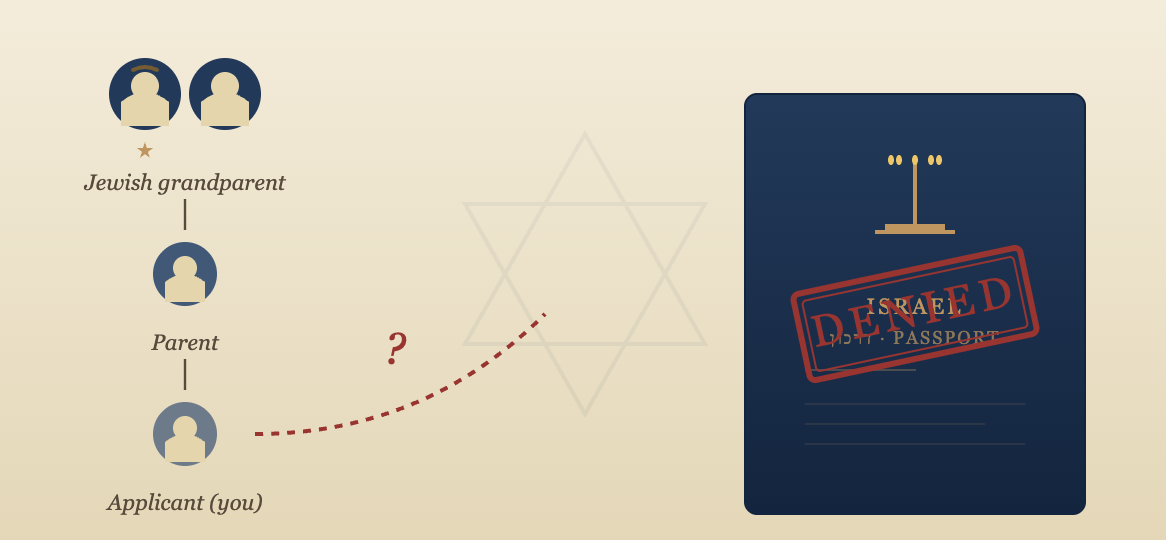
The grandparent clause has a hidden tripwire — and it often shows up on the wedding certificate.
Easy Aliyah · Legal & Eligibility
On paper, the rule sounds simple: if you have one Jewish grandparent, you qualify for aliyah. Many families arrive at our office with exactly that line in their head, picked up from a cousin who made aliyah in 1995 or from a half-remembered article online. They produce a grandmother's ketubah, a great-uncle's grave inscription, a yellowing birth certificate from Łódź, and assume the matter is settled.
It is not settled. Section 4A of the Law of Return — the famous "grandparent clause" — is broader than halacha but narrower than people remember, and the place it most often fails for real applicants is not the Jewish ancestor at all. It is what happened after the Jewish ancestor. Specifically: how they lived, how they married, how they buried their parents, and how they raised the next generation. The evidence trail of those decisions sits in church registers, on marriage certificates, on baptism records, and on tombstones across Europe and the Americas — and the Israeli Interior Ministry knows how to read it.
This is the conversation we have on intake when a client tells us their grandfather was Jewish. Before we look at the grandfather, we ask about the grandfather's wedding.
◆ ◆ ◆
What Section 4A Actually Says
The grandparent clause was added to the Law of Return in 1970, the same amendment that wrote a definition of "Jew" into section 4B. Section 4A extends the rights of an oleh to three additional categories of people who are not themselves Jewish:
• The child of a Jew.
• The grandchild of a Jew.
• The spouse of a Jew, and the spouse of a child or grandchild of a Jew.
That is the generous half. The restrictive half is the proviso, in the same section, that the rights do not apply to a person who has been a Jew and has voluntarily changed their religion. And in the practice of the Interior Ministry, that proviso has grown over fifty years into a doctrine considerably broader than the words suggest. The question is not only whether the applicant is a member of another religion — it is also whether the Jewish ancestor whose status the applicant relies on
lived as a Jew or had affirmatively left the Jewish community before producing the chain of descent the applicant is now claiming. If grandfather Yitzhak became Ignacy and married in a Warsaw church in 1923 and raised his children as Catholics, the Ministry may take the view that for purposes of section 4A he had ceased to be a Jew before the chain of descent that the applicant is invoking began. The grandparent is, in the Ministry's analysis, no longer the right kind of grandparent.
This is not in the statute. It is in the case law, the Ministry guidelines, and the practical exercise of administrative discretion. And it is the single most common reason that an apparently straightforward grandparent file falls apart.
◆ ◆ ◆
The Wedding Certificate Question
Why the church wedding matters
When a Jew of the late nineteenth or early twentieth century married in a church, it was almost never a casual choice. Civil marriage was rare or unavailable across much of Europe; the Catholic, Orthodox, and Protestant churches were the registrars of record for births, marriages, and deaths in much of the continent until at least the First World War, and in many places much later. To be married in a church, a Jew had to formally convert — or at minimum to formally declare adherence to the church performing the ceremony. There was no third option. You did not show up at a parish church in Lwów or Kraków or Vienna or Budapest and have the priest marry you on the strength of your civic credentials. You signed something. You stood at a font. There is paperwork.
That paperwork is what the Interior Ministry asks for. The standard demand on a grandparent-clause file is not only proof that the grandparent was born Jewish, but proof of what happened next — and the wedding certificate is the document that most reliably answers the question. A Jewish religious marriage (a ketubah, a rabbi, a synagogue) confirms that the ancestor remained within the Jewish community at the moment of marriage. A church wedding raises the inference that the ancestor had left it.
The inference is rebuttable, but the burden has shifted
A church wedding does not automatically end the file. There are well-documented patterns of Jews marrying in churches without intending to leave Judaism — wartime marriages in hiding, marriages of convenience to secure papers, marriages where one partner converted nominally without the family ever practising. The applicant is allowed to rebut the inference. But the burden has shifted. Before the wedding certificate surfaced, the applicant simply had to prove a Jewish grandparent. After the wedding certificate surfaces, the applicant has to prove a Jewish grandparent and explain why a Catholic wedding does not mean what it appears to mean.
Sometimes that explanation is easy. A 1943 marriage in a Polish village with forged Aryan papers is self-evidently not a conversion in any meaningful sense, and the Ministry has handled many such files with sympathy. A 1958 marriage in a London Catholic church between a Polish-Jewish refugee and a local Catholic woman, where the couple raised the children Catholic and never returned to Jewish life, is much harder. The Ministry will ask: in what sense was the ancestor still a Jew, for purposes of producing a chain of descent that triggers the grandparent clause, after that wedding?
◆ ◆ ◆
The Other Documents That Decide Files
Baptism certificates
The next document the Ministry asks for, or that surfaces when an applicant submits their own genealogical research, is baptism records — for the grandparent, the parent, and sometimes the applicant. A baptism of the Jewish ancestor as an adult is the clearest possible signal of conversion out. A baptism of the next generation — the parent — is less direct but still significant: it suggests the family was being raised outside Judaism, which is part of how the Ministry assesses whether the ancestor lived as a Jew. A baptism of the applicant themselves is, of course, a section 4B problem rather than a section 4A problem, and we covered that in the previous post.
Burial and cemetery records
Where the Jewish ancestor is buried, and under what rite, is often the single cleanest piece of evidence. A burial in a Jewish cemetery, with a Hebrew inscription on the stone, settles the matter favourably. A burial in a Catholic cemetery, with a cross on the stone, settles it unfavourably. A burial in a municipal or non-denominational cemetery is neutral but invites further questions.
Families are sometimes surprised that the Ministry pays attention to where great-grandmother is buried. They should not be. A Jewish death and burial is a religious act; it requires a chevra kadisha, a Jewish cemetery, and a Jewish funeral. The choices made at the end of a life are often more reliable evidence of religious affiliation than the choices made in the middle.
Birth certificates and the religion field
In much of Central and Eastern Europe, birth certificates from the nineteenth century through the 1930s recorded the religion of the parents. A birth certificate showing "Mosaisch" or "Israelite" or "Hebrew" or "Żyd" for the parents is positive evidence. A birth certificate showing "Roman Catholic" for the same family in a later year is negative evidence — and a series of birth certificates showing the religion field changing over time is the most legible possible record of a family that was leaving Judaism.
School and military records
A more obscure category: school enrolment records and military service records also recorded religion in many jurisdictions, and these can surface a family's practical religious life when the headline documents are silent. A grandfather conscripted into the Habsburg army as "konfession: römisch-katholisch" did not record himself that way by accident. The clerk asked, and he answered.
◆ ◆ ◆
What the Ministry Is Really Asking
Behind the document checklist there is a single question the Interior Ministry is trying to answer: did the Jewish ancestor live as a Jew long enough, and at the right moment, to produce a chain of descent that the Law of Return is willing to honour? The statute draws the line at the grandparent generation, but the line is more porous than it looks. The Ministry distinguishes, broadly, three patterns:
Pattern one: the unbroken Jewish family
The Jewish grandparent was born to Jewish parents, married a Jew in a synagogue, raised Jewish children, and is buried in a Jewish cemetery. The applicant's parent is the child of that marriage. Even if the applicant's parent married a non-Jew and the applicant was raised in a different faith or none, the grandparent-clause chain is robust. The Ministry will admit the file, subject only to confirming that the applicant themselves is not a member of another religion.
Pattern two: the ancestor who left Judaism after the chain of descent began
The grandparent was born Jewish, married Jewishly, had children who were halachically Jewish, and only later in life — perhaps in middle age, perhaps in response to political pressure or a second marriage — formally left the Jewish community. The descent chain to the applicant is intact and the grandparent was a Jew at the moment that mattered (the birth of the applicant's parent). This file is usually admissible, though the Ministry will scrutinise it more carefully and may ask for evidence about the religious life of the intervening generation.
Pattern three: the ancestor who left Judaism before the chain of descent began
The grandparent was born Jewish but had converted out — by marriage in a church, by baptism, by formal declaration — before the applicant's parent was born. The applicant's parent was raised Catholic or Protestant or Orthodox Christian from infancy, in a household where Judaism was a piece of family history rather than a lived identity. The Ministry's view, in this pattern, is that the grandparent's Jewish birth does not generate a section 4A right because the grandparent had voluntarily left the Jewish people before the relevant descent occurred. The file is, in practice, declined.
It is pattern three that catches families off guard. They have correctly identified a Jewish grandparent. They have correctly read the statute. They have not understood that the Ministry reads the statute with the gloss that the grandparent must, in some meaningful sense, have been a Jew at the time of the parent's birth — and a grandparent who married in a church a decade earlier and raised the entire family Catholic does not meet that test.
◆ ◆ ◆
The Practical Intake Conversation
When a client comes to us with a grandparent-clause file, the first round of questions is genealogical. The second round is religious-historical. The second round is the one that decides whether we proceed.
We ask:
• Where and when did the Jewish grandparent marry, and do we have a copy of the marriage certificate or registry entry?
• In what kind of ceremony? Synagogue, church, civil registry? If church, which denomination, and is there any record of a conversion preceding the wedding?
• How were the children of that marriage raised? Baptised? Confirmed? Bar mitzvah? Religious school? What religion is recorded on their birth certificates?
• Where is the Jewish grandparent buried, and what is on the headstone?
• What was the family's wartime experience? Did the grandparent survive in hiding? Under false papers? Did they survive a camp? Were they part of a community that was destroyed?
• Is there any evidence — letters, photographs, oral history — of continued Jewish identification after the marriage? Did they keep any traditions? Did they tell their children about their origins? Did they ask, in the end, to be buried as a Jew?
The answers to these questions shape the file. They determine which documents we go looking for, which witnesses we prepare to call, which affidavits we draft. In a strong file, the answers reinforce each other: the grandparent lived as a Jew, married as a Jew, raised the family with at least some Jewish identification, died as a Jew, and the descent chain to the applicant is unambiguous. In a weak file, the answers point in opposite directions, and our job is to decide honestly whether the file is recoverable or whether we should tell the client the truth before they spend a year on it.
◆ ◆ ◆
Common Misconceptions
"My grandfather was Jewish, so I qualify"
Not necessarily. The grandparent must have been a Jew at the time the chain of descent through your parent began — that is, your parent must have been born to a still-Jewish parent. A grandparent who left Judaism before your parent was born does not, in the Ministry's practice, generate the right.
"DNA proves I have Jewish ancestry"
It does not, for purposes of section 4A. The Law of Return is concerned with religious-civic status, not genetic descent. A DNA result showing Ashkenazi or Sephardi heritage is interesting and may help motivate further documentary research, but no Israeli consulate accepts a 23andMe report as evidence of a Jewish grandparent. The Ministry wants documents — birth, marriage, burial, religious community membership.
"The grandparent died in the Holocaust, so the rules are different"
They are different in spirit but not in mechanism. The Ministry handles Holocaust-era files with sensitivity, recognises destroyed archives, accepts reconstructed evidence, and takes seriously the affidavits of survivors and their families. But the legal test is the same: was the grandparent a Jew at the moment of the chain of descent? A grandparent who was murdered as a Jew at Auschwitz answers that question with finality. A grandparent who survived by passing as a Catholic, married a Catholic in 1947, raised the family Catholic, and died Catholic in 1985 — answers it differently, and the file is harder.
"My family is Jewish even though we have not practised"
This is a sincere statement and we hear it often. It is also legally insufficient. The Ministry is not asking whether the family feels Jewish; it is asking whether the relevant ancestor was Jewish at the moment that matters, by the evidence of contemporaneous documents. A family's present sense of itself is honoured but does not substitute for the record.
◆ ◆ ◆
What to Do Before You File
For anyone considering a grandparent-clause file where there is any complication — a non-Jewish-sounding family name change, a generation raised in another faith, a marriage in a church, a sense that the family "left" at some point — the right order of operations is:
• Build the documentary spine first. Gather the birth, marriage, and burial records for the Jewish grandparent and for the parent through whom you descend. Do this before you spend money on legal fees or translation.
• Read what those documents actually say. The religion field, the venue of the wedding, the language and rite of the burial. Translate them honestly. Do not assume.
• If a church wedding or a baptism appears, take it seriously. Do not file the case until you have a clear story about what that document means and what evidence rebuts the inference of conversion out.
• If the chain of descent is questionable, consider alternatives. A formal conversion to Judaism (Orthodox, Conservative, or Reform depending on recognition status) opens the section 4B route on its own and may be a cleaner path than fighting a contested grandparent file.
• Get a professional assessment before you submit. A declined file is not easily reversed, and a poorly prepared file that surfaces problematic documents the Ministry would not otherwise have seen can damage a case that could have been built differently.
◆ ◆ ◆
Conclusion: The Grandparent Has to Be the Right Kind of Grandparent
The grandparent clause is real and it is broad. It admitted nearly a million people from the former Soviet Union, where decades of state atheism had erased almost every external trace of Jewish life, on the strength of grandparent documentation alone. It has admitted the children and grandchildren of mixed marriages across Latin America, Western Europe, and the English-speaking world. It is not a narrow door.
But it is not a magic door either. The grandparent has to be a Jew in the sense the statute is willing to honour — which means, in the Ministry's practice, a Jew who had not affirmatively left the community before producing the chain of descent the applicant is now claiming. The single most reliable evidence of that affirmative leaving is a wedding certificate from a church, supported by baptism records for the children, a non-Jewish burial for the ancestor, and a family that lived for generations as members of another faith.
That is why the question to ask, before anything else, is not whether your grandparent was Jewish. It is where they got married, who married them, and what the certificate says. Get that document before you get excited. The rest of the file is built around it.
— Easy Aliyah —
For confidential eligibility review and document audits, write to easyaliyah.com