
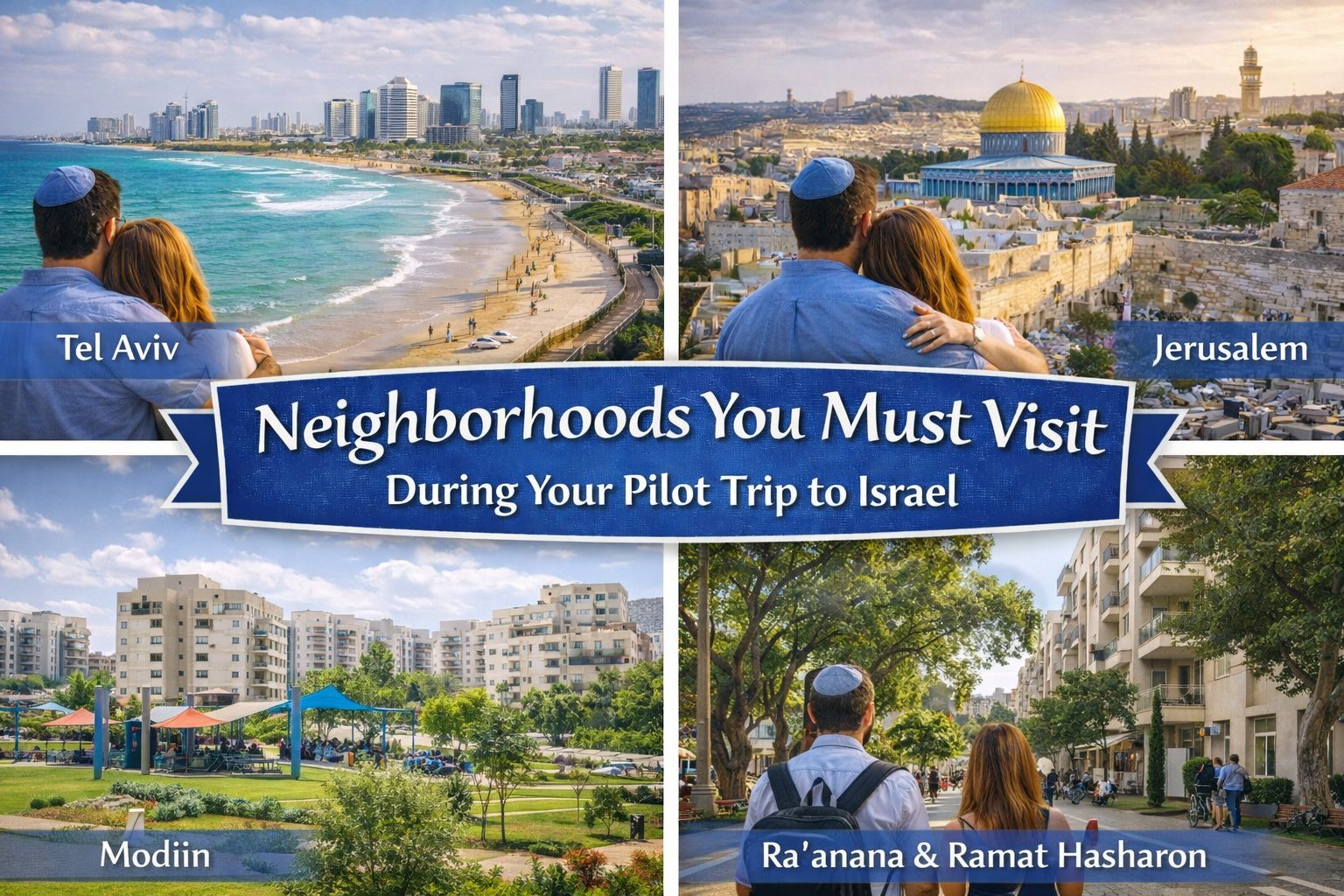
When people plan their pilot trips, they often think in terms of cities rather than neighborhoods, and this is their first mistake. Israel is a small country, but its neighborhoods vary so dramatically in character, demographics, cost of living, and daily rhythm that choosing a city without exploring its individual neighborhoods is like choosing to live in New York without distinguishing between the Upper East Side and Bushwick. The neighborhood you choose will shape nearly every aspect of your daily life, from the faces you see each morning to the language you hear on the streets to the schools your children attend to the synagogues available for your spiritual life. What follows are seven neighborhoods across Israel that represent the diversity of options available to olim, each offering a distinct lifestyle and community, and each worthy of serious consideration during your pilot trip regardless of whether they were on your initial radar.
The first neighborhood every potential oleh should visit is Baka, located in southern Jerusalem. Baka has become synonymous with Anglo aliyah for good reason, as it offers a unique combination of English-speaking community, proximity to the Old City, and a village-like atmosphere within a major urban center. Walking through Baka on a Friday afternoon, you will hear American and British accents mixing with Hebrew and Arabic, smell challah baking in apartment kitchens, and see families streaming toward the numerous synagogues that dot nearly every block. The main commercial street, Derech Beit Lechem, is lined with cafés, restaurants, and shops that cater to the Anglo palate while remaining authentically Israeli. Baka's housing stock consists primarily of older stone buildings that have been converted into apartments, giving the neighborhood an architectural charm that newer developments lack, though this also means that apartments can be quirky in their layouts and sometimes lacking in modern amenities. The schools in Baka range from ultra-Orthodox to secular, with several strong options for religious Zionist families seeking a balance between Torah study and general education. The downside of Baka is cost, as its popularity among immigrants has driven prices steadily upward, and finding a reasonably priced rental can require patience and persistence. During your pilot trip, spend at least a full day in Baka, walking its residential streets in the morning when children head to school, sitting in a café during the afternoon lull, and returning on Friday evening to experience the neighborhood as it transitions into Shabbat.
The second neighborhood to explore is Neve Tzedek in Tel Aviv, though you should approach it with clear eyes about what it represents and what it demands. Neve Tzedek is the oldest neighborhood in Tel Aviv, predating the city itself, and it has transformed over the past few decades from a neglected area of crumbling buildings to one of the most desirable and expensive addresses in the country. Its narrow lanes are lined with boutique shops, art galleries, acclaimed restaurants, and beautifully restored historic homes that now sell for prices that would make Manhattan real estate agents blink. Living in Neve Tzedek means living at the cultural heart of Israeli secular life, steps from the Suzanne Dellal Centre for contemporary dance, surrounded by artists and entrepreneurs and young professionals who have chosen urban sophistication over suburban comfort. It also means accepting a certain transience in your neighbors, as many Neve Tzedek residents are young people who will move to the suburbs once they have children, replaced by a new wave of ambitious newcomers. If you have school-age children, Neve Tzedek may not be practical, as families in central Tel Aviv often struggle to find schools that meet their standards and are forced to drive their children to neighborhoods farther from the coast. But if you are young, single, or a couple without children, and if you are drawn to a lifestyle of cafés and culture and late nights and creative energy, Neve Tzedek deserves your attention during your pilot trip. Visit on a Thursday evening when the streets come alive with diners and gallery openings, then return on a Saturday morning to see the quieter side of the neighborhood, the joggers heading to the beach, the couples walking dogs, the café terraces filling with people reading newspapers in the Mediterranean sun.
The third neighborhood is Ramat Beit Shemesh Aleph, which represents an entirely different conception of Israeli life. Located about thirty minutes from Jerusalem in the Judean foothills, Ramat Beit Shemesh Aleph was developed in the 1990s and quickly became a magnet for religious Anglo olim seeking affordable housing, strong Orthodox community, and room for large families to grow. The neighborhood is unmistakably suburban in its layout, with wide streets, apartment buildings surrounded by green spaces, and playgrounds on nearly every block filled with children speaking English and Hebrew in equal measure. The community is predominantly Orthodox, with most residents identifying as either Modern Orthodox or Charedi-leaning, and the presence of multiple synagogues, yeshivas, and religious schools means that Torah life permeates every aspect of daily existence. For families seeking immersion in observant Jewish community at a fraction of Jerusalem prices, Ramat Beit Shemesh Aleph has obvious appeal. During your pilot trip, visit on a regular weekday to see the community in its natural rhythm, with fathers heading to morning minyan, mothers walking children to school, and the commercial center bustling with shoppers stocking up for the coming Shabbat. Talk to residents about the challenges as well as the benefits, as Ramat Beit Shemesh has experienced significant tension between its various religious communities over the years, and understanding these dynamics is essential before committing to the area.
The fourth neighborhood is the German Colony in Haifa, which offers something that no other neighborhood on this list can match: integration into a truly mixed Jewish-Arab urban environment combined with a distinct Central European elegance that feels transported from another era. The German Colony was founded in the nineteenth century by German Templers, Protestant Christians who believed that settling in the Holy Land would hasten the Second Coming, and their architectural legacy remains in the form of beautiful stone houses with red-tiled roofs lining the neighborhood's main boulevard. Today, the German Colony sits at the foot of the Baha'i Gardens, one of Israel's most stunning landmarks, and serves as the heart of Haifa's cultural and culinary scene. Haifa itself is unlike any other city in Israel, with a population that is more secular than Jerusalem, more diverse than Tel Aviv, and more affordable than either. Jews and Arabs live as neighbors in a way that is rare elsewhere in the country, and the city's commitment to coexistence is not merely aspirational but woven into daily life. The German Colony, with its restaurants, galleries, and weekly farmers' market, attracts residents who value culture, diversity, and a slower pace of life than the frenetic energy of the center. During your pilot trip, walk the entire length of Ben Gurion Boulevard from the port to the Baha'i Gardens, stopping in the cafés and shops along the way. Ride the Carmelit, Israel's only subway, up to the Carmel Center and look out over the bay. Talk to residents about what brought them to Haifa and what keeps them there, and pay attention to how the city feels different from everywhere else you visit.
The fifth neighborhood is Kfar Saba, specifically the area known as the Green Kfar Saba or sometimes the Old North. Kfar Saba is a city of approximately one hundred thousand residents located in the Sharon plain, roughly twenty minutes from Tel Aviv without traffic, and it has become one of the most popular destinations for Anglo families seeking suburban life within commuting distance of the center. The Green Kfar Saba neighborhood is characterized by tree-lined streets, single-family homes with gardens, and a sense of spaciousness that feels almost American compared to the density of most Israeli cities. The city has invested heavily in parks, bike paths, and community facilities, making it particularly attractive to families with young children who want safe outdoor spaces for play. The Anglo community in Kfar Saba is smaller than in Jerusalem or Beit Shemesh but growing steadily, with several active English-speaking social groups and a Nefesh B'Nefesh regional community that organizes events throughout the year. The religious landscape is diverse, with Orthodox, Conservative, and Reform congregations all represented, making Kfar Saba suitable for families across the religious spectrum. During your pilot trip, visit on a Saturday morning when families are out walking and cycling through the parks, then return on a weekday afternoon to see the schools letting out and the playgrounds filling with children. Drive the route from Kfar Saba to Tel Aviv during rush hour to understand exactly what the commute will feel like, and visit the local shopping areas to get a sense of daily commerce and convenience.
The sixth neighborhood is Nachlaot in Jerusalem, which represents the bohemian counterpoint to the more established Anglo communities in the capital. Nachlaot is one of the oldest neighborhoods outside the Old City walls, a labyrinth of narrow alleyways, hidden courtyards, and tiny synagogues that seems to have grown organically rather than been planned. Walking through Nachlaot for the first time can feel like entering another world, as you turn corners to discover ancient fig trees, hear prayers drifting from windows, and encounter residents who have lived in these houses for generations alongside young artists who arrived last year. The neighborhood has always attracted seekers and dreamers, people who came to Jerusalem searching for something spiritual or creative and found in Nachlaot a community that embraces the unconventional. The housing stock is old and often in need of repair, the apartments are small and lack the amenities that suburban olim take for granted, and the streets are impossible to navigate by car. But for those who prioritize character over comfort and who want to live in a neighborhood that feels authentically Jerusalem in a way that newer developments never can, Nachlaot has a magnetic pull. During your pilot trip, visit Nachlaot on a Thursday night when the Machane Yehuda market adjacent to the neighborhood transforms into a nightlife destination, with bars and restaurants spilling into the market stalls. Then return on Shabbat afternoon when the narrow streets are silent and the neighborhood feels frozen in time.
The seventh neighborhood is Givat Shmuel, which has undergone a remarkable transformation over the past decade from a sleepy suburb to one of the most sought-after addresses for young religious families in the center of the country. Located adjacent to Bar Ilan University and just minutes from Bnei Brak and Ramat Gan, Givat Shmuel offers easy access to employment centers throughout the Gush Dan metropolitan area while maintaining a distinct small-town identity. The city has invested heavily in infrastructure for families, with new schools, community centers, and parks that rival anything in wealthier municipalities. The religious character of Givat Shmuel skews Modern Orthodox, with a vibrant community of young families who are committed to Torah observance while engaged fully in professional careers and Israeli society. The Anglo community is smaller than in Jerusalem but includes a core of active olim who have created social and religious programming specifically for English speakers. Housing in Givat Shmuel is expensive compared to peripheral areas but affordable compared to Tel Aviv or even nearby Ramat Gan, and new construction continues to add housing stock for the growing population. During your pilot trip, visit Givat Shmuel on a Friday afternoon when families are preparing for Shabbat, walk through the commercial center to see the shops and restaurants that serve the community, and if possible, arrange to spend Shabbat with a local family to experience the warmth and energy that has made this city such a popular destination for young religious olim.
Each of these seven neighborhoods represents a different vision of what life in Israel can look like, and your task during your pilot trip is not to find the perfect neighborhood but to understand yourself well enough to know which vision aligns with your own. Some people visit Baka and know immediately that they have found their home, while others feel stifled by its insularity and crave the energy of Tel Aviv. Some fall in love with the German Colony's elegance and diversity, while others cannot imagine themselves so far from the center of the country's religious and political life. The neighborhood you choose will shape your aliyah experience more than almost any other single decision, so invest the time during your pilot trip to explore widely, question deeply, and listen carefully to what each place is telling you about who you might become if you made it your home.