
Or Yehuda | Anglo Communities
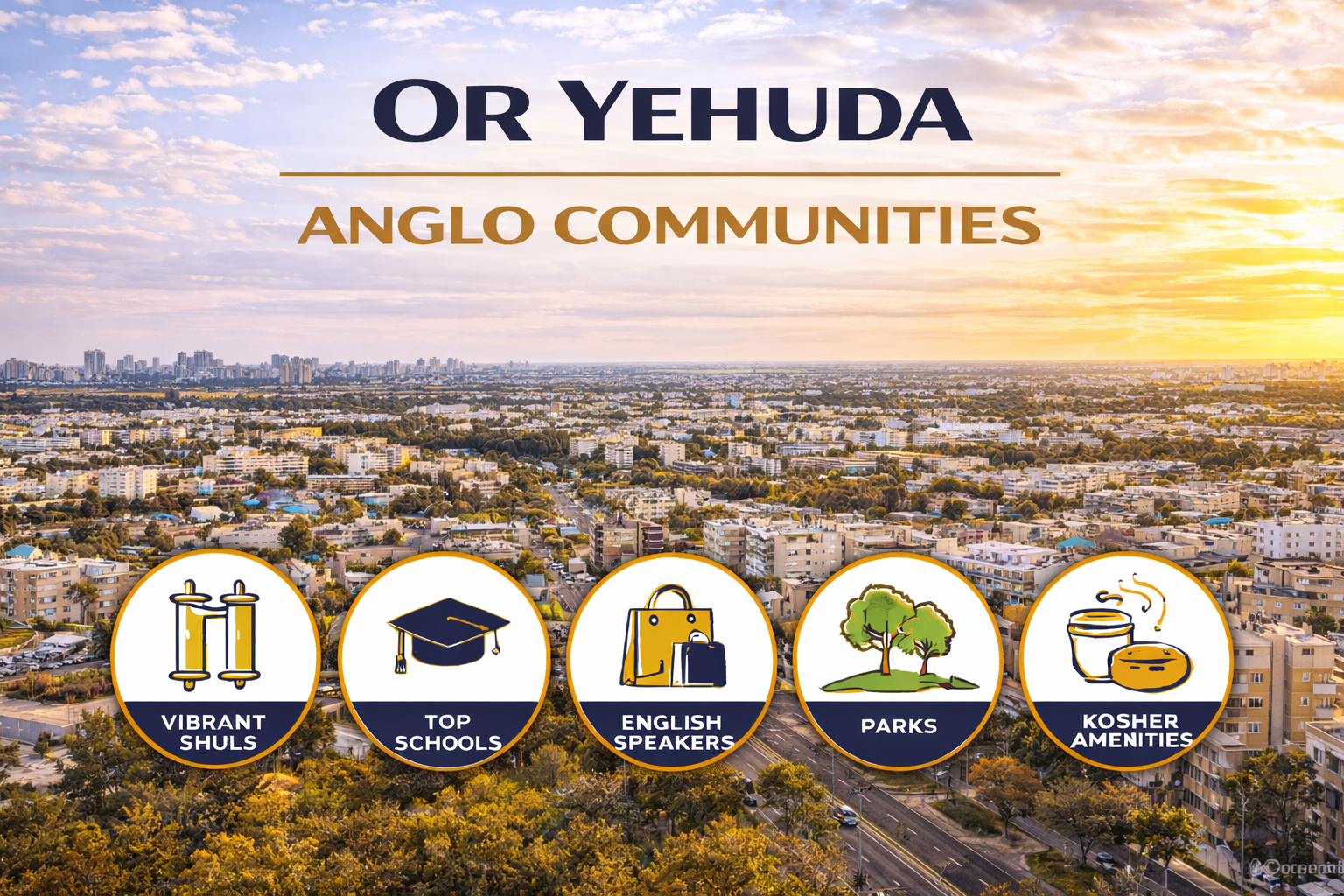
Or Yehuda is a small city of about 40,000 people wedged into the eastern part of the Gush Dan metropolitan area, bordered by Tel Aviv, Ramat Gan, Yehud, and the Ayalon highway corridor. It's one of those places that many Israelis drive past regularly without ever thinking about as a place to live, yet it sits in an extraordinarily central location and has been undergoing quiet transformation.
The city was founded in 1950 on the site of an abandoned Arab village, initially as a ma'abara transit camp for new immigrants. The population that settled there came primarily from Iraq, Iran, and other Middle Eastern countries, giving the community a strong Mizrachi character that persists today. Like other transit camps that became permanent towns, Or Yehuda developed with the haphazard planning and limited resources of that era, creating an urban fabric that was dense, modest, and lacking in amenities.
For decades, Or Yehuda was perceived as a poor, somewhat rough neighborhood sandwiched between more desirable areas. While Tel Aviv developed into a major city and Ramat Gan became an established urban center, Or Yehuda remained a backwater with low property values, aging housing stock, and limited appeal to the middle class. This reputation lingered even as circumstances began to change.
The transformation has been driven primarily by geography and economics. Or Yehuda sits in an almost absurdly central location. The Ayalon highway runs along its western edge, providing quick access to central Tel Aviv. The train station at nearby Yehud connects to the national rail network. Ben Gurion Airport is minutes away. The high-tech corridors of Ramat HaChayal, Herzliya, and Petah Tikva are all easily accessible. As housing prices in Tel Aviv and surrounding cities climbed beyond reach for many young families, Or Yehuda's low prices and central location began attracting attention.
New construction has changed parts of the city significantly. High-rise towers have gone up, bringing modern apartments to a city previously characterized by low-rise older buildings. Young professionals and families priced out of Tel Aviv have moved in, shifting the demographic mix. The municipality has invested in infrastructure, parks, and public spaces. The process is ongoing and uneven, with some neighborhoods transformed while others retain their older character, but the trajectory is clearly toward gentrification and development.
Housing costs in Or Yehuda remain lower than surrounding cities, though the gap has narrowed as the area has become more desirable. Apartments in newer buildings might cost 2 to 2.5 million shekels, substantially less than equivalent units in Tel Aviv or Ramat Gan. Older apartments in unrenovated buildings can still be found for under 1.5 million. Rentals range from about 4,500 to 7,000 shekels for family apartments, depending on building age and condition. For young families seeking to buy in a central location without the Tel Aviv price tag, Or Yehuda has become a realistic option.
The Anglo community in Or Yehuda is small and informal. There's no established Anglo infrastructure, no dedicated Facebook groups that I'm aware of, and no English-speaking synagogues. Individual Anglo families have moved there, typically young professionals working in Tel Aviv's tech sector who found affordable housing, but they're scattered rather than forming a cohesive community. Social life for Anglos in Or Yehuda involves either connecting with the broader Anglo communities in the Gush Dan area or integrating into Israeli social circles through work, neighbors, and children's activities.
The demographic shift happening in Or Yehuda means that young, educated Israeli families are moving in alongside the established Mizrachi population. This creates an interesting mix but also some tension as gentrification changes neighborhood character. The longtime residents have their own community networks, traditions, and ways of life, while newcomers bring different expectations and lifestyles. For Anglos, this means moving into a community in transition rather than an established environment.
The religious landscape reflects the city's Mizrachi heritage. Synagogues are predominantly Sephardic, following the customs and liturgy of Middle Eastern Jewish traditions. There's a traditional sensibility in much of the community, though not uniformly religious. For Ashkenazi Anglos, the synagogue experience would involve adapting to different melodies, customs, and cultural styles. Some find this enriching, while others prefer finding a congregation that matches their background, which might mean traveling to nearby cities.
Schools in Or Yehuda include both mamlachti (secular state) and mamlachti dati (state religious) options. The quality has been historically mixed, reflecting the city's socioeconomic challenges, though improvements have accompanied the broader development. Families moving in often research specific schools carefully and seek recommendations. Some families in Or Yehuda send children to schools in neighboring cities if they find better fits there, which is common throughout the Gush Dan area where municipal boundaries are porous.
Employment for residents typically means working elsewhere in the metropolitan area. The city itself has limited local employment beyond retail, services, and small businesses. But the location makes commuting practical to almost anywhere in central Israel. Tel Aviv is a short drive or train ride. The tech hubs of Herzliya and Ramat HaChayal are accessible. Petah Tikva's commercial centers are nearby. For professionals whose jobs are anywhere in the Gush Dan, Or Yehuda's location works well.
Healthcare is accessible through Kupot Holim clinics in the city and the proximity to major hospitals. Sheba Medical Center at Tel HaShomer is nearby, one of Israel's leading hospitals. The Rabin Medical Center in Petah Tikva is also accessible. Medical infrastructure in the broader metropolitan area is extensive, making Or Yehuda well-served despite its small size.
The physical environment is dense and urban. This isn't a leafy suburb with single-family homes. It's a city of apartment buildings, busy streets, and the intensity that comes with Gush Dan density. Parks and green spaces exist but are limited. The newer developments have better planning and amenities, while older areas are more cramped. The aesthetic is practical rather than beautiful, and those seeking charm or character should look elsewhere.
The social experience for Anglos in Or Yehuda depends heavily on individual circumstances. Without an Anglo community to plug into, relationships develop through work, children's schools, neighbors, and personal initiative. Hebrew proficiency matters significantly for social integration. Some Anglos thrive in environments that push them toward Israeli social life rather than allowing them to remain in an Anglo bubble. Others find the lack of English-speaking community isolating, particularly during the adjustment period after making aliyah.
The city's reputation is still catching up with its reality. Many Israelis retain outdated perceptions of Or Yehuda as undesirable, even as prices rise and the population changes. For some people, reputation matters and affects their sense of where they want to live. For others, the gap between perception and reality represents opportunity, allowing them to access central Israel at lower prices than the market might otherwise allow.
Comparing Or Yehuda to other options helps clarify what it offers. Versus Tel Aviv, it's dramatically more affordable but lacks the urban culture, nightlife, and amenities. Versus Givatayim, it's cheaper but less established and polished. Versus Petah Tikva, it's smaller and more central but with less developed infrastructure. Versus Ra'anana, it lacks Anglo community entirely but offers central location at lower prices. The tradeoffs depend on individual priorities.
For young Anglo professionals or families whose primary concerns are affordability and commute times, and who are comfortable without Anglo community infrastructure, Or Yehuda can work. The location genuinely is excellent for accessing jobs throughout the metropolitan area. The prices genuinely are lower than alternatives. The ongoing development suggests the city will continue improving. But those who need English-speaking community, who want established neighborhood character, or who prioritize aesthetics and amenities will find better fits elsewhere.
The realistic profile of an Anglo who might choose Or Yehuda is someone with decent Hebrew, a job in the Gush Dan area, a budget that doesn't stretch to pricier neighborhoods, and either existing social networks in Israel or comfort building relationships without Anglo community support. Young couples without children or with very young children might find it a good launching point, establishing themselves financially before potentially moving to a more expensive area later. Families with older children might find the lack of established Anglo peer groups more challenging.
If you're considering Or Yehuda, visiting different neighborhoods to understand the variation is important. The newer developments feel quite different from the older areas. Spending time in the city, getting a sense of daily life, and honestly assessing whether the environment fits your needs all matter. Connecting with anyone you can find who's lived there as an Anglo, though this may be difficult, would provide valuable perspective.