
Be'er Ya'akov Real Estate: From Peripheral Town to Central Israel's Rising Star
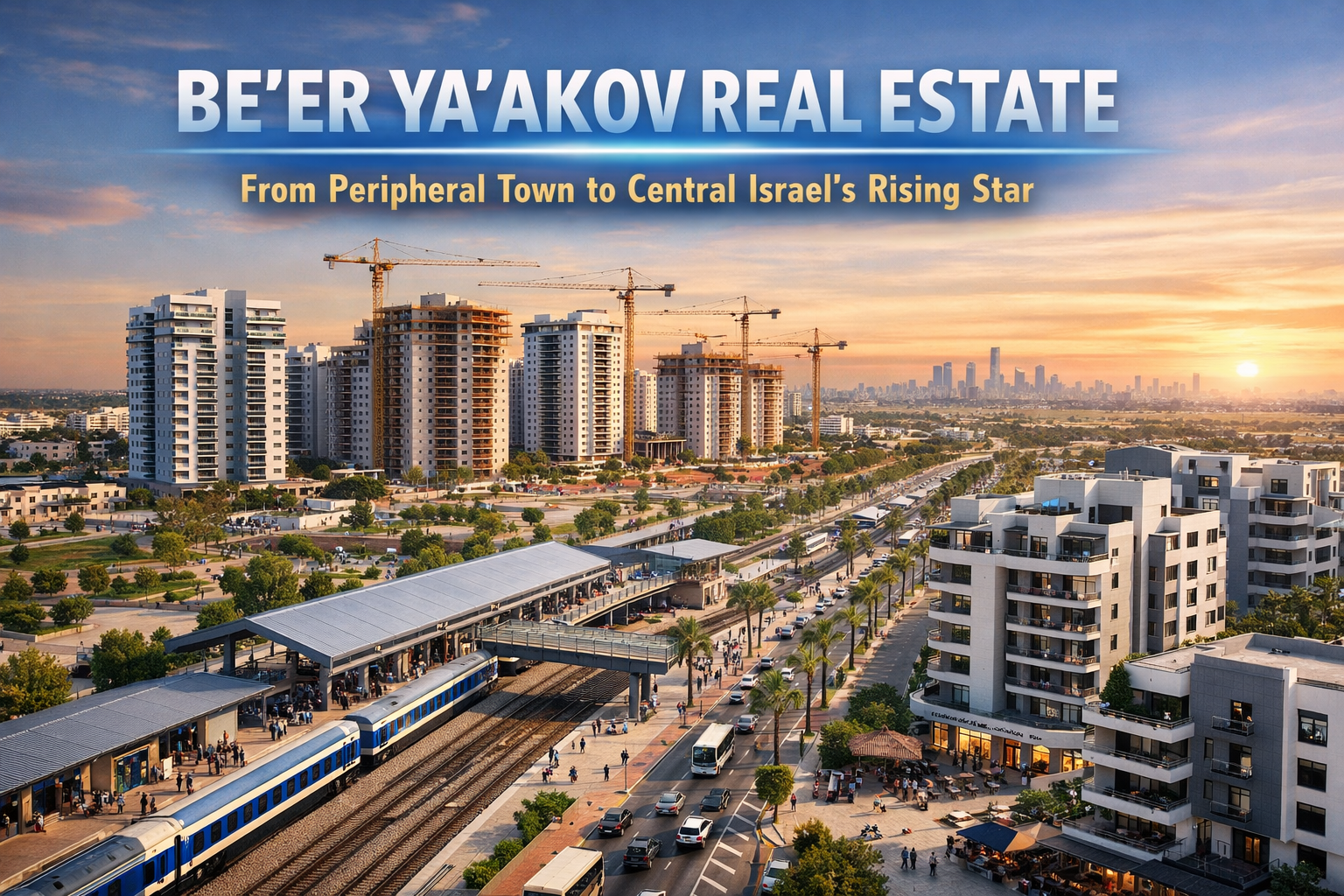
A Comprehensive Analysis of Housing Prices and Market Dynamics Compared to Surrounding Areas
The Transformation of a City
Be'er Ya'akov, once dismissively referred to as "that town near Tzrifin," has undergone a remarkable transformation over the past two decades. Established in 1907 and named after Rabbi Yaakov Yisrael Halevy, this historic settlement has evolved from a small, unassuming town with a poor reputation into one of central Israel's most dynamic real estate markets. Located just 7 kilometers east of Rishon LeZion and 20 kilometers southeast of Tel Aviv, Be'er Ya'akov now provides central Israel living without the premium price tag of its more famous neighbors—though that gap is rapidly closing.
In August 2021, Interior Minister Ayelet Shaked officially granted Be'er Ya'akov city status, marking the culmination of a 15-year campaign of intensive development. "Be'er Ya'akov has become an example of a strong municipality that succeeded in absorbing many new residents and significantly easing the housing crisis," Shaked stated. "It managed to establish itself economically amidst significant population growth, thanks to a mayor who took the town a major step forward, ensuring its development and prosperity."
The numbers tell a compelling story. According to the Central Bureau of Statistics, Be'er Ya'akov had a population of just 9,000 in 2005. By 2010, the number of residents had grown to approximately 12,000; in 2015, it reached 18,500; and by the end of 2019, the city was home to 28,000 people. As of 2023, that figure had climbed to 32,000 residents, with the city experiencing a staggering 5.4% annual population growth rate—more than double the national average. This growth stems not from natural increase but primarily from the surge in new construction expanding the settlement's boundaries.
The Price Revolution: From Affordable Alternative to Market Competitor
The transformation of Be'er Ya'akov's real estate market has been nothing short of dramatic. What was once considered an affordable alternative for those priced out of neighboring Rishon LeZion has become a sought-after destination in its own right, with prices that increasingly rival—and sometimes surpass—those of its larger neighbor.
The Historical Context
Ten years ago, prices in Be'er Ya'akov showed only a 10% gap above the national average—a difference of approximately 130,000 shekels compared to an average Israeli apartment. During this period, those who bought in Be'er Ya'akov were generally people who would have preferred living in neighboring Rishon LeZion but settled for something nearby. The city's image was still tethered to its past: during the early years of the state, immigrant transit camps were established nearby, and when these camps were later absorbed into Be'er Ya'akov, its socio-economic status dropped significantly.
The Current Reality
By 2021, the average price of a new 4-room apartment in Be'er Ya'akov was approximately NIS 2 million, with 5-room apartments selling for around NIS 2.3 million. Although these prices remained slightly cheaper than Rishon LeZion, the gap was already shrinking rapidly.
By February 2023, purchasing an apartment in Be'er Ya'akov required around 2.5-2.6 million shekels for a 4-room apartment and 2.7-2.8 million for 5 rooms—far from the national average exceeding 1.9 million shekels. This represented a gap exceeding 30% above the national average, a dramatic increase from the modest 10% premium of a decade earlier.
By October 2023, the average apartment price had climbed to 2.98 million shekels, with average rent reaching 6,600 shekels monthly. The average price per square meter reached 26,300 shekels—slightly above the national average of 23,300 shekels and far below Tel Aviv's 60,000 shekels per square meter, but now comparable to Rishon LeZion's average of 26,400 shekels per square meter.
The 2024 Watershed Moment
By October 2024, a significant new trend had emerged: prices in Be'er Ya'akov's new neighborhoods were beginning to surpass those of neighboring Rishon LeZion. Some neighborhoods now command average prices of 27,000 shekels per square meter or even higher, translating to approximately 2.7 million shekels for an average apartment. While this isn't occurring across all neighborhoods or all projects, it represents a notable shift in the market dynamics that previously characterized the relationship between these two cities.
The average price in Be'er Ya'akov now hovers around 25,500 shekels per square meter, though some new projects command exactly this figure. For comparison, prices at the massive Rambam neighborhood in Rishon LeZion stand at 25,000 shekels per square meter, with new construction pricing around 27,000 shekels depending on the specific project. For the first time, in certain transactions examined, Be'er Ya'akov's new neighborhood prices are actually surpassing new apartment prices in central Rishon LeZion.
Neighborhood-by-Neighborhood Analysis
Be'er Ya'akov's various neighborhoods offer different price points and investment characteristics:
Tsmarot HaMoshava (Treetop Colony)
One of the most recognized neighborhoods, Tsmarot HaMoshava attracts many residents from neighboring Rishon LeZion who view moving there as simply crossing the road while paying less—though the price differential has diminished considerably. A 4-room second-hand apartment costs around 2.6 million shekels, with average pricing at 27,400 shekels per square meter. Rental yields for property owners stand at approximately 2.42%, slightly above the city average. The neighborhood's proximity to the border between Be'er Ya'akov and Rishon LeZion makes it particularly popular among those relocating from the larger city.
Park HaMoshava
This neighborhood sells new apartments at a rapid pace with similar pricing to Tsmarot HaMoshava—26,000-27,000 shekels per square meter. The average apartment price reaches approximately 2.7 million shekels, with annual rental yields around 2.73% for property owners.
Talmei Menashe HaTse'ira (Young Talmei Menashe)
Located in the city's eastern section, this neighborhood offers somewhat lower prices at 23,000-25,000 shekels per square meter. Most construction finished approximately two years ago, explaining why current prices reflect second-hand rather than new construction values. This area represents a more affordable entry point into the Be'er Ya'akov market.
Ha'Eucalyptus Neighborhood
The new neighborhood adjacent to Rishon LeZion has become particularly expensive, even by Be'er Ya'akov standards. Residents describe the area as having the aesthetic of a moshav (cooperative agricultural community) rather than a large city, contributing to its appeal and premium pricing.
Recent Transaction Data
Recent sales in Be'er Ya'akov illustrate the current market reality:
She'a Nes 7: 91 sqm, 4 rooms, 1st floor — 2.48 million shekels (27,197/sqm)
Live Be'er Ya'akov: 94 sqm, 4 rooms, 11th floor — 2.51 million shekels (26,691/sqm)
HaTse'ira Be'er Ya'akov: 94 sqm, 4 rooms, 2nd floor — 2.64 million shekels (28,085/sqm)
ICR HaTse'ira Be'er Ya'akov: 99 sqm, 4 rooms, 7th floor — 2.6 million shekels (26,262/sqm)
Migdalei Prashkovsky: 104 sqm, 5 rooms, 4th floor — 3.07 million shekels (29,519/sqm)
Avisror Be'er Ya'akov: 168 sqm, 5 rooms, 16th floor — 4.65 million shekels
Avisror Be'er Ya'akov: 133 sqm, 5 rooms, 2nd floor — 3 million shekels
Kardan Sapir 2: 130 sqm, 5 rooms, 7th floor — 3.41 million shekels
Comparative Analysis: Be'er Ya'akov vs. Surrounding Cities
Rishon LeZion
The price per square meter in Rishon LeZion averages 26,000 shekels, though premium areas exceed 32,000 shekels per square meter. Overall, Be'er Ya'akov remains nominally cheaper than Rishon LeZion—but only by approximately 10%, whereas previously the difference was far more significant. In some newer neighborhoods, Be'er Ya'akov prices now match or exceed certain Rishon LeZion areas.
What surprises many observers is that when comparing the average apartment purchase price, Be'er Ya'akov (at 2.98 million shekels as of late 2023) actually exceeds Rishon LeZion's average of 2.5 million shekels. The explanation lies in apartment size: the average apartment in Be'er Ya'akov spans 112 square meters, compared to 92 square meters in Rishon LeZion. Buyers in Be'er Ya'akov are getting more space for their money, even if the total price is higher.
Ness Ziona
The price gap between Be'er Ya'akov and Ness Ziona currently stands at approximately 20% higher in Ness Ziona's favor, making Be'er Ya'akov still relatively attractive for buyers seeking central Israel locations at somewhat lower price points.
National Comparison
Be'er Ya'akov's prices sit well above the national average. While the average Israeli apartment costs around 1.9 million shekels, Be'er Ya'akov commands approximately 2.5-3 million shekels—a gap exceeding 30%. However, this remains far below Tel Aviv's stratospheric 60,000 shekels per square meter.
Rental Market Dynamics
The rental market in Be'er Ya'akov has experienced explosive growth. A typical 4-room apartment that rented for 5,000 shekels in 2021 commanded around 6,500-7,000 shekels by 2023-2024. This places Be'er Ya'akov among the leaders in rental price growth nationwide, surpassing even Tel Aviv's rental increases. Only communities like Caesarea, Zichron Ya'akov, Ra'anana, Tel Mond, and Even Yehuda rank higher in rental growth rates.
As of 2025, rental prices in Be'er Ya'akov average:
3-4 room apartments: 4,000-5,500 shekels monthly
4-5 room apartments: 6,000-7,000 shekels monthly
New apartments with large balconies or special features: 6,000+ shekels monthly
The rental yield for investors hovers around 2.5-3.6% annually, considered relatively high compared to other Israeli communities.
Development Plans and Future Growth
Be'er Ya'akov's transformation is far from complete. A comprehensive master plan approved by the District Planning and Building Commission establishes development over more than 9,500 dunams, accommodating a total of 27,000 apartments and bringing the city's projected population to approximately 85,000-100,000 by 2040.
Major Development Initiatives
A new neighborhood containing 2,200 housing units and a massive 100-dunam park has been deposited with the National Planning and Building Council (VATMAL). According to the Israel Land Authority's plan, 300 dunams in the city's west, north of Highway 431, will be annexed for residential purposes, continuing the urban fabric northward toward Rishon LeZion.
An employment and commercial district is under construction in the city center, including a complex with two 17-story office buildings above a large shopping floor totaling 40,000 square meters. This commercial development aims to transform Be'er Ya'akov from primarily a commuter town into a more self-sufficient urban center.
Transportation Infrastructure
Plans exist to connect Be'er Ya'akov to Gush Dan through a metro network. The city sits at the southeastern end of the 45-kilometer M1 line, which will pass through Rishon LeZion, Holon, Tel Aviv, Ramat Hasharon, Herzliya, and Ra'anana. A brown bus line extension serving Rishon LeZion, Be'er Ya'akov, and Ramla was scheduled to begin operation, designed as a complementary network for the Tel Aviv mass transit system. Additionally, plans include electrifying the railway to improve air quality and increase train speeds.
The city already benefits from its Be'er Ya'akov Railway Station, offering direct service to Tel Aviv (25 minutes), Ben Gurion Airport, Jerusalem, and southern cities. Highway access is excellent, with proximity to Highways 4, 431, and 44, plus easy connections to Highways 1 and 6.
The Investment Perspective
Supply and Demand Dynamics
Interestingly, Be'er Ya'akov ranks fourth nationally for growth in new apartment supply, with a 63% increase in one year. Yet despite this supply growth, prices continue rising—a phenomenon explained by extraordinarily high demand. The city represents an alternative to Gush Dan for young families priced out of the Tel Aviv metropolitan area but requiring reasonable commuting distances to central Israel employment centers.
Discounted Housing Programs
Be'er Ya'akov has become extremely attractive for Israel's discounted housing lottery programs. A recently published tender for over 1,200 housing units revealed interesting pricing dynamics. According to appraisers' reports, prices in these complexes range from 22,800 to 24,770 shekels per square meter—more than 10% below current market values. This discrepancy occurs because certain areas lack sufficient transaction data, requiring appraisers to derive values through land value, construction costs, and developer profit margins.
The discount program in Be'er Ya'akov was priced at 17,786 shekels per square meter before discount in May 2022, indicating prices rose approximately 1,700 shekels per square meter in the following 18 months. Those fortunate enough to win the discounted housing lottery in Be'er Ya'akov effectively receive apartments at roughly 40% below market price—a substantial windfall.
Quality of Life Considerations
Some argue that quality of life in Be'er Ya'akov surpasses Rishon LeZion, despite the short distance—only 10 minutes apart. This mirrors the American phenomenon of "suburban sprawl"—people choosing to abandon expensive central apartments and move a few kilometers to nearby cities. Quality of life is measured partly by apartment size: the average apartment in Be'er Ya'akov spans 112 square meters, compared to 92 square meters in Rishon LeZion.
Be'er Ya'akov offers an upgrade in living standards compared to Rishon LeZion without moving too far away. The city maintains the aesthetic quality of a moshav rather than a large metropolis, with parks throughout, a commercial center, schools, and a high school—all conveniently located and well-maintained.
Challenges and Considerations
Despite its many advantages, potential buyers and investors should consider several factors:
Infrastructure Strain
The rapid population growth has created infrastructure challenges. Some neighborhoods, particularly newer ones developed under the "Mechir LaMishtaken" (Price for Buyer) program, were built with only one parking space per apartment and no public parking facilities, creating severe parking congestion.
Ongoing Construction
The extensive development means ongoing construction noise and temporary inconveniences throughout much of the city. While this signals continued investment and improvement, it affects daily quality of life for current residents.
Market Timing
The rapid price appreciation of recent years has made entry more difficult for first-time buyers. Properties that were affordable five years ago now require significantly more capital. However, with prices potentially stabilizing or even declining slightly in some areas due to broader economic conditions, opportunities may emerge.
Conclusion: A City Writing Its Own Story
Be'er Ya'akov represents a fascinating case study in Israeli urban development—a place where authentic small-town Israel meets contemporary development and growing opportunity. It offers a distinctive solution to Israel's housing challenges, providing central location without the most extreme premium prices, though the gap has narrowed considerably.
The average salary in Be'er Ya'akov reaches 11,000 shekels monthly, approximately 1,000 shekels above the national average, indicating a population with solid economic foundations. The city's borders have effectively "stretched" the boundary of neighboring Rishon LeZion, even though the two remain separate municipalities.
For those willing to embrace a community in transformation, Be'er Ya'akov offers a compelling proposition—the chance to enjoy central Israel living with better housing value relative to Tel Aviv, stronger community connections, and the excitement of being part of a place actively becoming something new. Whether as a young family seeking a first home, a Tel Aviv resident tired of premium prices for minimal space, or an investor recognizing growth potential in an emerging area, Be'er Ya'akov merits serious consideration.
The city that was once dismissed as "that place near Tzrifin" has become a legitimate competitor to its larger neighbors, with prices reflecting its transformed status. As one longtime resident observed: "Be'er Ya'akov is writing its story now. It's not just preserving the past or rushing toward the future—it's thoughtfully blending both to create something unique. Those of us who live here are part of that evolution, helping shape what this community becomes."