
Why Britain Is No Longer Safe for Jews
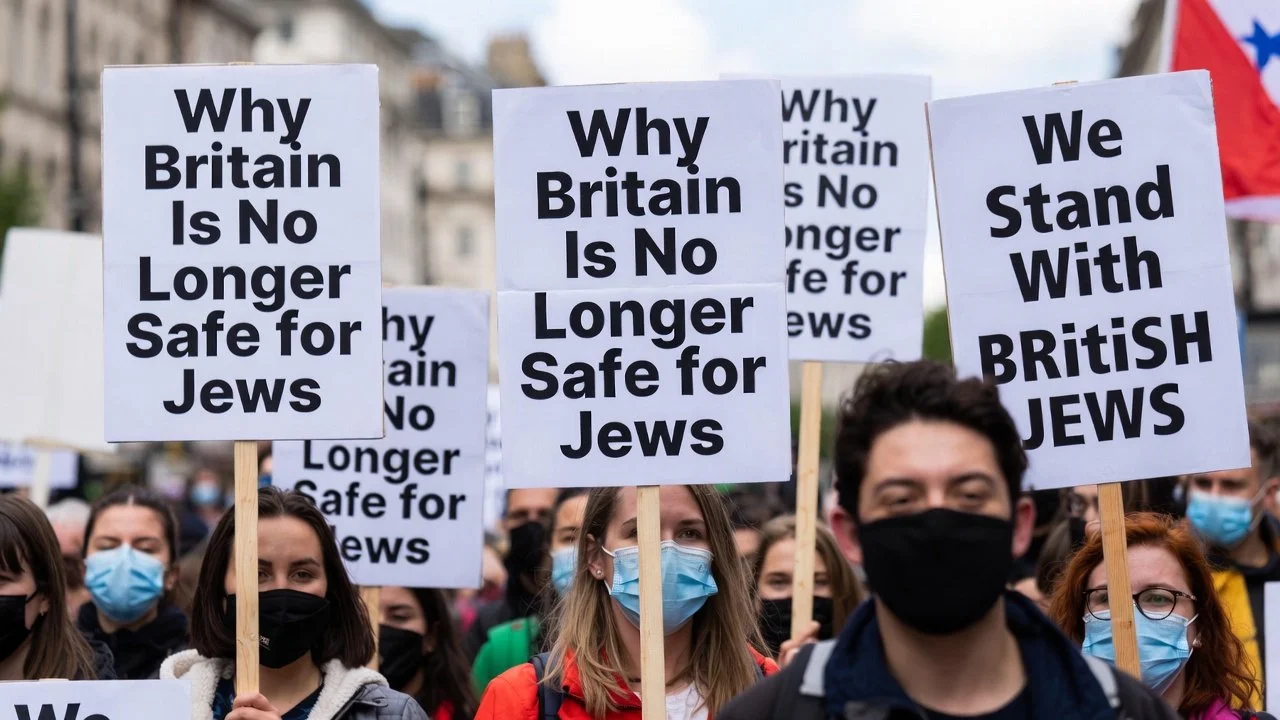
A country that once prided itself on tolerance is failing its oldest minority
There is a particular kind of terror that comes not from the violence itself, but from the recognition that the violence was expected. When a terrorist drove his car into worshippers and stabbed congregants outside the Heaton Park Hebrew Congregation in Manchester on Yom Kippur — the holiest day of the Jewish calendar — on 2 October 2025, the Jewish community recoiled in grief. But not in surprise. As one survivor, Anne Goldstone, put it with devastating understatement: "It was shocking. But… it was kind of a bit of an inevitability."
That sentence should haunt every citizen of Britain. When the murder of Jews at prayer is regarded as inevitable by the very people targeted, something has gone catastrophically wrong in the life of a nation.
The numbers tell a story of relentless escalation. The Community Security Trust, the charity that monitors antisemitic hatred across the United Kingdom, recorded 3,700 antisemitic incidents in 2025 — the second-highest total since it began keeping records in 1984 and a four per cent increase over the previous year. For the first time in recorded history, every single month exceeded 200 incidents. The monthly average reached 308 — precisely double what it had been before October 2023. And these figures are, by the CST's own admission, conservative. Some 3,001 additional events, including physical attacks and suspected reconnaissance of Jewish sites, were excluded because they did not meet the charity's rigorous evidence threshold.
What do these numbers look like in human terms? They look like Jewish schoolchildren practising self-defence drills. They look like synagogues reinforced with blast-resistant glass and steel security doors, the kind of hardening one associates with embassies in war zones, not houses of worship in suburban England. They look like rabbis receiving death threats on their answering machines, told to leave the cities where their families have lived for generations. They look like 81 per cent of British Jews reporting that they feel compelled to conceal their Jewishness in public — not in 1930s Berlin, but in 2025 London, Manchester, and Leeds.
The Heaton Park attack was the culmination, not the beginning, of this crisis. Melvin Cravitz, 66, was killed by the attacker. Adrian Daulby, 53, appears to have been struck by police gunfire as officers ended the assault — a detail of almost unbearable tragedy. Both men were from Crumpsall. Both were part of the fabric of a Jewish community that had worshipped in that neighbourhood since 1935. They were murdered, or caught in the crossfire of murder, because they went to synagogue on the Day of Atonement.
In the hours after the attack, two cars drove past the scene flying Palestinian flags while men in balaclavas muttered about Jews. Antisemitic hate crime in Greater Manchester tripled in the three weeks that followed. Bomb threats were phoned in to synagogues in Leeds. Across the country, Jewish congregations gathered for the remainder of the High Holy Days under armed guard — or did not gather at all.
The attack was declared a terrorist incident. But the broader ecosystem of hatred that produced it — the ambient dread in which British Jews now live — cannot be addressed with counterterrorism alone.
The concept of "ambient antisemitism" has become central to understanding what has happened to Jewish life in Britain. The Institute for Jewish Policy Research found that 45 per cent of British Jews now experience indirect antisemitism — hostile media coverage, online abuse, workplace microaggressions, casual conspiracy theories — on a frequent or regular basis. Before October 2023, that figure was eight per cent. The JPR's landmark study, surveying over 4,800 British Jews, revealed that 35 per cent now rate their safety in Britain between zero and four on a ten-point scale. Before the Hamas attack on Israel, only nine per cent felt so endangered.
These are not the anxieties of a community prone to exaggeration. British Jews number roughly 290,000 in a nation of 70 million. They are among the most integrated, most accomplished, and most civic-minded of all minority populations. They sit in Parliament, lead universities, shape the arts and the law. Yet a majority — 61 per cent — have considered leaving Britain in the past two years. Only a third believe they have a long-term future in the country.
Consider the weight of that finding. A community with roots in Britain stretching back centuries, one that survived the Aliens Act, the Blackshirts, and decades of genteel exclusion to become an integral part of the national story — this community now doubts whether it belongs here at all.
The sources of the hatred are multiple, and it is essential to name them honestly without collapsing into partisanship. The CST and the British government have identified antisemitism flowing from three distinct ideological currents: the far right, the far left, and Islamist extremism. Each has its own grammar of Jew-hatred, but they converge on the same victim.
The far right traffics in the old conspiracies — Jewish control of finance, media, governments — updated for the age of social media. The far left, particularly in its anti-Zionist formations, has increasingly blurred the line between opposition to Israeli government policy and the collective demonisation of Jewish people. More than half of all antisemitic incidents recorded by the CST in the first half of 2025 were linked to Israel and Palestine, with offenders in over 700 cases showing political motivation that went well beyond legitimate criticism of a foreign government. On 172 occasions, Jews in Britain were told that Israel is equivalent to Nazi Germany — a comparison designed not to illuminate but to wound, to weaponise Jewish suffering against the Jews themselves.
And Islamist extremism, as the Manchester attack demonstrated with sickening clarity, brings the threat of lethal violence. The attacker at Heaton Park did not ask his victims for their views on Zionism. As the novelist Howard Jacobson observed, he targeted them because they were Jews — gathered in prayer, in a suburb of Manchester far from Gaza, as innocent of colonial ambition as it is possible to be.
What makes Britain's situation especially painful is the failure of its institutions to meet the moment. Only 14 per cent of British Jews believe the police do enough to protect them. A mere seven per cent feel the Crown Prosecution Service provides adequate protection. The courts fare little better, with only ten per cent expressing confidence. Ninety-three per cent believe the government does not do enough.
These are not fringe sentiments. They reflect a lived experience in which antisemitic abuse goes unreported because reporting feels futile, in which marches through city centres carry banners that Jewish communities experience as threatening while the police facilitate the marchers' right to protest, in which synagogues must fund their own private security because the state cannot guarantee their safety.
The political landscape offers scant comfort. Eighty per cent of British Jews believe the current Labour government has been bad for the Jewish community — a staggering indictment of a party that promised to exorcise the antisemitism that metastasised under its previous leadership. Trust in political parties across the spectrum remains at rock bottom. The sense is not that one party has failed but that the entire political class has averted its gaze.
There is a phrase that recurs in discussions of antisemitism: that Jews are the canary in the coal mine — that when they are targeted, it signals a broader civilisational danger. This is true, but as the Spectator recently noted, it risks reducing living, breathing human beings to a warning system for others. British Jews are not an alarm. They are citizens. They are neighbours. They are, as the article put it, "our people."
The question before Britain is not an abstract one about the health of liberal democracy, though it is that too. It is a concrete and urgent question about whether a country that claims to value pluralism, tolerance, and the rule of law can guarantee that a quarter of a million of its citizens can walk to synagogue without fear, can wear a Star of David on the Tube without dread, can send their children to school without wondering whether the security guard at the gate will be enough.
At present, Britain cannot make that guarantee. The statistics say so. The polling says so. The reinforced doors on synagogues say so. The blood on a rabbi's white robes in Manchester says so.
A nation is ultimately judged not by the rights it enshrines in law but by the safety it provides in practice. By that measure, Britain is failing its Jews. And in failing them, it is failing itself — betraying the very values it professes to hold most dear. The question is no longer whether the crisis is real. It is whether Britain possesses the moral courage to confront it before it is too late.