
Jerusalem Property Market Report Q3 2025
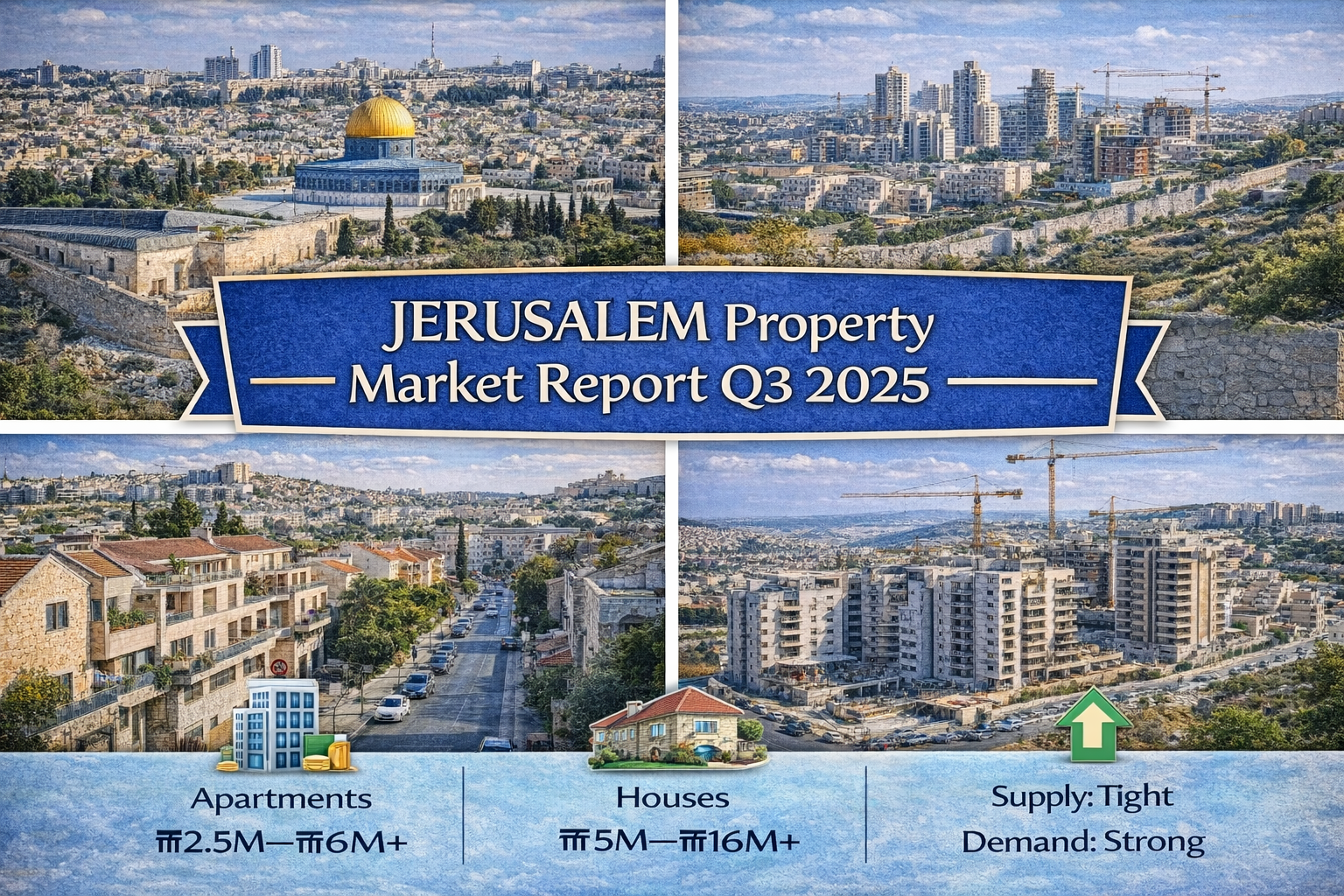
Jerusalem stands as Israel's eternal city and spiritual capital, a municipality of extraordinary significance where three thousand years of history create real estate dynamics unlike any other market in the world. The city's property market in Q3 2025 demonstrated exceptional resilience amid national correction trends, with average prices reaching 2.899 million shekels according to Central Bureau of Statistics data, representing remarkable 6.3 percent annual appreciation compared to Q3 2024 when most Israeli cities experienced price declines. This counter-cyclical performance positions Jerusalem as the only major Israeli city showing strong positive growth during a period when Tel Aviv declined 1.6 percent and the Central District fell 2.8 percent, demonstrating fundamental demand characteristics that transcend economic cycles and provide insulation from forces affecting markets lacking Jerusalem's unique combination of spiritual significance, historic preservation constraints, and sustained diaspora investment.
The quarterly price movement from Q2 to Q3 2025 showed continued positive momentum with 0.5 percent growth, making Jerusalem the only major city posting positive quarterly gains when Tel Aviv declined 0.1 percent, Haifa fell 1.2 percent, and the Central District dropped 0.9 percent during the same period. This exceptional relative strength reflects multiple reinforcing factors including structural supply constraints from geographic limitations and historic preservation requirements, irreplaceable spiritual significance attracting perpetual demand from religious communities worldwide, established diaspora investment patterns providing capital flows independent of Israeli economic conditions, and government institutional presence creating stable employment supporting local purchasing capacity. The market demonstrates that Jerusalem operates according to different rules than typical real estate markets, with demand drivers extending far beyond conventional housing economics into spiritual, cultural, and emotional dimensions creating sustained buyer interest regardless of interest rates, economic cycles, or geopolitical uncertainties.
Geographic and political constraints create Jerusalem's fundamental supply limitations, with hilly terrain, political boundaries, and extensive preservation requirements severely restricting developable land and preventing the inventory buildups that pressure prices in less constrained markets. The Old City and surrounding historic areas face strict building regulations protecting ancient structures and archaeological resources, eliminating development opportunities in central locations where demand concentrates most intensely from buyers seeking proximity to Western Wall, Temple Mount, and other holy sites commanding spiritual premiums impossible to quantify through conventional valuation methodologies. Modern development proceeds primarily in peripheral areas and through urban renewal projects replacing older buildings in established neighborhoods, creating limited new supply that cannot possibly satisfy demand from growing religious populations, sustained diaspora interest, and government institutional expansion requiring housing for civil servants and their families.
The three thousand year history as Jewish capital creates spiritual significance unmatched by any other city worldwide, generating perpetual demand from religious Jews seeking proximity to holy sites and the opportunity to fulfill religious obligations through Jerusalem residence. This spiritual premium manifests in buyer willingness to pay prices disconnected from conventional housing economics, with families sacrificing space, amenities, and financial comfort to afford Jerusalem addresses enabling walking access to Western Wall prayers, participation in Temple Mount pilgrimage traditions, and immersion in religious community life centered around the city's dense synagogue infrastructure. The demand extends beyond current residents to diaspora communities worldwide where Jerusalem property represents spiritual connection, inheritance planning for descendants, and concrete expression of religious identity transcending pure investment considerations, creating buyer pools whose motivation incorporates emotional and ideological dimensions fundamentally different from secular markets driven primarily by housing functionality and financial returns.
Neighborhood segmentation in Jerusalem spans extraordinary diversity from ultra-premium historic districts to affordable peripheral developments, with pricing reflecting proximity to holy sites, neighborhood character, and accessibility to employment and services. Rechavia and Talbiya represent Jerusalem's elite addresses commanding forty thousand to seventy thousand shekels per square meter and above for well-maintained apartments and exceptional properties, with typical units ranging from 3.6 to 4.5 million shekels and above attracting affluent domestic buyers and international diaspora purchasers seeking premier Jerusalem positioning. German Colony commands thirty-five thousand to fifty thousand shekels per square meter with typical properties at 3.2 to 4.0 million shekels, offering historic charm near the popular Emek Refaim commercial corridor and attracting lifestyle buyers valuing pedestrian-oriented neighborhood character. Baka serves young professionals and families at thirty-five thousand to fifty thousand shekels per square meter with units typically ranging from 2.8 to 3.5 million shekels, providing quality residential environment with good accessibility and moderate prices compared to ultra-premium alternatives.
Old Katamon and Arnona offer established residential character at twenty-eight thousand to thirty-eight thousand shekels per square meter, with properties typically ranging from 2.5 to 3.5 million shekels and providing value-oriented positioning for buyers seeking Jerusalem address without extreme premium pricing characteristic of elite neighborhoods. Beit Hakerem serves secular western Jerusalem populations at twenty-five thousand to thirty-five thousand shekels per square meter with typical units at 2.3 to 3.0 million shekels, offering middle-class residential character with good transportation access and moderate costs. Gilo represents affordable southern Jerusalem with pricing at eighteen thousand to twenty-five thousand shekels per square meter and properties typically ranging from 1.8 to 2.4 million shekels, providing budget-conscious entry points for buyers prioritizing Jerusalem residence over neighborhood prestige or central location, though requiring acceptance of peripheral positioning and commute requirements for employment access.
Recent transaction examples from 2025 demonstrate Jerusalem's price positioning across varied locations and property types, with actual recorded sales providing concrete market evidence supplementing average statistics. A four-room apartment on Gedalia Bublick Street sold for 2.7 million shekels representing eighty-two square meters in a 1980 building, demonstrating mid-market pricing for standard units in established locations. A 3.5-room apartment on Abba Eban Street commanded 3.69 million shekels for eighty-nine square meters in a 2010 construction, reflecting premium positioning in newer building with contemporary standards. A four-room unit on Arnon Street achieved 3.61 million shekels for eighty-eight square meters in a 2001 building, while a five-room apartment on Harav Toledano Street sold for 3.7 million shekels representing one hundred twenty-one square meters in 2018 construction. A four-room apartment on Bibas Street commanded substantial 4.2 million shekels for eighty square meters in 1994 building, demonstrating premium pricing in desirable location where neighborhood character and positioning justify elevated per-square-meter valuations.
The rental market in Jerusalem demonstrates robust activity with gross yields averaging 3.54 percent across the city, outperforming Tel Aviv's 3.14 percent average and providing better cash flow characteristics for investors despite similar capital requirements. One-bedroom apartments typically rent for 3,200 to 5,000 shekels monthly serving students and singles, particularly the substantial yeshiva student population requiring temporary housing during religious study periods. Two-bedroom units command 5,000 to 8,600 shekels monthly appealing to couples and small families, with significant variation based on neighborhood quality and property condition. Four-bedroom apartments generate 9,000 to 10,500 shekels monthly serving larger families requiring space for children, while premium properties in Rechavia and Talbiya command 11,900 to 14,000 shekels and above monthly serving diplomatic personnel, senior executives, and affluent tenants seeking Jerusalem's finest residential environments.
Annual rental growth of at least four percent during 2024-2025 reflects sustained upward pressure on rents from continued population growth and housing demand exceeding supply additions, creating landlord-favorable dynamics where rental income appreciation supplements capital gains for investors. The diverse tenant base including religious students attending Jerusalem's numerous yeshivot, diplomatic personnel staffing embassies and international organizations, government employees working at Knesset and ministry offices, and Hebrew University academic community creates multi-dimensional rental demand providing market stability through tenant diversity rather than dependence on single demographic whose circumstances might change dramatically. The rental strength indicates underlying housing demand continues exceeding supply in ways supporting property values through fundamental scarcity rather than speculative dynamics, providing income cushion for investors generating positive cash flows during market uncertainties when appreciation expectations become less certain.
Structural supply constraints create Jerusalem's fundamental market characteristics distinguishing the city from locations where development can expand meeting demand through construction responding to price signals. Geographic limitations from hilly terrain surrounding the city and political constraints from complex jurisdictional boundaries prevent the geographic expansion characteristic of less constrained municipalities, forcing development intensity within existing boundaries where regulatory and preservation requirements limit vertical growth as well. Historic preservation requirements protecting Old City, adjacent neighborhoods, and archaeological resources throughout the city prevent development in locations where demand concentrates most intensely, ensuring that well-located properties with holy site proximity retain scarcity value regardless of market conditions. The Q3 2025 transaction composition showing only 436 new unit sales versus over 700 second-hand transactions demonstrates limited new supply entering market despite sustained demand, with construction primarily occurring in peripheral areas rather than central locations where buyers most prefer.
Religious community demographics create structural demand supporting Jerusalem market resilience independent of economic cycles affecting secular populations where housing demand correlates more directly with employment and income volatility. High birth rates among Orthodox and ultra-Orthodox communities generate organic household formation requiring housing regardless of economic conditions, creating buyer pools with inelastic demand continuing through downturns when secular markets experience transaction collapses. Religious lifestyle priorities emphasizing community proximity over geographic flexibility reduce outmigration that might otherwise moderate demand, as families sacrifice potential financial advantages from cheaper locations to maintain synagogue access, children's religious education, and social networks within observant communities. The yeshiva student population requiring temporary housing creates continuous rental demand supporting investor returns and property values through sustained tenant activity even during periods when purchase markets slow from affordability constraints.
International diaspora investment provides capital flows supporting Jerusalem market strength independent of Israeli economic conditions, with Jewish communities worldwide viewing Jerusalem property as spiritual connection, inheritance for descendants, and concrete expression of religious identity worth substantial financial sacrifice. North American and European buyers frequently purchase Jerusalem apartments for part-year residence during holidays and visits, generating limited personal use but maintaining properties as spiritual anchor points and potential future retirement destinations when professional obligations permit relocation. The strong shekel against major currencies during portions of 2024-2025 affected foreign buyer calculations, with currency movements sometimes overwhelming property price changes in determining relative value for international investors assessing all-in costs in home currencies, though fundamental spiritual motivations often override pure financial optimization in Jerusalem purchase decisions. The new immigrant tax benefits providing substantial purchase tax reductions for qualifying buyers create powerful financial incentives supporting demand from diaspora families making aliyah, effectively reducing acquisition costs by hundreds of thousands of shekels on typical Jerusalem transactions.
Government institutional presence creates stable employment foundation supporting Jerusalem housing demand through civil service positions at Knesset, Supreme Court, and ministry offices providing reliable income streams enabling mortgage qualification and property purchases. The government employment concentration, while creating dependence on public sector rather than diversified private economy, provides counter-cyclical stability during economic downturns when private sector layoffs reduce housing demand in commercially-oriented cities while government positions remain secure. Hebrew University and other academic institutions create additional professional employment and student populations supporting both purchase and rental demand across varied price points and neighborhoods, with academic community representing sophisticated buyer demographic valuing Jerusalem's cultural and intellectual environment beyond pure housing functionality. Diplomatic community from embassies, consulates, and international organizations generates premium rental demand and occasional purchases from personnel establishing longer-term Jerusalem presence, creating high-end market segment with distinct characteristics and premium price tolerance.
Investment perspectives on Jerusalem property require analyzing the city's value proposition as spiritually significant real estate serving buyers whose motivations extend beyond conventional housing economics into religious, cultural, and emotional dimensions creating unique market characteristics. For diaspora buyers seeking spiritual connection and potential future residence, Jerusalem represents irreplaceable opportunity combining religious significance with real estate investment, though purchase decisions should incorporate realistic assessment of rental income potential during absence periods and practical considerations around property management from overseas. The 6.3 percent annual appreciation during challenging market conditions demonstrates Jerusalem's counter-cyclical characteristics providing portfolio diversification for Israeli real estate investors, with the city often performing differently than Tel Aviv and other major markets during various economic phases. The superior rental yields of 3.54 percent versus Tel Aviv's 3.14 percent create better cash flow dynamics for income-oriented investors, particularly when combined with appreciation potential from structural scarcity supporting sustained value growth.
For local investors focused primarily on financial returns, Jerusalem provides compelling combination of yield and appreciation potential, though requires acceptance of neighborhood diversity where religious character varies substantially and property selection must align with intended tenant demographics. Old Katamon and Arnona at twenty-eight thousand to thirty-eight thousand shekels per square meter offer value positioning with appreciation potential as established neighborhoods maintain desirability without premium pricing of elite addresses. Gilo represents affordable entry at 1.8 to 2.4 million shekels with rental demand from budget-conscious tenants and government employees, providing accessible investment opportunities for buyers lacking capital for premium neighborhoods. Properties near yeshivot and religious institutions benefit from sustained student rental demand providing reliable tenant flows and reduced vacancy risk compared to locations dependent on more volatile secular tenant populations with greater residential flexibility.
For religious families establishing permanent Jerusalem residence, neighborhood selection represents crucial decision affecting daily life quality through synagogue access, children's education options, and community integration opportunities that extend far beyond pure property characteristics. Proximity to holy sites commands spiritual premium justifying financial sacrifice for observant families prioritizing religious practice over material comfort, with walking distance to Western Wall creating substantial value for buyers whose religious observance requires Sabbath accessibility to prayer services. The comprehensive religious infrastructure including hundreds of synagogues across denominations, extensive yeshiva networks, kosher commercial ecosystems, and mikvah facilities creates self-contained religious environment where families can maintain Orthodox lifestyles without compromise, attracting buyers for whom religious community cohesion represents primary purchase motivation exceeding financial considerations.
For sellers, Jerusalem's exceptional market strength creates favorable positioning with the 6.3 percent annual appreciation and positive quarterly growth demonstrating sustained buyer demand supporting pricing power when most markets experience corrections. Emphasis on proximity to holy sites, neighborhood religious character, and community integration opportunities proves essential when marketing to appropriate buyer pools, particularly international diaspora purchasers for whom spiritual significance may override conventional property evaluation criteria. Marketing through channels reaching North American and European Jewish communities can access international buyer pools with purchase motivations and financial capacity differing from local buyers, potentially achieving better outcomes than purely domestic marketing missing international demand sources. Timing listings to coincide with diaspora visitation periods during holidays and summer months when international buyers travel to Israel can optimize buyer exposure compared to periods when international visitor traffic diminishes.
Market considerations requiring buyer attention include the dramatic variation in religious character across neighborhoods, with some areas predominantly ultra-Orthodox, others modern Orthodox or religious Zionist, and still others secular, requiring careful matching of family religious practice with appropriate community environment. Commute distance of sixty to seventy-five minutes to Tel Aviv eliminates Jerusalem as viable option for daily Tel Aviv commuters, restricting buyer pool to those with Jerusalem-based employment, remote work flexibility, or willingness to accept substantial travel burdens for occasional urban access. Government employment dominance creates different economic character than technology-focused Tel Aviv, with lower private sector salaries and reduced high-income employment opportunities affecting buyer demographics and potentially limiting appreciation potential compared to markets benefiting from technology sector wealth creation.
Historic property maintenance in premium neighborhoods requires higher upkeep costs than modern construction, with older buildings in Rechavia and German Colony demanding specialist contractors and authentic materials increasing ownership expenses beyond typical apartment assessments. Political sensitivity around Jerusalem's status can affect international buyer confidence during periods of heightened diplomatic tension, though historical patterns suggest that short-term political concerns rarely translate to sustained market impacts given fundamental demand drivers independent of political developments. Premium area entry costs with Rechavia and Talbiya requiring forty thousand to seventy thousand shekels per square meter demand significant capital accessible only to wealthy buyers, creating natural barriers limiting buyer pools for elite properties and potentially affecting liquidity compared to more accessible mid-market segments with broader demographic participation.
Security considerations, heightened following October 2023 events and subsequent regional tensions, increasingly influence buyer preferences with properties featuring protected rooms commanding measurable premiums over units lacking these safety features. Jerusalem's complex security environment creates distinct considerations from other Israeli cities, with mixed populations and political sensitivities affecting neighborhood-level perceptions and property values in ways requiring local expertise to properly assess. Municipal emergency preparedness infrastructure and responsive local government create confidence among residents that challenges will be managed professionally, supporting market stability during stress periods when less secure locations experience sharper corrections. International buyers particularly sensitive to security dynamics benefit from professional guidance assessing specific building and neighborhood characteristics, as these factors increasingly affect values in ways not immediately apparent to purchasers lacking Israeli security environment experience.
Environmental and quality of life considerations in Jerusalem reflect the city's highland location and historic character creating both benefits and challenges for residential experience. The elevated positioning provides cooler temperatures than coastal cities during summer months, creating climate advantages appreciated by residents escaping humid heat affecting Tel Aviv and Mediterranean locations. Historic character and preserved architecture create aesthetic environment distinguishing Jerusalem from modern Israeli development, though older building stock may lack contemporary energy efficiency and climate control capabilities requiring higher operating costs or renovation investments. The density and historic preservation in central areas limit green space and recreational facilities compared to planned suburban municipalities, though the Old City and surrounding hills provide unique walking and exploration opportunities impossible to replicate elsewhere.
Future development prospects in Jerusalem remain constrained by geographic limitations, political boundaries, and preservation requirements preventing dramatic expansion or transformation that might alter fundamental market dynamics. Urban renewal projects replacing older buildings with modern construction will continue in established neighborhoods, creating selective new supply at premium pricing while eliminating some affordable older inventory that provided accessible entry points. Government infrastructure investments including light rail expansion and road improvements may enhance accessibility and property values in areas benefiting from improved connectivity, though construction disruption during implementation periods can temporarily depress nearby property values before ultimate benefits materialize. The population growth from natural increase in religious communities and continued immigration should sustain housing demand exceeding supply additions, supporting long-term appreciation trajectory through fundamental scarcity dynamics rather than speculative excess.
Demographic projections suggest Jerusalem will continue experiencing population growth driven primarily by high birth rates in religious communities and sustained immigration from diaspora populations seeking Israeli residence, creating ongoing housing demand supporting property values through fundamental supply-demand imbalances. The aging of current residents may create lifecycle transitions as elderly populations downsize or relocate for health reasons, potentially increasing inventory of certain property types while creating demand for age-appropriate configurations and senior-oriented housing options. The religious demographic dominance suggests continued demand concentration in neighborhoods with strong religious infrastructure, potentially creating bifurcated market dynamics where religious areas experience different performance than secular neighborhoods serving different buyer demographics with distinct preferences and price sensitivities.
Comparison to alternative markets helps contextualize Jerusalem's value proposition within competitive landscape of Israeli premium residential destinations. Tel Aviv commands comparable pricing with dramatically different character emphasizing secular cosmopolitan lifestyle, Mediterranean beaches, and technology employment concentration, creating distinct market segment with limited direct competition despite price similarity given fundamentally different buyer motivations and lifestyle preferences. Ramat Beit Shemesh offers religious community alternative at substantially lower costs with thirty-five minute Jerusalem commute proximity, providing affordable option for religious families prioritizing community over Jerusalem address while accepting suburban rather than urban character. Modi'in provides modern planned city alternative for professional families requiring employment access to both Jerusalem and Tel Aviv, offering contemporary housing at moderate prices but lacking Jerusalem's spiritual significance and historic character that command premium positioning.
Looking forward, Jerusalem's property market trajectory appears positioned for continued resilience based on fundamental demand drivers including spiritual significance creating perpetual buyer interest, structural supply constraints preventing inventory buildups, religious demographic dynamics generating organic demand independent of economic cycles, and sustained diaspora investment providing capital flows less sensitive to Israeli economic conditions. The exceptional Q3 2025 results showing 6.3 percent annual appreciation and positive 0.5 percent quarterly growth when other markets declined demonstrate market momentum suggesting near-term continuation of favorable dynamics absent dramatic negative shocks. The structural supply constraints from geography and preservation requirements provide foundation for sustained appreciation over long time horizons as growing populations encounter fixed premium housing inventory, creating scarcity dynamics that historically drive real estate returns independent of broader economic fluctuations.
Jerusalem emerges from this analysis as Israel's most resilient major market demonstrating exceptional 6.3 percent appreciation and positive quarterly growth when national markets experienced corrections, driven by unique combination of three thousand year spiritual significance, structural supply constraints from geography and preservation, religious demographic dynamics creating perpetual demand, and sustained diaspora investment providing counter-cyclical capital flows. The city serves buyers whose motivations extend beyond conventional housing economics into spiritual, cultural, and emotional dimensions creating market characteristics fundamentally different from typical real estate, with demand drivers transcending interest rates, economic cycles, and geopolitical uncertainties that determine outcomes in secular markets driven primarily by financial calculations. For diaspora buyers seeking spiritual connection, religious families prioritizing holy site proximity, and investors pursuing counter-cyclical diversification, Jerusalem provides irreplaceable combination of attributes that no alternative market can match across all dimensions simultaneously. The eternal city ultimately rewards those who value what Jerusalem specifically offers—spiritual significance, historic character, religious community—and align purchase decisions with these attributes rather than expecting secular amenities, coastal lifestyle, or characteristics more appropriately associated with different market segments operating at alternative positioning and serving distinct buyer demographics.