
Jerusalem | Anglo Communities
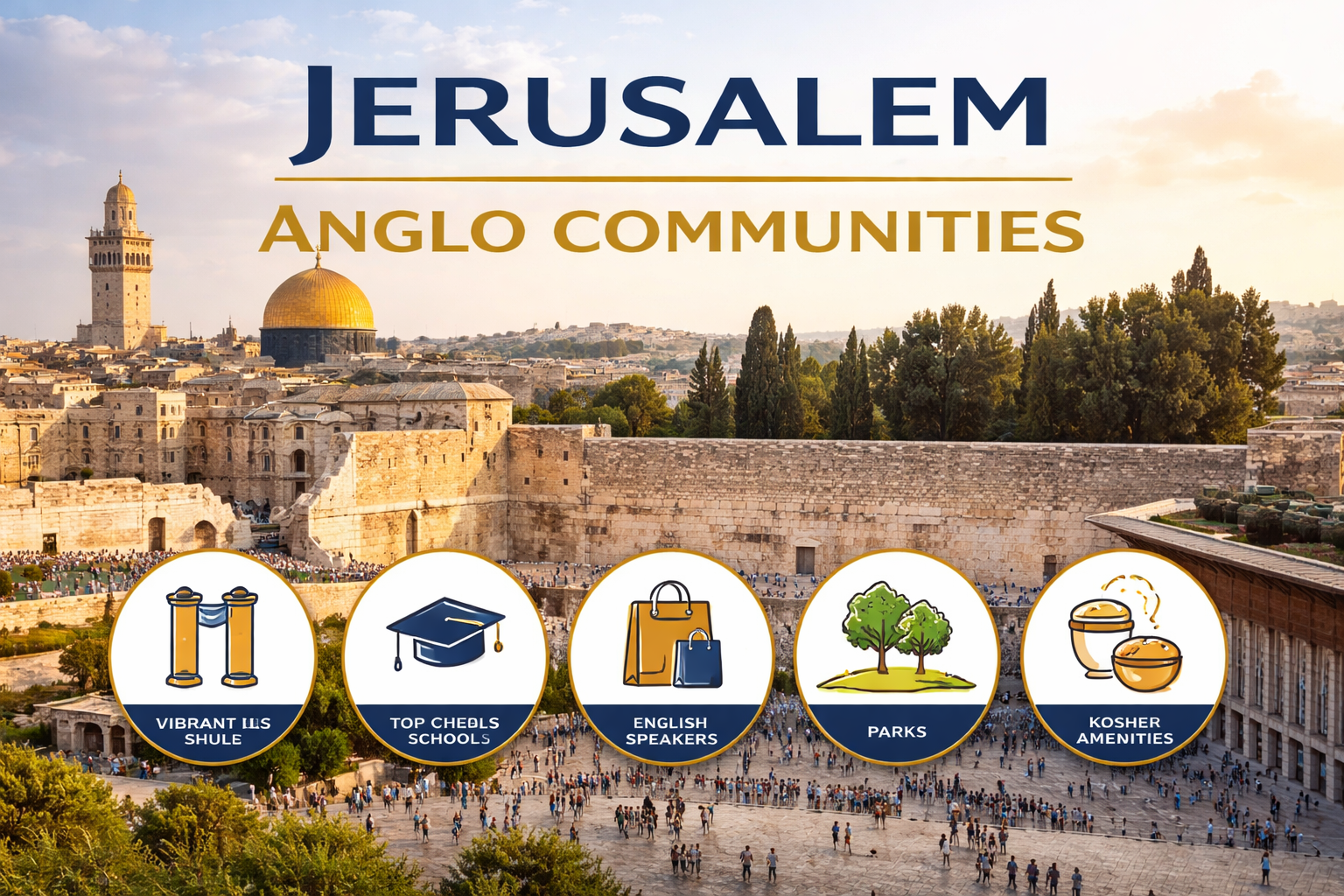
Jerusalem has several well-established Anglo communities, each with its own character and price point.
The German Colony and Baka in southern Jerusalem are probably the most iconic Anglo neighborhoods. These areas are long-time favorites among English-speaking buyers thanks to their strong Modern Orthodox presence, vibrant cultural scene, and convenient access to schools, synagogues, shops, and public transportation. Baka tends to be quieter and more residential, while the German Colony is livelier and more commercial, centered around the bustling Emek Refaim Street. The German Colony is a comfortable, luxe area full of schools, parks and cafés, and is also a frequently chosen neighborhood for embassies and consulates, making it a truly international neighborhood. Baka properties are often newer, larger and better in value, and the array of local amenities from cafés to delicatessens selling cheese, wine and delicious spreads is a major draw. The tradeoff is cost—a 4-room apartment typically sells for NIS 4.8–6.2 million, depending on renovation level and location.
Nearby Katamon is one of the most sought-after areas for religious English-speaking families. Talbiya has long attracted Anglos who value prestige, walkability, and historic architecture, especially diplomats, academics, and families with deep ties to Israel. While Talbiya has fewer new developments than other neighborhoods, recent years have seen a handful of luxury projects alongside the preservation of its iconic Bauhaus and Arab-style buildings. A 4-room apartment typically ranges from NIS 5.2–7 million, with high-end properties commanding even more. One consideration for buyers: some parts of Talbiya sit on land owned by the Greek Orthodox Church and leased to the state, which has created uncertainty around long-term ownership for certain properties.
In western Jerusalem, Ramot has a significant Anglo population, particularly among Haredi and Hasidic communities along with Modern Orthodox residents. Estimates put the number of English speakers in Ramot at about 20 percent. While Ramot has strong Dati Leumi and Chareidi communities, it includes a wide variety of residents across the religious spectrum, and synagogues and schools reflect this diversity. In 2011, Ramot Mall opened with about fifty stores. The mall is closed on Shabbat, as are almost all malls in Israel, and all the food is kosher, predominantly mehadrin. The neighborhood is more affordable than central Jerusalem but isolated from the city center with limited secular options and hilly terrain. These days only a small number of religious Anglo olim are moving to Ramot, with most choosing to move into newer, smaller and more affordable apartments in communities a bit farther away from Jerusalem.
For those seeking better value, Ramat Eshkol in northern Jerusalem is an established neighborhood known historically for its National Religious but now predominantly Haredi communities, and it also has a strong and steady Anglo presence. With access to the light rail and major roads, it offers a quieter, more suburban feel while remaining connected to city life. The area is home to many yeshivot, seminaries, and parks, and is very popular with parents whose children already live in the area. Prices are considerably lower here—a 4-room apartment typically ranges from NIS 3–3.7 million, depending on building age and condition.
Further south, Talpiyot, Armon HaNatziv and Arnona are further out but more affordable and still have a notable English-speaking presence. Talpiot offers excellent value for Anglos looking to stay close to southern Jerusalem without overstretching their budget. It's a mixed community—religious, traditional, and secular—with a growing number of English-speaking families and young couples.
Some emerging areas are also drawing Anglo interest. Katamonim, once a modest part of Jerusalem, is now undergoing significant redevelopment that could reshape its future as a hub for Anglo residents. These communities offer a blend of modern living, tradition, and connectivity at more affordable prices.
Jerusalem is very cosmopolitan, with great cultural activities, a growing young Anglo community, and lots of English and Hebrew speakers. The city offers good public transport and the famous evening breeze that cools things down in summer. On the other hand, all out of town guests will want to crash on your couch and there can be religious tension in some areas.
Worth noting: many olim dream of living in Jerusalem but either find it too expensive or can't find jobs, so they move elsewhere—often to nearby communities. Families are moving to places like Modi'in, Beit Shemesh, Ramat Beit Shemesh, Efrat, and Ma'ale Adumim that offer more space and affordability while maintaining strong Anglo infrastructure. The families choosing to live in areas like Sheinfeld in Beit Shemesh are drawn not only because of affordable housing; they are looking for an active English-speaking community that offers the religious and social equivalent of the Modern Orthodox communities they have left behind in the Diaspora.