 Image 1 of 1
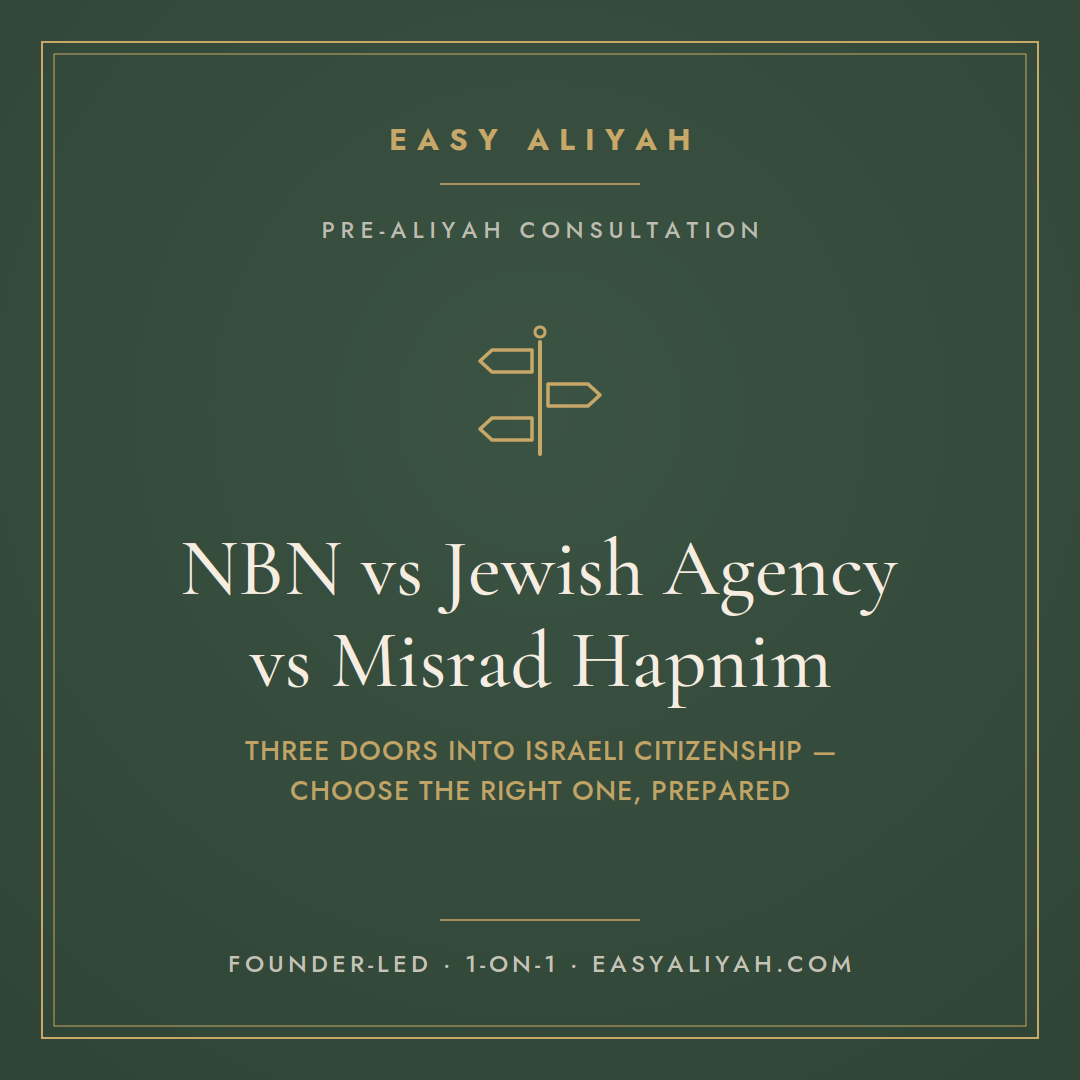
Every aliyah runs through one of three doors:
Nefesh B'Nefesh (NBN) — for olim from the USA, Canada, and the UK, processing in partnership with the Jewish Agency
The Jewish Agency for Israel (Sochnut) — direct processing through your local shaliach for most other countries
Misrad Hapnim (Ministry of Interior) — aliyah from within Israel: changing status to oleh while you're already in the country on a tourist, student, work, or A-1 temporary resident visa
Which door you use — and how you handle what's behind it — shapes your paperwork, your interview, your timeline, your benefits, and in the Misrad Hapnim route, whether your case moves at all. Most olim discover the differences the hard way, mid-process. This consultation puts you ahead of the system before you open your file.
The Aliyah Routing Consultation is a founder-led session that explains — from years of real casework on the Israeli side — how each of the three routes actually operates: how files move, where they stall, what your shaliach, aliyah advisor, or Misrad Hapnim clerk will ask, what they're really checking, and how to present your case so it progresses instead of sitting in a queue.
What your aliyah routing consultation covers:
Route 1 & 2 — Aliyah from abroad (NBN / Jewish Agency):
How NBN's partnership with the Jewish Agency works for North American and UK olim, and what direct Sochnut processing looks like everywhere else
What "opening a file" actually triggers in each system, and the correct application sequence for your country
The online aliyah application step by step: document upload standards, the proof-of-Judaism review, and the order in which stages unlock
Shaliach and interview preparation: the questions that trip families up, how conversion cases and mixed-status households are assessed, and how to answer honestly and effectively
The aliyah visa stage — consular processing at the Israeli consulate, what to bring, and how the visa connects to your flight and Teudat Oleh
Flights and benefits by route: NBN group flights and grants vs standard routing, and how your route interacts with sal klita and olim benefits
Route 3 — Aliyah from within Israel (Misrad Hapnim change of status):
Who can — and who should — make aliyah from inside Israel: students finishing Masa or degree programs, workers, olim-in-waiting who arrived as tourists, partners of Israelis, and long-stay visitors
Change of status to oleh: the Misrad Hapnim application, which lishka (branch office) handles your case, appointment booking through MyVisit, and the documents Israeli clerks demand that consulates never mention
The real trade-offs of the internal route: which benefits change when you convert status inside Israel (flight grant, some absorption benefits) versus what you keep (sal klita, tax rights, ulpan, customs rights) — and how timing your status change protects your entitlements
Jewish Agency approval within the internal route — why Misrad Hapnim still sends your file for eligibility confirmation, and how to keep that loop short
Handling Misrad Hapnim in practice: what to bring to every appointment, how to survive the pakid encounter, when a file needs written escalation, and when it needs a lawyer — available in-house through our licensed Israeli advocate
Common internal-route traps: expired visas mid-process, tourist visa extensions, gaps between status expiry and oleh approval
For every route:
A written route recommendation for your specific case — including hybrid situations (one spouse abroad, one in Israel; returning minors; toshav chozer questions; citizenship claims from a parent's aliyah decades ago)
Realistic timelines by stage — from file opening to Teudat Zehut — and the specific bottlenecks (document review queues, interview scheduling, consular appointments, lishka backlogs) you can plan around
How to keep your file moving: follow-up cadence, escalation that helps rather than annoys, and when a stalled file needs professional intervention
You leave with a written recommendation, an application walkthrough tailored to your route, interview preparation notes, and a realistic timeline — so you start your aliyah knowing exactly how the machine works.
Includes: Founder-led 1-on-1 video consultation · three-route analysis for your country, visa status, and family situation · written route recommendation · application walkthrough · shaliach / Misrad Hapnim interview preparation · benefits comparison by route · timeline expectations by stage · written summary · one week of WhatsApp follow-up.
Who this is for: Applicants ready to open an aliyah file from the US, UK, Canada, South Africa, Australia, or Europe; anyone already in Israel on a student, work, volunteer, or tourist visa weighing a change of status; families with complexity (conversion, non-Jewish spouse, prior visas) whose interview needs preparing; and anyone whose file — consular or lishka — is already open and stuck.
What's the difference between Nefesh B'Nefesh, the Jewish Agency, and Misrad Hapnim? The Jewish Agency approves aliyah eligibility worldwide; Nefesh B'Nefesh partners with it to process and support olim from North America and the UK; Misrad Hapnim is Israel's Ministry of Interior, which handles aliyah for people applying from inside Israel and issues everyone's Teudat Zehut at the end. Which one runs your process depends on where you are and where you're from — that's exactly what this session maps.
Can I make aliyah while already in Israel? Yes — through a change of status at Misrad Hapnim, with Jewish Agency eligibility confirmation. It's a different process with different paperwork, different appointment logistics, and different benefit implications than arriving on an aliyah visa. We map whether it's the right move for you and how to run it.
Do I lose benefits if I make aliyah from within Israel? Some change — most notably the flight grant, and certain absorption benefits are calculated differently — while core rights like sal klita, ulpan, tax benefits, and customs rights generally remain. Timing your status change correctly is how you protect the maximum package; we cover your specific numbers in the session.
What happens in the aliyah interview? Verification of identity, Jewish status, family situation, and intentions — with extra attention on conversion cases, mixed-status families, and document gaps. At Misrad Hapnim, add strict document formalities and appointment discipline. Preparation is the difference between a formality and months of follow-up requests.
My file is stuck — at the consulate or at the lishka. Can this help? Yes. Understanding where your file actually sits in the machine is the first step; targeted follow-up and escalation is the second. Both are covered, with done-for-you handling and legal escalation available as follow-on services.
Target keywords: Nefesh B'Nefesh vs Jewish Agency, aliyah from within Israel, change of status Misrad Hapnim, aliyah while in Israel, tourist visa to aliyah Israel, student visa aliyah, A-1 visa to citizenship, Misrad Hapnim appointment MyVisit, NBN aliyah application, Jewish Agency aliyah process, aliyah shaliach interview, aliyah interview questions, how to apply for aliyah, aliyah visa process, aliyah timeline, aliyah file stuck, Sochnut aliyah, aliyah flight grants, Teudat Oleh, Teudat Zehut new oleh, aliyah consultant Israel.
Every aliyah runs through one of three doors:
Nefesh B'Nefesh (NBN) — for olim from the USA, Canada, and the UK, processing in partnership with the Jewish Agency
The Jewish Agency for Israel (Sochnut) — direct processing through your local shaliach for most other countries
Misrad Hapnim (Ministry of Interior) — aliyah from within Israel: changing status to oleh while you're already in the country on a tourist, student, work, or A-1 temporary resident visa
Which door you use — and how you handle what's behind it — shapes your paperwork, your interview, your timeline, your benefits, and in the Misrad Hapnim route, whether your case moves at all. Most olim discover the differences the hard way, mid-process. This consultation puts you ahead of the system before you open your file.
The Aliyah Routing Consultation is a founder-led session that explains — from years of real casework on the Israeli side — how each of the three routes actually operates: how files move, where they stall, what your shaliach, aliyah advisor, or Misrad Hapnim clerk will ask, what they're really checking, and how to present your case so it progresses instead of sitting in a queue.
What your aliyah routing consultation covers:
Route 1 & 2 — Aliyah from abroad (NBN / Jewish Agency):
How NBN's partnership with the Jewish Agency works for North American and UK olim, and what direct Sochnut processing looks like everywhere else
What "opening a file" actually triggers in each system, and the correct application sequence for your country
The online aliyah application step by step: document upload standards, the proof-of-Judaism review, and the order in which stages unlock
Shaliach and interview preparation: the questions that trip families up, how conversion cases and mixed-status households are assessed, and how to answer honestly and effectively
The aliyah visa stage — consular processing at the Israeli consulate, what to bring, and how the visa connects to your flight and Teudat Oleh
Flights and benefits by route: NBN group flights and grants vs standard routing, and how your route interacts with sal klita and olim benefits
Route 3 — Aliyah from within Israel (Misrad Hapnim change of status):
Who can — and who should — make aliyah from inside Israel: students finishing Masa or degree programs, workers, olim-in-waiting who arrived as tourists, partners of Israelis, and long-stay visitors
Change of status to oleh: the Misrad Hapnim application, which lishka (branch office) handles your case, appointment booking through MyVisit, and the documents Israeli clerks demand that consulates never mention
The real trade-offs of the internal route: which benefits change when you convert status inside Israel (flight grant, some absorption benefits) versus what you keep (sal klita, tax rights, ulpan, customs rights) — and how timing your status change protects your entitlements
Jewish Agency approval within the internal route — why Misrad Hapnim still sends your file for eligibility confirmation, and how to keep that loop short
Handling Misrad Hapnim in practice: what to bring to every appointment, how to survive the pakid encounter, when a file needs written escalation, and when it needs a lawyer — available in-house through our licensed Israeli advocate
Common internal-route traps: expired visas mid-process, tourist visa extensions, gaps between status expiry and oleh approval
For every route:
A written route recommendation for your specific case — including hybrid situations (one spouse abroad, one in Israel; returning minors; toshav chozer questions; citizenship claims from a parent's aliyah decades ago)
Realistic timelines by stage — from file opening to Teudat Zehut — and the specific bottlenecks (document review queues, interview scheduling, consular appointments, lishka backlogs) you can plan around
How to keep your file moving: follow-up cadence, escalation that helps rather than annoys, and when a stalled file needs professional intervention
You leave with a written recommendation, an application walkthrough tailored to your route, interview preparation notes, and a realistic timeline — so you start your aliyah knowing exactly how the machine works.
Includes: Founder-led 1-on-1 video consultation · three-route analysis for your country, visa status, and family situation · written route recommendation · application walkthrough · shaliach / Misrad Hapnim interview preparation · benefits comparison by route · timeline expectations by stage · written summary · one week of WhatsApp follow-up.
Who this is for: Applicants ready to open an aliyah file from the US, UK, Canada, South Africa, Australia, or Europe; anyone already in Israel on a student, work, volunteer, or tourist visa weighing a change of status; families with complexity (conversion, non-Jewish spouse, prior visas) whose interview needs preparing; and anyone whose file — consular or lishka — is already open and stuck.
What's the difference between Nefesh B'Nefesh, the Jewish Agency, and Misrad Hapnim? The Jewish Agency approves aliyah eligibility worldwide; Nefesh B'Nefesh partners with it to process and support olim from North America and the UK; Misrad Hapnim is Israel's Ministry of Interior, which handles aliyah for people applying from inside Israel and issues everyone's Teudat Zehut at the end. Which one runs your process depends on where you are and where you're from — that's exactly what this session maps.
Can I make aliyah while already in Israel? Yes — through a change of status at Misrad Hapnim, with Jewish Agency eligibility confirmation. It's a different process with different paperwork, different appointment logistics, and different benefit implications than arriving on an aliyah visa. We map whether it's the right move for you and how to run it.
Do I lose benefits if I make aliyah from within Israel? Some change — most notably the flight grant, and certain absorption benefits are calculated differently — while core rights like sal klita, ulpan, tax benefits, and customs rights generally remain. Timing your status change correctly is how you protect the maximum package; we cover your specific numbers in the session.
What happens in the aliyah interview? Verification of identity, Jewish status, family situation, and intentions — with extra attention on conversion cases, mixed-status families, and document gaps. At Misrad Hapnim, add strict document formalities and appointment discipline. Preparation is the difference between a formality and months of follow-up requests.
My file is stuck — at the consulate or at the lishka. Can this help? Yes. Understanding where your file actually sits in the machine is the first step; targeted follow-up and escalation is the second. Both are covered, with done-for-you handling and legal escalation available as follow-on services.
Target keywords: Nefesh B'Nefesh vs Jewish Agency, aliyah from within Israel, change of status Misrad Hapnim, aliyah while in Israel, tourist visa to aliyah Israel, student visa aliyah, A-1 visa to citizenship, Misrad Hapnim appointment MyVisit, NBN aliyah application, Jewish Agency aliyah process, aliyah shaliach interview, aliyah interview questions, how to apply for aliyah, aliyah visa process, aliyah timeline, aliyah file stuck, Sochnut aliyah, aliyah flight grants, Teudat Oleh, Teudat Zehut new oleh, aliyah consultant Israel.